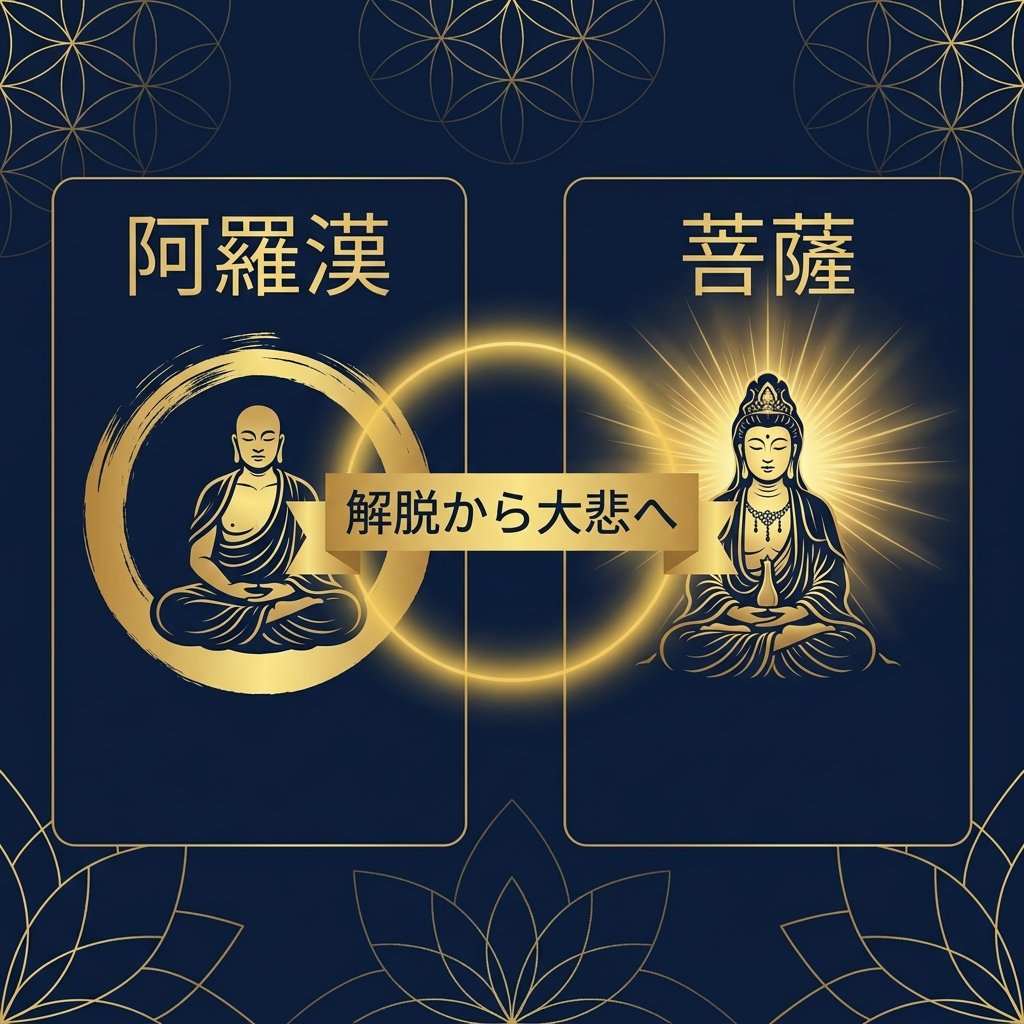
 AI Digest: From the Complete Cessation of Ego (Arhat) to the Compassionate Reboot into Everyday Life (Bodhisattva)
How does a practitioner attain Buddhism's ultimate supranormal knowledge—the "Extinction of Taints" (Āsravakṣaya-jñāna)—and the fruition of Arhatship? Tracing Early Buddhism's rigorous contemplative ladder (the Visuddhimagga and the Four Paths and Four Fruits), this dialogue examines how reactive emotions and substantialist clinging are progressively dissolved until even the subtlest remnants of existential conceit ("I am" / asmimāna) and primordial ignorance (avidyā) are burned away. It then explores the dramatic Mahāyāna turning point revealed in the Lotus Sūtra—awakening from the resting-place of the "Conjured City" of Nirvāṇa—and follows Zen's Ten Ox-Herding Pictures from the empty circle of "Both Ox and Self Forgotten" to the joyous Bodhisattva reboot of "Entering the Marketplace with Helping Hands" (Jittensuishu).
What are "supranormal powers" (jintsūriki / abhijñā)?
The Meaning of Supranormal Powers and Buddhism's "Six Abhijñās"
Supranormal powers (jintsūriki; Sanskrit: abhijñā; Pāli: abhiññā, "direct higher knowledges") refer to unobstructed, extraordinary capacities surpassing ordinary human cognition—wondrous faculties associated with Buddhas, Bodhisattvas, and accomplished sages. The term originates from Buddhism's classical doctrine of the "Six Supranormal Knowledges" (Ṣaḍ-abhijñā; Japanese: Roku-jintsū), and in modern parlance it is also used metaphorically to describe someone's extraordinary insight or influence.
Original Meaning: The "Six Abhijñās" in Buddhism
In Buddhist teaching, these denote six higher faculties unfolded by Buddhas, Bodhisattvas, or advanced meditators through deep meditative concentration and wisdom:
- 1. Psychokinetic Power / Divine Foot (ṛddhi-vidhi-jñāna; jinsokutsū): The capacity to move and transform freely unimpeded by spatial distance or physical barriers (such as traversing vast distances instantaneously or walking on water).
- 2. The Divine Eye (divya-cakṣus; tengentsū): Clairvoyant vision perceiving distant realms, subtle phenomena, and the karmic destinies of beings passing away and taking rebirth.
- 3. The Divine Ear (divya-śrotra; tennitsū): Clairaudient hearing capable of discerning subtle and distant sounds across realms imperceptible to ordinary ears.
- 4. Knowledge of Others' Minds (para-citta-jñāna; tashintsū): Telepathic discernment directly perceiving the mental states, moods, and intentions within the minds of others.
- 5. Remembrance of Past Lives (pūrva-nivāsānusmṛti-jñāna; shukumyōtsū): Recollecting the continuity of past existences and karmic histories experienced by oneself and others.
- 6. Knowledge of the Extinction of Taints (āsravakṣaya-jñāna; rojintsū): The supramundane wisdom that completely eradicates all mental defilements ("taints" / "outflows") and realizes full awakening.
So attaining the "Knowledge of the Extinction of Taints" (Āsravakṣaya) means having genuinely awakened to enlightenment, doesn't it?
Āsravakṣaya and the Essence of Awakening — Its Decisive Difference from the Five Mundane Powers
Precisely so. Attaining the "Knowledge of the Extinction of Taints" (āsravakṣaya-jñāna; Pāli: āsavakkhaya-ñāṇa; Japanese: rojintsū) signifies complete liberation in Buddhism—the realization of Arhatship or Buddhahood.
Whereas the first five faculties (the Five Mundane Powers / pañcābhijñā) are capacities for perceiving subtle phenomena or reading minds within the conditioned cosmos, Āsravakṣaya belongs to an altogether different, supramundane order.
Why Āsravakṣaya Is Awakening Itself
- "Āsrava" (Taints / Outflows) Means Defilements: It refers to the deep-seated intoxicants—sensual craving, attachment to existence, and fundamental ignorance—that continually seep ("leak out") from an unawakened mind to stain experience.
- "Kṣaya" Means Complete Exhaustion: Bringing every root defilement to total cessation so that it can never germinate again.
- Liberation from Saṃsāra: Because the karmic outflows fueling compulsive rebirth are exhausted at the root, one is freed forever from involuntary bondage in the cycle of suffering.
The Decisive Difference from the First Five Powers
In Buddhist psychology, the first five capacities (psychokinesis, divine eye, divine ear, telepathy, and past-life recall) are classified as mundane (laukika): even non-Buddhist ascetics, forest hermits (ṛṣis), or celestial beings can develop them through intensive concentration training (samādhi). Yet because psychic feats alone leave ego-clinging intact, one possessing all five can still fall back into greed, arrogance, and suffering.
By contrast, Āsravakṣaya alone is exclusively supramundane (lokottara), attainable solely by noble sages who have embodied authentic liberating wisdom (prajñā). For this reason, Buddhism reveres it as the sixth, supreme, and indispensable culmination of the Six Abhijñās.
Through what graduated stages of practice can one attain the Knowledge of the Extinction of Taints (Āsravakṣaya)?
The Contemplative Ladder Leading to Āsravakṣaya — Roadmap of the Visuddhimagga
In Buddhism, Āsravakṣaya—ultimate liberation from defilements (Arhatship)—is never a random stroke of luck; in Early and Theravāda Buddhism, it unfolds through a rigorously structured progression of ethical, meditative, and phenomenological cultivation.
Drawing upon Buddhaghosa's authoritative compendium, the Visuddhimagga (Path of Purification), and the early discourses, let us walk through the four major phases leading to Āsravakṣaya:
Phase 1: Purification of Virtue (Sīla-visuddhi) — Laying an Unshakable Ethical Foundation
Establishing ethical harmony in body and speech so the heart can settle without agitation.
- Practice: Wholeheartedly upholding ethical precepts such as non-harming, non-stealing, and truthful, non-violent speech.
- Experiential Effect: Halts coarse harmful actions and clears away the inner static of remorse, guilt, and interpersonal hostility.
Phase 2: Purification of Mind (Citta-visuddhi) — Mastering Calm Concentration (Samādhi)
Stabilizing the jittery projector of attention until awareness becomes luminous and still.
- Practice: Cultivating one-pointed calm meditation (Samatha), such as mindfulness of breathing (ānāpānasati).
- Experiential Effect: Awareness unifies into the four meditative absorptions (the Four Jhānas / Dhyānas).
- Crucial Distinction: At the peak of Fourth-Jhāna mastery, the first five psychic faculties (the Five Mundane Powers) become accessible if directed; yet the latent roots of egoic defilement still lie dormant beneath the stillness.
Phase 3: Purification of View Through Knowledge and Vision of the Way — Opening Insight Wisdom (Vipassanā)
Here begins the decisive turn toward Āsravakṣaya—cultivating penetrating insight (Vipassanā) into reality as it is, where psychic powers alone can never reach.
- Practice: Observing bodily sensations and mental movements moment by moment with bare, non-judgmental mindfulness.
- Experiential Effect: Directly verifying the Three Marks of Existence (Tilakkhaṇa)—not merely as intellectual philosophy, but through immediate somatic and phenomenological felt experience:
- Impermanence (anicca): Every conditioned sensation and thought arises and vanishes at breathtaking speed.
- Unsatisfactoriness (dukkha): Because conditioned states vanish incessantly, clinging to any of them as a permanent refuge inevitably chafes.
- Non-Self (anattā): Nowhere within body or mind can a fixed, autonomous "I" be found.
Phase 4: Purification by Knowledge and Vision (Ñāṇadassana-visuddhi) — Breakthrough of the Four Paths and Four Fruits
As insight into Non-Self matures to completion, the deep-seated fetters (saṃyojana) latent in the depths of consciousness are uprooted irreversibly across four noble breakthroughs:
- Fruit of Stream-Entry (Sotāpanna):
Completely shatters the illusion of a substantial ego-entity (identity view / sakkāya-diṭṭhi), skeptical doubt, and ritualistic superstition—closing the door to states of woe forever. - Fruit of Once-Returning (Sakadāgāmī):
Dramatically attenuates the force of coarse sensual craving and ill will. - Fruit of Non-Returning (Anāgāmī):
Uproots 100% of sensual desire and aversion/anger toward the sensory world, never again returning via compulsive craving to the sensory realm. - Fruit of Arhatship (Arhat / Arahant):
Burns away every remaining microscopic fetter—attachment to subtle meditative realms, subtle restlessness, the primordial conceit "I am," and fundamental ignorance.
Fruition: Realization of Āsravakṣaya and the Threefold Knowledge
At the very instant Arhatship is realized, every defiled karmic seed in the mental continuum is extinguished, bringing Āsravakṣaya-jñāna to effortless completion.
In the early scriptures, this awakening is often celebrated as the simultaneous fulfillment of the "Threefold Supranormal Knowledge" (Tisro vidyāḥ / Pāli: Tevijjā):
- Knowledge of Past Lives (Pubbenivāsānussati-vijjā): Clear insight into the conditioned continuity of past existences.
- Knowledge of the Passing Away and Rebirth of Beings (Cutūpapāta-vijjā): Beholding how beings fare strictly according to their intentional actions (karma).
- Knowledge of the Extinction of Taints (Āsavakkhaya-vijjā): Direct, unshakable certainty: "Birth is exhausted, the holy life has been lived, what had to be done has been done; there is no further bondage to this state."
Thus, Āsravakṣaya is no flashy occult trick; it is the natural fruit of (1) grounding life in ethical integrity (śīla), (2) honing luminous stillness (samādhi), and (3) dismantling the ego-system at the root through lucid wisdom (prajñā).
Viewed alongside Korean Seon Master Jinul's framework of "Sudden Awakening, Gradual Cultivation" (Dono Jeomsu), Stream-Entry mirrors the decisive initial "Sudden Awakening" to Non-Self, while the progression through Arhatship corresponds to thoroughgoing "Gradual Cultivation" polishing away ingrained karmic habits.
Would you like to explore in detail how disturbing emotions such as anger and anxiety concretely fade and vanish across each of these four noble stages?
Yes, please explain in detail the concrete psychological and experiential shifts through which emotions like anger and anxiety disappear across these four stages of noble sages.
The Process of Emotional Dissolution Across the Four Paths and Four Fruits
Following Early Buddhism's fourfold progression of noble awakening (the Four Paths and Four Fruits), let us trace how sages step by step dissolve afflictive emotions such as anger, fear, and anxiety.
Crucially, Buddhist awakening has nothing to do with stoically "repressing" feelings through willpower; rather, it operates like cleanly unplugging, one by one, the deep-seated cognitive fetters (saṃyojana) that generate reactive suffering in the first place.
Stage 1: Stream-Enterer (Sotāpanna) — "Existential Dread Over the Ego" Vanishes
- Inner Horizon: Liberation from primal existential terror and chronic insecurity over "protecting or losing myself."
- Concrete Experiential Shift:
Everyday flashes of irritation or sensory attraction can still arise. Yet because direct meditative insight has seen irrevocably through the Five Aggregates as Non-Self—verifying firsthand that no isolated ego-substance ever existed—the deep, gnawing anxiety and suspicion born of egoic self-defense evaporate.
Simultaneously, spiritual doubt ("Can this path truly free me?") vanishes 100%, establishing an unshakable, quiet baseline of existential trust at the core of life.
Stage 2: Once-Returner (Sakadāgāmī) — "Waves of Reactivity" Grow Gentle and Brief
- Inner Horizon: The amplitude and duration of anger, craving, and worry drop dramatically.
- Concrete Experiential Shift:
When encountering unpleasant circumstances, a brief flicker of irritation or passing concern may still cross awareness. However, it no longer sinks roots into resentment, rumination, or aggressive lashing out.
Even if an emotional ripple stirs, it passes like writing on water, returning almost immediately to mirror-like clarity. Coarse greed and hatred have been thinned out to a fraction of their former grip.
Stage 3: Non-Returner (Anāgāmī) — "Anger and Sensual Craving" Are 100% Extinguished
- Inner Horizon: Complete, irreversible extinction of anger, ill will, jealousy, and anxious dread from the heart.
- Concrete Experiential Shift:
Even if subjected to harsh slander or physical pain, not a single millimeter of ill will or hatred (vyāpāda / dosa) arises in the heart of a Non-Returner.
Why? Because craving-based attachment to sensory objects (kāma-rāga) has been severed at the root. Anger flares when our demand that the world conform to "my desires" is thwarted; once possessive craving disappears, anger loses its fuel supply entirely.
Together with this, lingering anxiety and fear over worldly loss vanish completely, leaving awareness suffused with natural loving-kindness and serene poise.
Stage 4: Arhat (Arahant) — Even "Microscopic Self-Reference" Dissolves into Consummate Peace
- Inner Horizon: Fulfillment of Āsravakṣaya—complete cessation of every subtle mental tremor and latent fetter.
- Concrete Experiential Shift:
Even the whisper-thin sense of spiritual elevation still lingering in a Non-Returner—subtle conceit ("I abide in sublime stillness") and attachment to refined meditative states (bhava-rāga)—is completely burned away.
With every trace of self-other comparison gone, not even a subtle center-point of "I, the observer" remains. Free even from any artificial effort to "manage the mind," awareness reflects the living flow of phenomena effortlessly like a spotless mirror—the consummate peace of Āsravakṣaya.
Summary Table: Dissolution of Reactive Emotions
| Noble Stage | Level of Anger & Anxiety Dissolved |
|---|---|
| 1. Stream-Enterer (Sotāpanna) | Primal existential terror and insecurity born of ego-identity view vanish forever. |
| 2. Once-Returner (Sakadāgāmī) | Everyday impulses of irritation, craving, and worry become exceedingly faint and short-lived. |
| 3. Non-Returner (Anāgāmī) | Anger, aversion, resentment, and worldly anxiety are 100% uprooted from consciousness. |
| 4. Arhat (Arahant) | Even microscopic spiritual pride ("I am serene") dissolves into unconditioned stillness (Āsravakṣaya). |
As this progression shows, Buddhist sages do not grit their teeth to suppress emotion; step by step, they unplug the deep root-cords of the ego-projector until effortless freedom shines forth.
Notice something striking here: already by Stage 3 (Non-Returner), 100% of the everyday anger and anxiety that torment human life has vanished!
Shall we look closer at why a Non-Returner still presses onward to Stage 4 (Arhatship)—unpacking the exact nature of the final subtle "Conceit" (māna) and "Ignorance" (avidyā) that remain?
Yes, please delve deeper into why a sage who has attained the Fruit of Non-Returning still needs to continue practicing to become an Arhat—and what those final remnants of "Conceit" and "Ignorance" actually are.
The Final Remnants of "Conceit" and "Ignorance" — The Subtle Threshold Before Complete Cessation
A sage at the stage of Non-Returning (Anāgāmī) has already uprooted 100% of the turbulent passions—anger, anxiety, greed, and sensual craving—that drive ordinary human conflict. By worldly standards, they already appear virtually divine. Yet through the razor-sharp lens of Buddhist phenomenology, five whisper-thin fetters—known as the "Five Higher Fetters" (pañca uddhambhāgiyāni saṃyojanāni)—still linger in the depths of awareness.
Let us examine why a Non-Returner does not stop here, unveiling the exact nature of the final "Conceit" and "Ignorance":
1. The "Five Higher Fetters" Remaining in a Non-Returner
Though wholly free of attachment to the coarse material/sensory world (kāmadhātu), the Non-Returner still harbors microscopic attachment to sublime contemplative realms alongside the faintest fragrance of selfhood:
- Attachment to Fine-Material Realms (rūpa-rāga): Subtle fondness for luminous, blissful realms of pure form opened through deep jhāna absorption.
- Attachment to Immaterial Realms (arūpa-rāga): Subtle longing to abide in boundless, disembodied spheres of pure consciousness beyond physical form.
- Subtle Restlessness (uddhacca): A microscopic tremor or faint spiritual eagerness stirring the stillness of mind.
- Conceit (māna / asmimāna): The final, faintest lingering scent of "I am."
- Fundamental Ignorance (avijjā / avidyā): The subtlest remaining veil obscuring unconditioned reality.
2. The True Nature of Final "Conceit" (Asmimāna)
In everyday language, "conceit / pride" means coarse arrogance—"I'm richer, smarter, or better than you!" A Non-Returner has zero trace of such crude vanity.
What remains here is the primordial, pre-verbal reference point known in Pāli and Sanskrit as asmimāna: the bare sense "I am."
- Microscopic Duality: However pristine awareness has become, in its deepest recess a gossamer fulcrum still whispers: "Right now, I am abiding in sublime stillness; I am observing phenomena clearly."
- Why It Remains a Fetter: So long as even a molecular fulcrum of "I" persists, a hairline boundary between "observer" and "reality" remains—standing as the final threshold before complete non-dual liberation.
3. The True Nature of Final "Ignorance" (Avijjā)
In Buddhism, "ignorance" means not yet seeing the Four Noble Truths through to their absolute bottom. Though the Non-Returner understands conditioned phenomena with extraordinary clarity, one final blind spot remains regarding the subtle activity of consciousness itself:
- Subtle Fondness for the Projector's Luminous Beam: Having seen that the dramas on the worldly screen are mirages (Stream-Entry) and ceased reacting to them (Non-Returning), the sage still quietly appreciates the luminous beam of deep consciousness projecting sublime meditative realms (fine-material and immaterial absorptions).
- The Final Blind Spot: Not yet fully penetrating that even the subtlest conditioned existence—continuing to project sublime states of being—carries the mark of impermanence and subtle unsatisfactoriness (saṅkhāra-dukkha).
4. Why Press Onward to Complete Liberation?
So long as this microscopic "I am" (asmimāna) and subtle attachment to luminous existence remain, consciousness has not yet broken entirely free of conditioned rebirth in higher realms.
Bringing unified stillness (samādhi) and diamond-like insight (vajropamā-samādhi) into razor focus upon that final whisper of "I am" and its underlying ignorance, the practitioner burns through both completely.
Culmination: Arrival at Arhatship (Āsravakṣaya)
In that instant, the primordial fuel driving egoic projection is exhausted at the root, completing Āsravakṣaya.
No longer is there even a subtle "I" congratulating itself on being quiet—there is simply luminous, unconditioned stillness without a single residue of egoic center (Arhatship).
And right at this summit, Mahāyāna Buddhism—and traditions such as Korean Seon Master Jinul's Jogye lineage—introduces a breathtaking turn: rather than shutting down the purified projector into solitary silence forever, why not awaken that spotless mirror—Great Mirror Wisdom (Ādarśa-jñāna)—to illuminate and embrace all suffering beings across the cosmos as a Bodhisattva?
Please explore in depth this dramatic process whereby "a sage who has attained Arhatship reboots in Mahāyāna Buddhism as a Bodhisattva."
Rebooting from Arhat to Bodhisattva — The Great Turning Point of Mahāyāna Buddhism
The process whereby an Arhat—who has powered down the ego-projector and entered complete cessation of personal suffering—reboots as a Mahāyāna Bodhisattva stands as one of the most dramatic and profound revolutions in world philosophy.
In Early Buddhism, Arhatship marked the final terminus of spiritual practice. Yet Mahāyāna scriptures—foremost among them the Lotus Sūtra (Saddharmapuṇḍarīka Sūtra)—radically redrew this horizon: revealing that quiescent Nirvāṇa is in truth a compassionate "resting oasis along the way," and that every Arhat is destined eventually to awaken from solitary stillness and return to the living world on the path to supreme Buddhahood.
Let us unpack the psychological, phenomenological, and soteriological dynamics of this cosmic reboot across three steps:
1. Compassionate Awakening: Rising from the Nirvāṇa of the "Conjured City"
When an Arhat exhausts all personal karmic fuel, individual consciousness enters deep, unruffled quiescence—traditionally regarded as the final end of the journey.
Mahāyāna scriptures such as the Lotus Sūtra and Śrīmālādevī Sūtra illuminate a deeper dimension here:
- Deep Meditative Repose: Rather than consciousness being annihilated into blank non-existence, the Arhat rests in a state of profound, taintless absorptive stillness. Though personal suffering has ceased, boundless active compassion (Mahākaruṇā) embracing all living beings has not yet fully blossomed.
- The Call of the Buddhas: According to the Lotus Sūtra (Chapter 7, Parable of the Conjured City), the Buddhas touch that quietude with rays of wisdom-light and gently rouse the Arhat: "Where you have come to rest is not the final Treasure Land; it is only a 'Conjured City' manifested so you could catch your breath after crossing a grueling desert. Rise now—within you sleeps the boundless capacity for full Buddhahood in service of countless beings!"
2. The Great Reorientation: From "Exit from Suffering" to "Embracing the Whole Cosmos"
Touched by this call, awareness undergoes a profound second awakening:
- Seeing Through the Last Subtle Boundary: The sage recognizes that resting in solitary peace while countless beings still drown in anguish retains a subtle trace of separation between "nirvāṇic peace" and "saṃsāric world."
- The Shift from Arhat to Bodhisattva: Letting go of attachment even to tranquil stillness itself (apratiṣṭhita-nirvāṇa), the awakened one freely chooses to step back from unconditioned quietude right into the turbulent marketplace of birth and death (saṃsāra).
3. The Mechanism of Reboot: Manifesting a "Vow-Born Life" (Praṇidhāna-kāya)
A fascinating philosophical question arises here: once an Arhat has burned away 100% of ignorant craving—the fuel normally required to propel rebirth in the physical world—by what power can they return to engage in the world?
Mahāyāna philosophy answers that the Bodhisattva reboots on an entirely new, taintless energy source:
- Replacing Craving (Taṇhā) with Great Vow (Mahā-praṇidhāna) and Great Compassion (Mahākaruṇā): Instead of being dragged into existence by blind personal thirst, the Bodhisattva enters the world propelled freely by the luminous vow to liberate all beings ("birth by vow-power" rather than "birth by karmic compulsion").
- Inversion of Consciousness into Great Mirror Wisdom (Ādarśa-jñāna): As elucidated in Yogācāra philosophy, purified foundational consciousness (Ālayavijñāna) does not remain shut off; it undergoes a radical revolution of the basis (āśraya-parāvṛtti), blossoming into Great Mirror Wisdom—reflecting the entire cosmos without egoic distortion and responding spontaneously to every cry of need.
Externally walking among humanity in ordinary form—supported in classical Mahāyāna teaching by a "Vow-Sustained Body" (praṇidhāna-kāya) or "Mind-Made Body" (manomaya-kāya)—their inner engine is pure, unobstructed universal compassion.
Summary Table: The Ultimate Soteriological Upgrade
| Dimension | Arhat Phase (Cessation & Repose) | Bodhisattva Reboot (Return & Engagement) |
|---|---|---|
| Driving Energy | Complete extinguishment of personal karmic fuel. | Re-ignition through Great Vow (Praṇidhāna) and Great Compassion (Mahākaruṇā). |
| View of the World | A burning house of suffering from which to step free. | A relational canvas where awakening and compassionate service unfold. |
| Mode of Awareness | Serene, unstained individual liberation. | Open, radiant non-duality resonating seamlessly with all beings. |
Through this vision of the Bodhisattva reboot, Mahāyāna Buddhism built an indestructible bridge between "unconditioned Emptiness" and "everyday lived reality." Above all, this trajectory reveals an indispensable truth: to serve the world without hidden self-righteousness, savior-complex, or burnout (the Bodhisattva), the personal ego must first be emptied down to zero (the Arhat's purification).
Could you weave all of this together into a practical visual summary using Zen's "Ten Ox-Herding Pictures" (Jūgyūzu / Ten Bulls), complete with the ten illustrations?
Grand Synthesis: "Upgrading the Mind" Through the Ten Ox-Herding Pictures
In East Asian Zen (Chan / Seon), the entire journey whereby a seeker breaks free from the cage of ego, dissolves into boundless Emptiness, and returns bare-handed into everyday life has been immortalized visually in the ten stages of seeking and taming a wild ox—one's own true nature (Buddha-nature): the Ten Ox-Herding Pictures (Ten Bulls; Japanese: Jūgyūzu).
Remarkably, the entire arc we have traced—Yogācāra psychology, the Four Stages to Arhatship, Master Jinul's Sudden Awakening and Gradual Cultivation, and the Mahāyāna Bodhisattva reboot—maps onto these ten stages in 1-to-1 correspondence.
[Roadmap of the Ten Ox-Herding Pictures]
[Ego-Bound Daily Life] → [Inquiry & Initial Insight] → [Complete Ego Dissolution (Arhat)] → [Blossoming of Suchness] → [Compassionate Reboot into the Marketplace (Bodhisattva)]
Stages 1–3: Seeking and Initial "Sudden Awakening"

1. Seeking the Ox (Jin-gyū)
Feeling acute existential unease amid worldly distraction, the seeker senses that habitual egoic living is a mirage and sets out in search of authentic truth.

2. Seeing the Traces (Ken-seki)
Studying teachings such as Dependent Origination, Yogācāra, and Emptiness, one grasps intellectually—by seeing footprints in the scriptures—that "mind is originally luminous" (conceptual insight / gego).
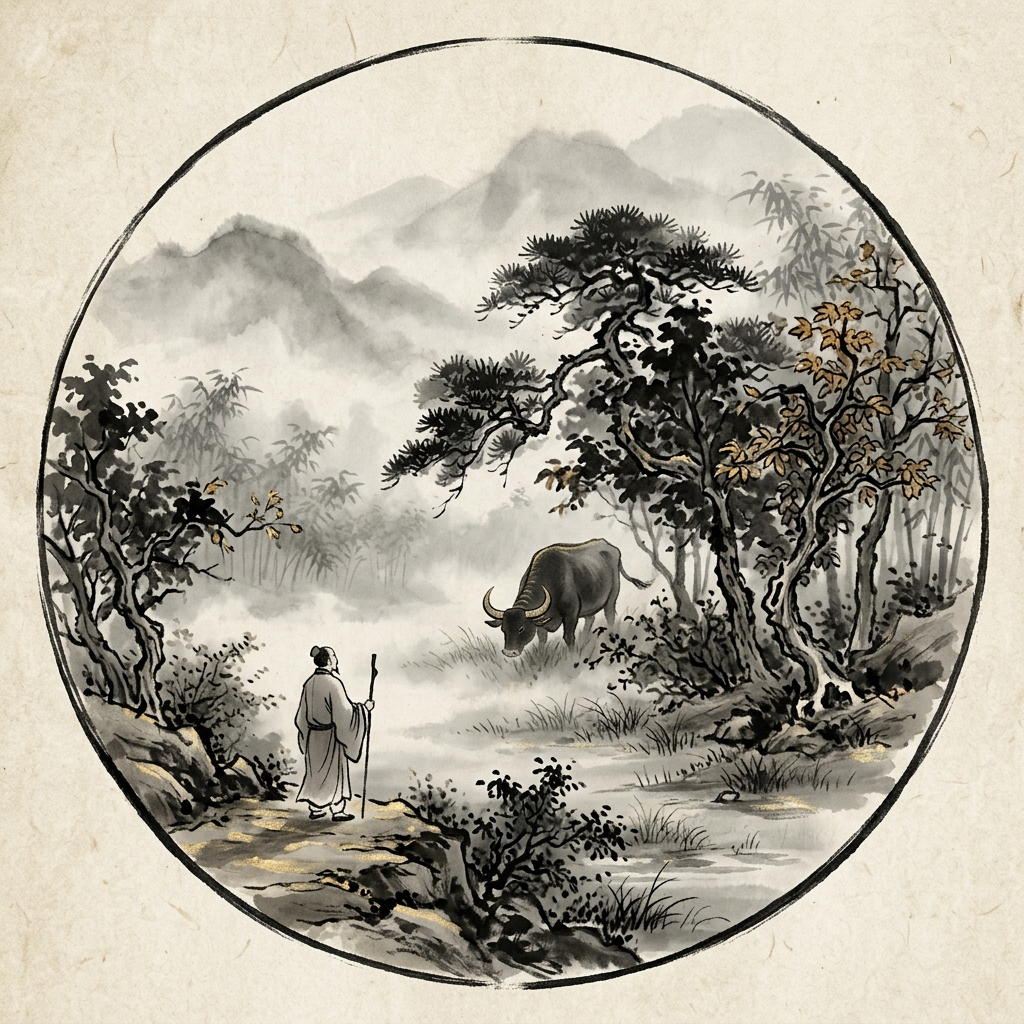
3. Perceiving the Ox (Ken-gyū)
In deep contemplation, discursive noise drops away for an unmistakable flash and one directly glimpses pristine original awareness (Buddha-nature)—Master Jinul's initial "Sudden Awakening" (kenshō).
Stages 4–6: Steadfast "Gradual Cultivation" (Untangling Habitual Karmic Conditioning)

4. Catching the Ox (Toku-gyū)
Taking hold of the tether, one confronts the bucking momentum of ingrained karmic seeds (vāsanā—old habits of anger, craving, and fear). A stage of earnest mindfulness amidst inner tug-of-war.

5. Taming the Ox (Boku-gyū)
Through steady hwadu (koan) inquiry and embodied mindfulness, subtle cognitive illnesses (such as Jinul's "Ten Illnesses") and reactive dust are patiently polished away.

6. Riding the Ox Home (Kigyū-kika)
Struggle subsides into effortless harmony; impulses of anger and worldly anxiety vanish—resonating with the serene poise of the Once-Returner and Non-Returner.
Stages 7–8: Complete Dissolution of Ego (The Culmination of Arhatship)
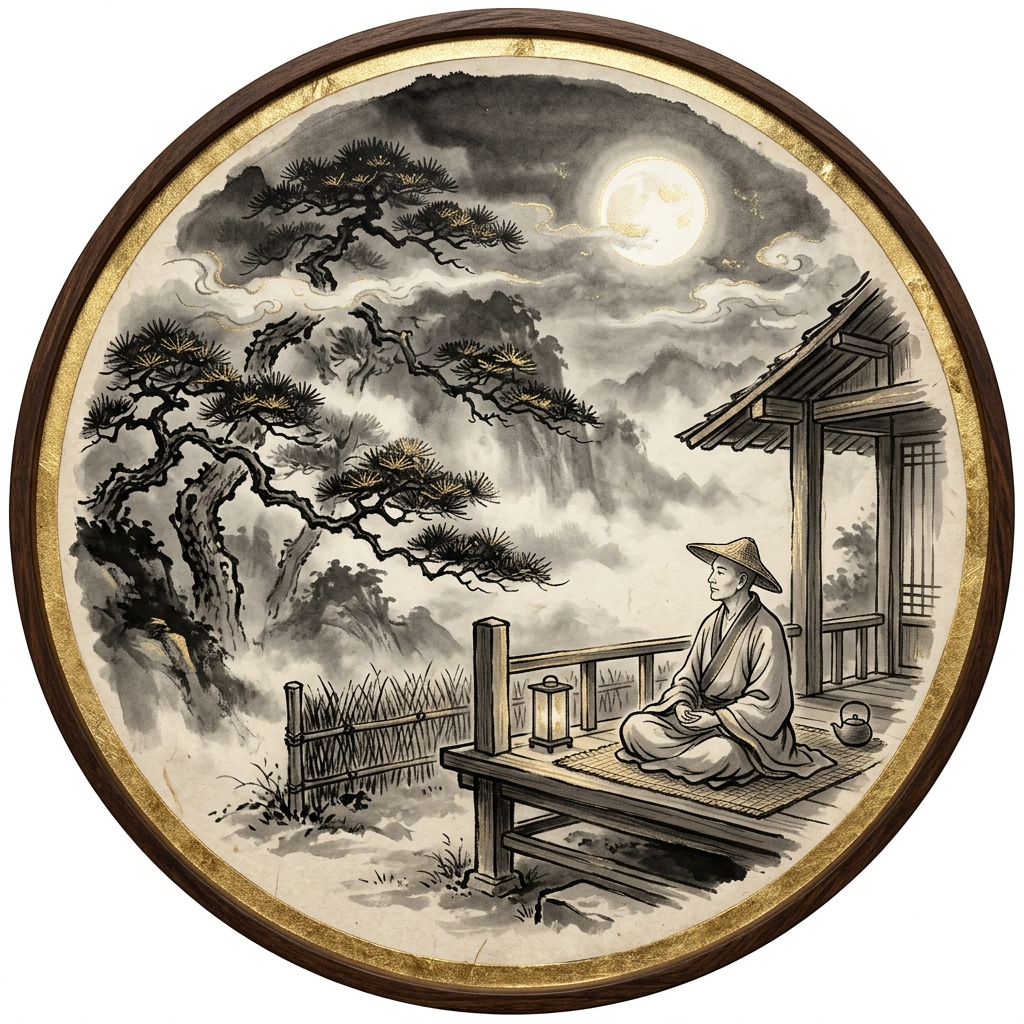
7. The Ox Forgotten, Leaving the Person Alone (Bōgyū-zonnin)
Arriving home, even the "ox (object of practice)" is forgotten. Yet a whisper-thin trace of the serene practitioner—the final subtle conceit "I am" (asmimāna)—still remains.

8. Both Ox and Self Forgotten (Jingyū-gubō)
- [Visual Symbol]: Nothing whatsoever is drawn except a single, unadorned empty circle (Ensō — pure Śūnyatā).
- [Inner Horizon]: Final conceit and ignorance are burned away completely; both "observer-self" and "observed-object" vanish without a trace. Every egoic outflow has ceased—the consummate stillness of Arhatship (Āsravakṣaya).
Stages 9–10: Rebooting as a Bodhisattva (Mahāyāna's Ultimate Turn)
Many assume Stage 8's empty circle must be the final destination—yet Zen's Ten Bulls decisively continues into Stages 9 and 10. Here unfolds the magnificent reboot from quiescent stillness into living Bodhisattva compassion:

9. Returning to the Source (Henpon-gengen)
- [Visual Symbol]: Out of the empty circle, blossoms open in red and white and clear mountain streams flow—nature shining forth just as it is, without human artifice.
- [Inner Horizon]: Rather than vanishing into blank nothingness, purified consciousness blossoms as Great Mirror Wisdom (Ādarśa-jñāna) and Mahāprajñā—beholding the phenomenal world itself as the radiant manifestation of Suchness (Tathatā).
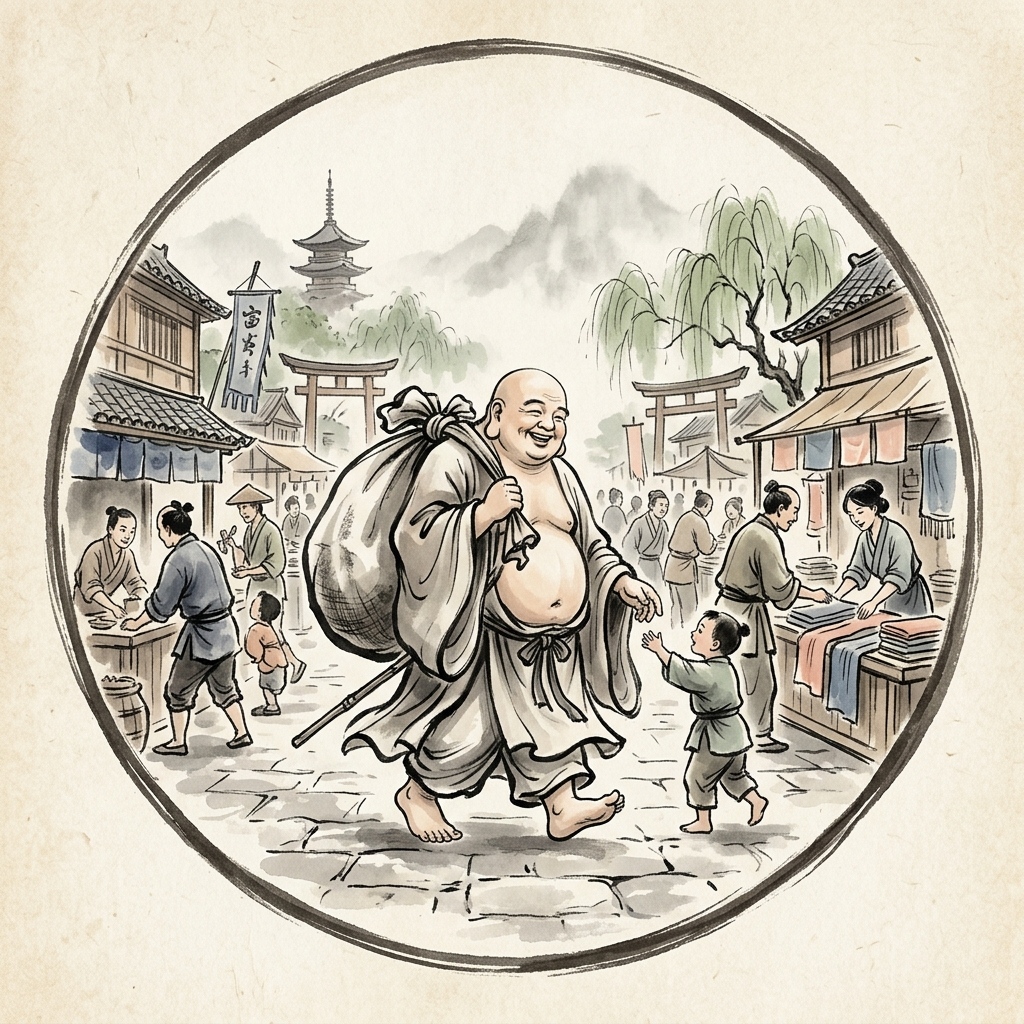
10. Entering the Marketplace with Helping Hands (Jittensuishu)
- [Visual Symbol]: The laughing, pot-bellied monk Hotei (Budai—archetype of the Bodhisattva Maitreya), barefoot and carrying a cloth sack, strolls warmly into the dusty,noisy town marketplace to mingle with tavern-keepers and fishmongers.
- [Inner Horizon]: Complete Bodhisattva Reboot. Utterly free of personal ego-agenda and spiritual pretension, fueled solely by Great Compassion, the awakened person walks right into the mud and bustle of everyday human life—sharing laughter and tears, meeting people exactly where they hurt, and quietly awakening everyone they encounter from within.
Closing Reflection: A Living Compass for Us Today
If our lived world is inseparable from consciousness, trying to escape suffering through self-destruction or escapist withdrawal is like slashing at a movie screen while leaving the projector running; conversely, stopping at mere intellectual talk about non-duality (conceptualism) is like staring at a travel brochure without ever taking a single step.
The authentic freedom to which this entire tradition invites us unfolds across four living movements:
- Awakening directly to how consciousness shapes our lived world (Sudden Awakening),
- Patiently polishing away everyday reactivity, irritation, and fear in the crucible of daily life (Gradual Cultivation),
- Emptying out even the subtlest spiritual ego down to zero (Arhat's Taintless Stillness / Stage 8), and
- Stepping right back into the noisy marketplace of family, work, and society with warm, unpretentious hands and an open smile (Bodhisattva's Return / Stage 10).
When the mirror of the heart is wiped clean of self-clinging, this ordinary everyday world right before our eyes reveals itself as the luminous ocean of wisdom and boundless compassion.
Visualized through the Ten Ox-Herding Pictures, the intricate philosophy of Abhidhamma, Yogācāra, and Mahāyāna awakening becomes a single, intuitive map of human transformation—culminating not in withdrawal from life, but in grounded, compassionate presence right in the everyday marketplace.