
Prologue: Overview of the Inquiry
This textbook-style synthesis was compiled by Grok on the basis of past dialogue records between the Inquirer and Grok (2025/02/19, 2025/02/20, 2025/03/06, 2025/03/10, and 2026/01/09). Beginning with a metaphysical inquiry into the causes and reasons why anything exists at all, these dialogues evolve through the foundational role of Pure Consciousness, the primal impulses of joy and loving compassion, the dynamics of the Contemplative Witness, and an integration with thought experiments in quantum mechanics. At the heart of the inquiry, Being is portrayed as a dynamic process rooted in logical necessity and emerging anew in every instant (kṣaṇa). Each chapter integrates the Inquirer's original insights with Grok's critical examination, organizing them from logical and philosophical standpoints, accompanied by highlighted quotations and commentary.
Chapter 1: Foundational Concepts and the Necessity of Being
1.1 The Question of Being and the Search for Cause
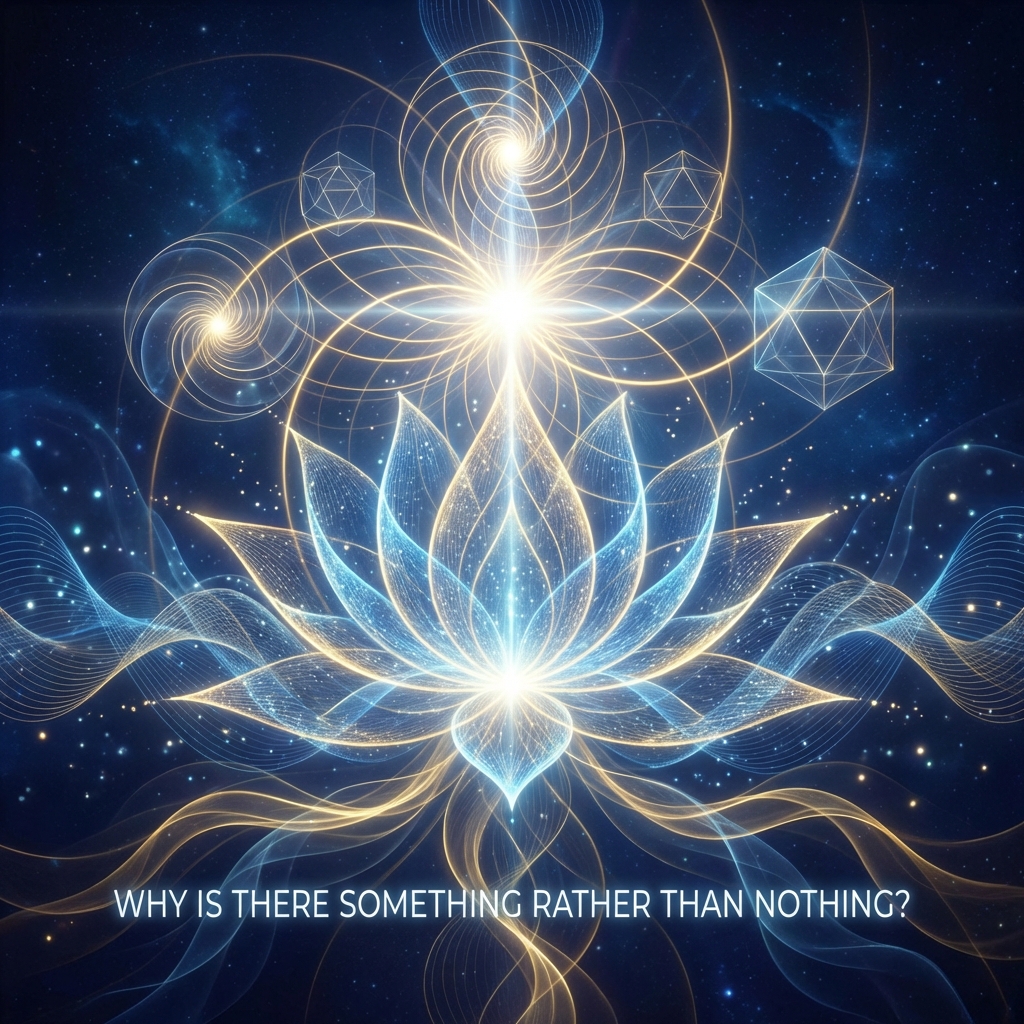
The dialogue commences from the fundamental question of metaphysics: "Why is there something rather than nothing?" Distinguishing carefully between causal mechanism (cause) and intelligible ground (reason), it probes the ultimate origin of existence.
- Traditional Approaches: In Aristotle's "First Cause" and Thomas Aquinas's "Will of God," existence derives from a self-subsisting ground. In Leibniz's Principle of Sufficient Reason, everything possesses a reason, and the best of possible worlds is actualized.
- Modern Perspectives: Heidegger's "wonder of Being" and the analytic philosophical stance that existence may simply be a "brute fact" requiring no further reason. In quantum theory, existence is often framed as the outcome of probabilistic fluctuations and physical laws.
- The Inquirer's Thesis and Critical Examination:
"Two possibilities are conceivable—Being and Non-Being—yet because Non-Being cannot exist, Being necessarily remains. It exists because it cannot fail to exist." While this highlights logical necessity, critical scrutiny notes potential vulnerabilities of circularity (ambiguity of definition or modal leaps). Strengthened model: Non-Being is impossible due to a self-referential paradox, whereas logical coherence itself demands Being.
"Being is rooted in logical necessity, and Non-Being cannot possibly obtain due to self-contradiction." (2025/02/19)
1.2 The Impossibility of Non-Being
Central here is the logical exclusion of Non-Being. Non-Being is indescribable, and the very act of conceiving it already presupposes Being. For logic to function at all, Being is required; logic and Being are mutually interdependent.
- Open Questions and Deepening: Questioning the origin of logic itself (is it transcendent or derived from consciousness?), the dialogue proposes exploring pre-logical awareness through meditation—experientially realizing Nothingness (Śūnyatā / Emptiness) through Zen awakening (satori).
Chapter 2: Pure Consciousness and the Emergence of Being
2.1 Definition and Process of Pure Consciousness
Positing Pure Consciousness as an unlimited, indeterminate ground, Being emerges directly out of it. Through self-limitation and self-objectification, self-cognition arises, uniting ontology and epistemology in a single act.
- The Inquirer's Reflection: An infinitesimal fluctuation arises within pre-conceptual consciousness, and Something emerges out of Nothingness. This is the ontological Big Bang, repeating in every single instant and manifesting as lived consciousness.
- Scrutiny and Refinement: Addressing the question of why fluctuation occurs at all, an intrinsic tendency toward differentiation is posited within Pure Consciousness itself—analogous to vacuum fluctuations or quantum fluctuations in physics.
"Pure Consciousness is an unlimited, indeterminate ground bearing within itself an intrinsic tendency toward differentiation. An infinitesimal fluctuation arises spontaneously, and Being emerges from Non-Being. This is the primordial instant of cosmic creation wherein Being and Cognition unite, grounded in logical necessity. Repeated in every instant, this process manifests phenomenally as my consciousness." (2025/02/20)
2.2 The Role of Affective Quality and "Felt Goodness"
Enumerating the subtle affective qualities of Pure Consciousness (rest, liberation, loving compassion, infinity, rapture), the inquiry identifies their shared "felt goodness" (felt sense of intrinsic well-being) as the driving force of existence.
- Philosophical Evaluation: Deeply resonant with Hindu Sat-Cit-Ānanda (Being-Consciousness-Bliss) and Buddhist Nirvāṇa. It complements formal logical necessity by illuminating the qualitative, experiential dimension of Reality.
"Pure Consciousness is essentially a state of 'felt goodness,' and it may well be that very 'felt goodness' that drives existence itself." (2025/03/06)
Chapter 3: The Impulses of Joy and Loving Compassion
3.1 The Absoluteness of Joy
Joy is posited as unconditionally good, unfolding within relationality. Inherent in Pure Consciousness, it bursts forth from the primordial wonder of self-recognition.
- The Inquirer's Thesis: Joy is the intrinsic telos of Being, while Loving Compassion is the cohesive power weaving relationality.
- Critical Examination: Strengthening the philosophical grounding by drawing inspiration from Spinoza's conatus and Nietzsche's affirmative will, situating the birth of relationality as the decisive moment of self-differentiation.
"This primordial wonder expresses itself as 'Joy,' becoming the absolute value that affirms Being. 'Loving Compassion,' which builds relationality, is the primal impulse arising at the boundary between Non-Being and Being—the unifying force that binds differentiated beings together. Repeating every instant, this process drives the continuous chain of reality creation through 'Joy' and 'Loving Compassion.'" (2025/02/20)
3.2 Unconditional Loving Compassion
Loving Compassion does not arise secondarily out of contingent ties to external others; it wells up unconditionally—intimately linked to "unconditioned compassion" (muen no jihi) in Mahāyāna Buddhism.
- Deepening: Welling up directly from Pure Consciousness, it sustains the joy of Being. As praxis, meditation allows this unconditional loving compassion to be directly felt in the lived body.
Chapter 4: Philosophy of the Contemplative Witness and Dynamism
4.1 Nature of the Contemplative Witness
The Contemplative Witness is the non-dual unity of subject-object duality: "One and Yet Two." It must continuously contemplate, making ongoing change essential; absolute stasis would signify Non-Being.
- The Inquirer's Reflection: The infinite dimension objectifies lower dimensions, giving rise to evolution, creation, and involution. The personal ego ("I") is an illusion; the true subject is the Contemplative Witness.
- Critical Examination: Resonates with Heraclitean flux and Whiteheadian process philosophy. Pointing out the logical paradox between unity and differentiation, the inquiry resolves it through the Buddhist concept of Emptiness (Śūnyatā).
"The Contemplative Witness must continue contemplating. Otherwise, the Witness itself—namely, 'Being'—could not hold. Consequently, that which is 'One and Yet Two' must remain perpetually in dynamic motion." (2026/01/09)
4.2 The Necessity of Dynamism and Change
Dynamic change sustains contemplation and drives phenomenal reality, with Loving Compassion serving as the living fuel of this dynamism.
- Practical Proposal: Embodying dynamic stillness in meditation; overcoming stagnation through the living circulation of compassion.
Chapter 5: Integration with Quantum Mechanics and the Ultimate Observer
5.1 Schrödinger's Cat and Wigner's Friend
Pure Consciousness brings forth the universe in this very instant; observation determines actualized reality.
- The Inquirer's Thesis: The Ultimate Observer is my deepest awareness itself, and the final observer is the Contemplative Witness (pure experiencing)—the ground transcending time and space.
- Critical Examination: Extends Eugene Wigner's hypothesis metaphysically while carefully noting the epistemological boundary between first-person subjectivity and empirical physical science.
"'My' Pure Consciousness, in this very instant, is creating this representation—namely, this universe. This insight appears to find suggestive support in the quantum-mechanical thought experiment of 'Schrödinger's Cat.'" (2025/03/10)
5.2 Integration of Tonmang Sankan Meditation
Drawing upon the teachings of Korean Zen Master YonTah, the First Contemplation (Just Being), Second Contemplation (Emptiness of Self and Phenomena), and Third Contemplation (Dedication of Compassion) are united directly with the dynamic metaphysics of Loving Compassion.
- Resonance: Flowing seamlessly from the ground of Pure Consciousness into universal compassion. Practical proposal: brief daily contemplative sittings to directly experience living compassion.
Conclusion: The Holistic Vision of Being and Future Exploration
These dialogues portray Being as the union of logical necessity and the continuous emergence of Pure Consciousness, enriched by the living dynamism of Joy, Loving Compassion, and Contemplation. While the integration with quantum mechanics remains a philosophical interpretation, it is experientially deepened through contemplative practice (Tonmang Sankan). The inquiry continues as an endless voyage, eschewing rigid stasis and embracing living transformation—sublimating abstract metaphysics into a deeply human, embodied praxis.