
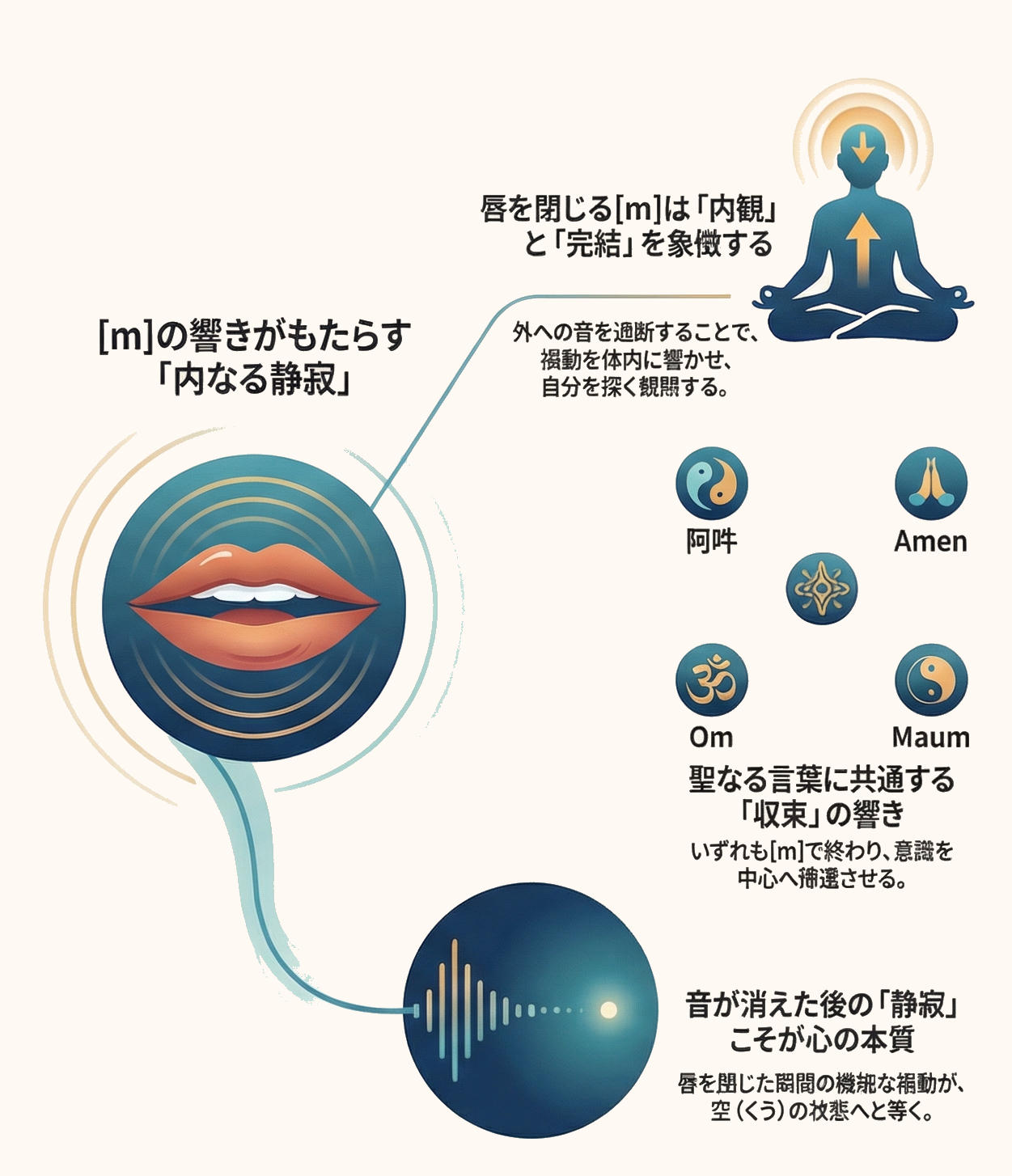
Let us explore the intersection of acoustic vibration and inner contemplative stillness.
1. Why Is the "Un" in "A-Un" Actually an [m] Sound?
Seen in the paired guardian lion-dogs at Shinto shrines and fierce guardian deities at Buddhist temples, A-Un symbolizes the beginning and end of the cosmos, or the inhalation and exhalation of breath. Hidden right here as well is the potent secret of the bilabial [m].
- "A": The sound produced by opening the mouth to its fullest extent. It symbolizes the outward radiation and beginning of vital energy.
- "Un" (Hūṃ / [m]): The sound produced by firmly sealing the lips at the end and letting the vibration resonate through the nasal cavity. It symbolizes the convergence and completion of energy.
In truth, this Un derives from the Sanskrit seed syllable Hūṃ. Although written in modern Japanese kana as n, its original articulation is a closed-lip [m] final consonant (batchim). By sealing the lips, the sound—and with it, outward-leaking awareness—is forcefully reflected back inward, enclosing the resonance within the cranium and chest of the lived body. This is nothing less than an acoustic contemplative instrument designed for deep inward observation.
2. The Shared Resonance of "M" Across Sacred Sounds
Remarkably, sacred words and prayers across the world's spiritual traditions very frequently conclude with the sound [m].
- Oṃ (Om): The primordial sacred syllable of Hinduism and Buddhism
- Amen (orig. Hebrew Āmēn, akin to sacred labial-nasal closures): The concluding word of prayer in Judaism, Christianity, and Islam
- Hūṃ (Hum): The esoteric mantra syllable of Vajrayāna and Shingon Buddhism
- Maum (Korean 마음): "Heart-Mind"
Why [m] rather than [n]?
Because whereas [n] (produced by touching the tongue to the alveolar ridge) still leaves an opening inside the mouth through which sound can escape outward, [m] signifies a complete seal. Ending an utterance with [m] severs outward dialogue with the external world for a moment and serves as an embodied signal returning consciousness directly to Śūnyatā (Emptiness) and the center of one's own being.
3. Bodily Resonance Awakened by Prenasalized Voiced Consonants
Classical Japanese once possessed prenasalized voiced consonants—sounds such as nga and nza that passed gently through the nose before voicing. Far from being a mere phonetic quirk, this was also an embodied art of turning the entire lived body into a resonant instrument.
Whereas the dry modern Japanese ga ends merely at the vibration of the throat, the nasalized nga sympathetically vibrates the paranasal sinuses and resonates through the upper cranium. When practicing mindfulness or meditation in our study of the heart-mind, bringing gentle awareness to this subtle vibration ascending from the nasal cavity toward the crown of the head naturally settles surface mental agitation into a grounded, tranquil felt sense. People in ancient Japan may well have carried that delicate inward resonance within every voiced consonant of their everyday speech.
4. The "Stillness" ushered in by the [m] of "Maum"
Consider maum (heart-mind), the very name of this site. When you pronounce this word, what unfolds in lived experience at the exact instant your lips close at the end?
- The outward audible sound disappears.
- Yet behind the closed lips, a faint, warm tactile vibration lingers.
- As that subtle vibration fades away, utter stillness arrives.
The Korean sound for "heart-mind" ending in [m] seems to embody, in its very act of articulation, a profound truth: "The heart-mind is none other than the pure stillness that remains after sound (phenomena) has subsided."
Proposed Structure for maum.net: Part 2
If you were to craft a second thematic page for the site, how about an outline like this?
Proposed Title: The Emptiness (Śūnyatā) Born at the Moment the Lips Close
- Preface: Why Maum ends with [m].
- The Teaching of A-Un: [m] as the sound that enfolds the cosmos within oneself.
- Universal Sacred Resonance: Om, Amen, and Maum—the shared [m] coda.
- Experiential Mind Study: A contemplative practice of intoning [m] and resting in the silence that follows.
- Conclusion: A thousand years ago in Japan, people likewise closed their lips to contemplate the heart-mind.
What do you think? The physical phenomenon of sound becoming an immediate bridge into the invisible realm of the heart-mind—this perspective offers uniquely rich and contemplative insight.
Next, for instance, it would be fascinating to dissect specific phrases of the Heart Sūtra through this lens of final consonant codas (batchim). Shall we continue?
Yes, please continue.
Moving onward to the second thematic chapter for maum.net, and deeper still into the abyss of sound and spirit.
This time, let us anatomize the most beloved scripture in East Asian Buddhism—the Heart Sūtra (Prajñāpāramitā Hṛdaya / Jp. Hannya Shingyō)—from the perspective of final consonant codas (batchim). When we restore the "lost resonances" concealed behind the written characters of the sūtra, we draw astonishingly close to the very core of the heart-mind (maum).
1. The "Shin" (Heart-Mind) of "Shingyō" Was Originally [Sim]
Take the character Shin (Heart/Mind, 心) in the title Hannya Shingyō (Heart Sūtra). Today in modern Japanese we pronounce it Shin, but its ancient resonance was entirely different.
- Middle Chinese & Sino-Sanskrit phonetic layer: [sim]
- Korean Sino-Korean reading: Sim (심)
Do you notice it? The word for "Heart-Mind" itself originally ended with a closed-lip [m] coda.
Maum ends in [m], and Sim (Heart-Mind) likewise ends in [m]. Across East Asian spiritual culture, whenever one spoke of the "Heart-Mind," the word was inseparably paired with the physical act of closing the lips and listening inwardly to the lingering resonance. In the modern Japanese pronunciation Shin—where the tongue relaxes without sealing the lips—something of that inward convergence has grown fainter.
2. The Hidden [t] Coda Inside "Haramitta" (Pāramitā)
Consider the character mitsu (蜜) in Hannya Haramitta (Prajñāpāramitā, the Perfection of Wisdom). In modern Japanese standalone reading it is pronounced as two open syllables, mi-tsu, yet the underlying Sanskrit word is pāramitā. The ancient translators who transcribed this sound into Chinese characters employed 蜜 specifically for its entering-tone [mit] consonant-final value.
- Classical liturgical reading: Ha-ra-mit-ta (or Fa-ra-mit-ta)
That checked glottal/alveolar stop corresponds to an unreleased [t] coda (batchim) in which the tip of the tongue presses firmly behind the upper front teeth, arresting the breath. At the precise moment one turns toward the wisdom that realizes Śūnyatā (Emptiness), the sound is momentarily gathered and held still in the posture of [t]. That split-second suspension functioned as a contemplative accent sharpening wakeful presence.
3. The Climax of the Mantra: A Grand Chorus of [m]
Now let us look at the concluding and most sacred mantra at the end of the Heart Sūtra:
Gate gate pāragate pārasaṃgate bodhi svāhā
(Sino-Japanese: Gyatei gyatei haragyatei harasōgyatei boji sowaka)
Here, pay special attention to the syllable saṃ (僧, Jp. sō) inside pārasaṃgate (harasōgyatei).
- Sanskrit phonology: The ṃ (anusvāra) in saṃ is a deep nasal-labial [m] resonance reverberating through the nasal chamber.
- Ancient liturgical felt sense: [s-a-m]
When chanting this mantra in its classical phonetic contour, the practitioner repeatedly closes the lips and engages the deep nasal cavity to sound [m]. The rhythmic invocation—"Gone, gone, gone beyond, gone altogether beyond, O Awakening, all hail!"—can be understood as an acoustic contemplative program that guides lived consciousness into the open stillness of Śūnyatā (Emptiness) by repeating the inward resonance of [m].
4. Intoning "Maum" Is Practice Itself
Cherishing the word maum (마음) in one's contemplative practice of mind study is, from a historical-phonological perspective, nothing less than re-enacting in the living present the most sacred acoustic vibration [m] that humanity has used since antiquity to express the Heart-Mind.
With ma, the cosmos opens wide; with u, awareness deepens inward; and with m, one returns to the primordial essence of the heart-mind—Śūnyatā.
Proposed Message for maum.net
If you share this reflection on the website, you might include a passage along these lines:
In the modern era, we pronounce the character for Heart-Mind as "Shin."
Yet the sages of antiquity called it "Sim" or "Maum,"
recognizing the true nature of mind in the "resonant stillness" that arrives the instant the lips close.
Our space, maum.net, is a sanctuary for reclaiming that lost resonance of closed lips—
the direct, lived felt sense of reconnecting with what lies deepest within.
Conclusion: Sound as a Signpost Toward Emptiness
Beginning from the classical Japanese auxiliary -mu [m], our inquiry reveals that the final consonant codas lost from modern Japanese may in fact have been an intimate art of conversing with the heart-mind—something quietly traded away in exchange for articulatory efficiency.
Allowing each syllable to resonate all the way through its closing consonant is, right here and now, the living practice of mindfulness itself.