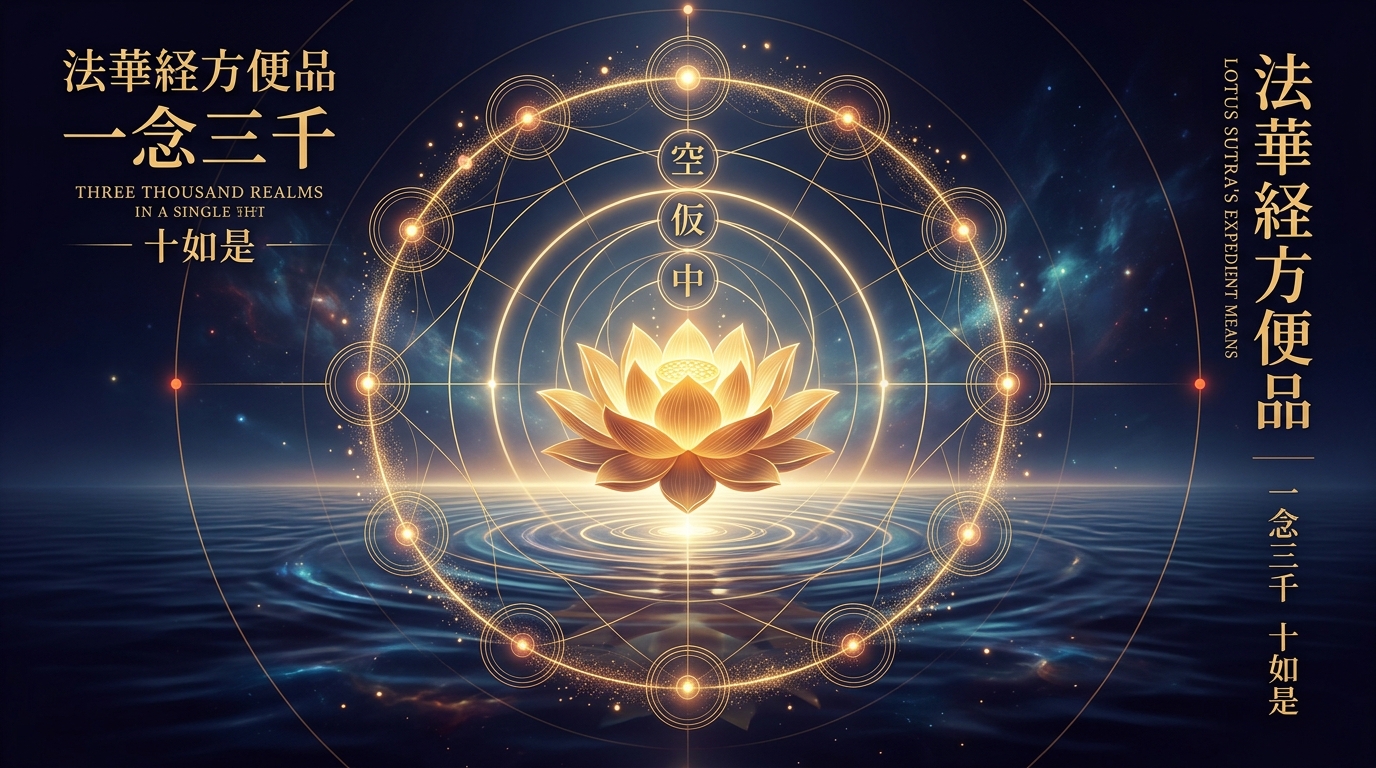
 [Overview] From the Summit of Non-Duality Down Into the Muddy Arena of Everyday Life
Revered across East Asia as the crowning scripture of Mahāyāna Buddhism, the Lotus Sūtra (Skt. Saddharmapuṇḍarīka-sūtra / Jp. Myōhō Renge Kyō) reaches a decisive philosophical turning point in Chapter 2: "Expedient Means" (Upāya-kauśalya / Hōben-pon). Here Śākyamuni Buddha unveils the supreme horizon of his awakening—the "True Aspect of All Phenomena" (Shohō Jissō)—and articulates it through the "Ten Suchnesses" (Jū Nyoze: Appearance, Nature, Entity, Power, Influence, Internal Cause, Relation, Latent Effect, Manifest Effect, and Consistency from Beginning to End).
Starting from the foundational questions "How do the Ten Suchnesses bring liberation from suffering?" and "What is Ultimate Identity (Kukyō-soku) in Tiantai/Tendai's Six Identities?", this dialogue traverses Śākyamuni's profound inner conflict at Brahmā's Entreaty (choosing between solitary quiescent Nirvāṇa and returning to the muddy arena of society to liberate fellow beings), the integration of the Two Truths (Ultimate and Conventional), the Threefold Truth in Perfect Harmony (Emptiness, Provisionality, and the Middle), and the mathematical-metaphysical architecture of "Three Thousand Realms in a Single Thought-Moment" (Ichinen Sanzen)—unraveling the pinnacle of Buddhist philosophical logic.
What is the "Expedient Means" chapter (Hōben-pon) of the Lotus Sūtra?
Dialogue 1: Overview and Core of the Lotus Sūtra's Chapter 2: "Expedient Means" (Hōben-pon)
Chapter 2: "Expedient Means" (Hōben-pon / Skt. Upāya-kauśalya) of the twenty-eight-chapter Lotus Sūtra is one of the most pivotal sections of the entire scripture, in which Śākyamuni Buddha reveals both the ultimate reality of his awakening and the skillful pedagogical means (upāya) employed to guide sentient beings toward it.
Principal Teachings and Core Themes
- Expedient Means (Hōben / Upāya): Skillful methods, provisional teachings, and compassionate approaches tailored to draw people closer to and guide them into ultimate awakening.
- The Ten Suchnesses (Jū Nyoze): An elucidation of the fundamental reality of all phenomena across ten aspects (Appearance, Nature, Entity, Power, Influence, Internal Cause, Relation, Latent Effect, Manifest Effect, and Consistency from Beginning to End)—a passage famously chanted three times in succession during liturgical recitation.
- Opening the Three Vehicles to Reveal the One Buddha Vehicle (Kaisan Ken'itsu): The declaration that the previously taught Three Vehicles (for Voice-Hearers, Cause-Awakened Ones, and Bodhisattvas) were provisional stepping-stones, whereas the sole ultimate purpose of the Buddhas' appearance in the world is the One Buddha Vehicle (Ekayāna / Ichibutsujō) leading every single being to Buddhahood.
In the Tiantai/Tendai and Nichiren traditions of East Asian Buddhism, "Expedient Means" (Chapter 2) is revered alongside Chapter 16, "The Life Span of the Tathāgata" (Nyorai Juryō-hon), as one of the two central pillars of the sūtra and is recited daily in devotional practice.
Is the true realm of awakening expounded through the Ten Suchnesses?
Dialogue 2: The Ten Suchnesses (Jū Nyoze) and the Structure of the "True Aspect of All Phenomena" (Shohō Jissō)
Yes, precisely. In Kumārajīva's celebrated Chinese translation of the "Expedient Means" chapter, the Ten Suchnesses (Jū Nyoze) employ ten interlocking dimensions to disclose the unadorned reality of all existence—the True Aspect of All Phenomena (Shohō Jissō)—thereby articulating the ultimate realm of awakening fathomed by the Buddhas.
Specifically, the teaching unfolds through the following structure:
1. The True Aspect of All Phenomena (Shohō Jissō)
Śākyamuni expresses the ultimate horizon of Buddha-wisdom with the phrase Shohō Jissō ("the True Aspect of All Phenomena"—all things just as they truly are). He declares of this fathomless reality: "Only a Buddha together with a Buddha can fathom the True Aspect of All Phenomena" (唯仏与仏 乃能究尽 諸法実相)—signifying a depth of realization fully shared only among awakened Buddhas.
2. The "Ten Suchnesses" Disclosing Ultimate Reality
To unfold that profound "True Aspect of All Phenomena"—otherwise beyond the conceptual grasp of ordinary unawakened beings—into concrete, intelligible dimensions, Kumārajīva's text presents the Ten Suchnesses.
Every phenomenon and living being (mind, matter, human life, and cosmos alike) is pervaded by these ten universal modalities of Suchness (Nyoze):
- Such an Appearance (如是相, Nyoze sō): Outwardly manifest form, posture, and visible aspect
- Such a Nature (如是性, Nyoze shō): Inherent inner disposition, quality, and unchanging essence
- Such an Entity (如是体, Nyoze tai): The integral living whole or substrate possessing both appearance and inner nature
- Such a Power (如是力, Nyoze riki): Latent capacity and inherent potential energy
- Such an Influence / Function (如是作, Nyoze sa): Outwardly enacted activity and dynamic functioning
- Such an Internal Cause (如是因, Nyoze in): Direct inner cause stored within life that generates an effect
- Such a Relation / Condition (如是縁, Nyoze en): Auxiliary external conditions, encounters, and environments that activate the inner cause
- Such a Latent Effect (如是果, Nyoze ka): The immediate internal result produced within the mind when inner cause meets external condition
- Such a Manifest Effect / Retribution (如是報, Nyoze hō): The tangible outcome manifesting visibly in lived reality over time
- Such a Consistency from Beginning to End (如是本末究竟等, Nyoze honmatsu kukyōtō): The ultimate coherence, inseparability, and equality uniting the entire sequence from the initial Appearance ("beginning," hon) through the final Manifest Effect ("end," matsu)
✦ What ThisUltimately Means
Through these Ten Suchnesses, the Lotus Sūtra reveals the revolutionary truth that "every living being—however flawed or deluded on the surface—inherently possesses in its very structure the realm of Buddhahood (the full potential for supreme awakening)."
Whereas earlier teachings often implied that only extraordinary ascetics after countless lifetimes of austerity could attain Buddhahood, expounding the Ten Suchnesses (Shohō Jissō) established the ontological ground for Universal Buddhahood (Kaijō Butsudō): the path whereby all beings can awaken to Buddhahood right as they are.
How do the Ten Suchnesses actually lead to liberation from suffering?
Dialogue 3: The Mechanism by Which the Ten Suchnesses Bring Liberation from Suffering
The Ten Suchnesses lead directly to liberation from suffering because they illuminate the exact causal architecture of how suffering arises and demonstrate that by transforming one's own inner life-state, one can dissolve suffering right in the place where one stands.
In Buddhism, suffering is never inflicted unilaterally from an external world; it arises through the coupling of one's own "internal cause" (in) with "external conditions" (en). Understanding the Ten Suchnesses—especially the dynamic interplay of Internal Cause, Relation, Latent Effect, and Manifest Effect—frees us from suffering in two decisive ways:
1. Clearly Perceiving the True "Internal Cause" of Suffering
The Ten Suchnesses lay bare how our inner state translates into lived reality:
- Such an Internal Cause (Nyoze in): Habitual inner attachments, resentments, and reactive patterns accumulated from past experience
- Such a Relation / Condition (Nyoze en): Someone else's sharp remark or an unwelcome external event
- Such a Latent Effect (Nyoze ka): The immediate inner contraction—"There it goes again, I'm furious/miserable because of them"
- Such a Manifest Effect (Nyoze hō): Somatic exhaustion from chronic stress or deteriorating human relationships
When we suffer, we habitually blame external triggers alone: "It's all that person's fault" or "My environment is terrible" (blaming en). Contemplating the Ten Suchnesses reveals that suffering (ka and hō) arises because an "internal cause" (in—our own clinging and framing) latches onto that external "condition" (en). Precisely because the decisive causal pivot lies within our own heart-mind, we discover the freedom to transform it ourselves.
2. Transforming the "Fundamental Mode of Life" (Honmatsu Kukyōtō)
The tenth Suchness—Honmatsu kukyōtō ("Consistency from Beginning to End")—signifies that everything from initial Appearance (sō) through final Manifest Effect (hō) is seamlessly integrated around one's underlying life-state:
- When abiding in a state of torment (such as the Realm of Hell):
One wears a darkened expression (sō), harbors bitterness within (shō), explodes in rage (sa) at a single passing remark (en), and reaps destructive consequences (hō). Beginning to end is consistently colored by suffering. - When awakening the state of Buddhahood:
The Ten Suchnesses teach that in the deepest stratum of every person's life, "Buddha-nature" (Nyoze shō) is inherently present from the outset. When contemplative practice (meditation, sutra recitation, mindful inquiry) awakens this inner Buddha-nature, even when encountering the exact same unpleasant event (en), one meets it unshaken with clear wisdom and compassion.
Once the foundational ground of life (shō and tai) shifts to the mode of Buddhahood, every enacted response (sa) and every resulting fruit (ka and hō) coherently shifts from beginning to end into unshakeable peace and creative fulfillment.
✦ Summary: Transforming Yourself Without Escaping Reality
Liberation from suffering through the Ten Suchnesses does not mean fleeing everyday life for some distant paradise.
It is a dynamic, practical philosophy of inner transformation: shifting the Ten Suchnesses of your own life from the "mode of delusion and suffering" into the "mode of Buddhahood," thereby overcoming suffering right in the midst of this living world.
After all is said and done, what kind of state is Kukyō ("Ultimate Consummation")?
Dialogue 4: The Realm of "Ultimate Consummation" (Kukyō) and Honmatsu Kukyōtō
In Buddhist philosophy, Kukyō (究竟, "Ultimate Consummation") signifies "the furthest, unsurpassable summit beyond which nothing higher exists"—that is, complete awakening and the living realm of Buddhahood itself.
Within the phrase Honmatsu kukyōtō ("Consistency from Beginning to End") concluding the Ten Suchnesses, what this realm of Kukyō entails can be understood through two complementary dimensions:
1. Complete Awakening to Ultimate Reality (The Middle Way / True Aspect)
Literally, the characters kukyō mean "to fathom and exhaust to the very bottom."
In Tiantai/Tendai philosophy, leaning neither toward surface appearances alone (the Provisional, Ke—such as sō) nor toward blank negation (one-sided Emptiness, Kū—detaching from form), but illuminating the True Aspect of the Middle Way (Chūdō Jissō) across all phenomena is called "Ultimate Identity" (Kukyō-soku), the supreme stage of Buddhahood.
Free of every cognitive distortion and delusion, beholding with crystal clarity all universal laws from beginning (hon = Appearance) to end (matsu = Manifest Effect)—that is Kukyō.
2. Realizing That "Even Delusion and Suffering Are Not Separate from Buddhahood"
The final character tō (等, "equal / identical") in Honmatsu kukyōtō signifies that at the ultimate level, all are equal and non-dual:
- The Ten Suchnesses of a deluded ordinary person (anguished appearance, angry heart, painful outcomes)
- The Ten Suchnesses of an awakened Buddha (compassionate presence, pure mind, liberating outcomes)
Though diametrically opposed on the surface, seen from the ultimate horizon (Kukyō), both are manifestations of the single undivided reality of life (Shohō Jissō), without the slightest difference in their intrinsic dignity and worth.
Accordingly, the state of Kukyō never means discarding your struggling present self to become some alien, sterile perfection elsewhere.
It means awakening to the unshakeable conviction that "at the deepest ground of my life right now—even amidst afflictions and pain—the realm of Buddhahood is already wholly complete," empowering you to invert suffering itself into wisdom and compassionate strength.
Please explain in detail the position of Kukyō-soku within the six stages of awakening taught by the Tendai school, known as the "Six Identities" (Roku-soku).
Dialogue 5: Detailed Position of "Ultimate Identity" (Kukyō-soku) Within Tiantai/Tendai's "Six Identities" (Roku-soku)
"Ultimate Identity" (Kukyō-soku) stands as the sixth and highest stage—supreme Buddhahood—within the Six Identities (Roku-soku / Rikusoku) formulated by Tiantai Master Zhiyi.
The doctrine of the "Six Identities" safeguards practitioners against two opposite errors—arrogantly claiming "I'm already enlightened so no practice is needed" or despairing "Buddhahood is impossibly out of reach"—by pairing "Identity" (soku: every being inherently possesses Buddha-nature right now) with "Six Stages" (the concrete progression through which delusion is cleared away until Buddhahood shines forth in full).
Position of Kukyō-soku Across the Six Identities
| Stage | Name of Identity | State of Consciousness and Meaning |
|---|---|---|
| Stage 1 | Identity in Principle (理即, Ri-soku) | Though one has neither heard the Dharma nor begun any practice, one inherently possesses complete Buddha-nature in principle from the very beginning. |
| Stage 2 | Verbal Identity (名字即, Myōji-soku) | Through hearing the words and teachings of the scriptures, one awakens intellectually for the first time to the truth: "All phenomena—and my own life—are inherently Buddha." |
| Stage 3 | Identity of Contemplative Practice (観行即, Kangyō-soku) | Guided by that understanding, one engages earnestly in contemplative practice (such as śamatha-vipaśyanā meditation), bringing word and lived conduct into alignment. |
| Stage 4 | Identity of Resemblance (相似即, Sōji-soku) | As contemplation deepens and sensory attachments fall away, clear wisdom closely "resembling" true Buddha-wisdom emerges. |
| Stage 5 | Identity of Progressive Awakening (分真即, Bunshin-soku) | Progressively severing fundamental ignorance (avidyā) portion by portion, one embodies authentic awakening step by step as a high Bodhisattva. |
| Stage 6 | Ultimate Identity (究竟即, Kukyō-soku) | Having severed every last trace of delusion, one arrives at the consummate summit of awakening—complete Buddhahood. |
What "Ultimate Identity" (Kukyō-soku) Signifies
Kukyō-soku corresponds to Marvelous Awakening (Myōkaku), the highest fruition in Mahāyāna Buddhism, characterized by three hallmarks:
- Complete Eradication of Fundamental Ignorance: Every last drop of primordial existential ignorance (Ganpon no Mumyō) clouding the depths of consciousness has dissolved completely.
- All-Embracing Wisdom (Sarvajña): Unclouded omniscience beholding the True Aspect of All Phenomena (Shohō Jissō) across the entire cosmos exactly as it is.
- Circular Return to and Fulfillment of "Identity in Principle" (Ri-soku): What one realizes upon reaching the supreme peak of Stage 6 (Kukyō-soku) is none other than the truth of Stage 1 (Ri-soku)—that Buddha-nature was wholly present from the very beginning! Rather than manufacturing a foreign Buddhahood, it is the circular consummation of fully manifesting who one originally was all along.
In Tiantai philosophy, therefore, Kukyō-soku is never a static retirement in which life stops; it is the dynamic, compassionate state of Buddhahood that fully unfolds the supreme dignity inherent in all beings and works freely in the world to liberate others.
What is the actual content of the "True Aspect of All Phenomena" (Shohō Jissō)?
Dialogue 6: The Three Cores of "True Aspect of All Phenomena" (Shohō Jissō) — Total Affirmation of Reality
The content of Shohō Jissō ("True Aspect of All Phenomena") is the radical teaching that "all concrete phenomena in this world (shohō), just as they are, are none other than Ultimate Reality (jissō)."
Expounded in Chapter 2 ("Expedient Means") of the Lotus Sūtra, this insight revolutionized the entire worldview of Buddhist history. It rests upon three core pillars:
1. "All Phenomena" (Shohō) and "Ultimate Reality" (Jissō) Are Non-Dual
- All Phenomena (Shohō): Every concrete thing, mind, society, person, and distinction unfolding before our eyes—including our confusion, grief, friction, and joy.
- True Aspect / Ultimate Reality (Jissō): The unchanging ultimate truth of the cosmos—the reality awakened to by the Buddha.
Earlier world-renouncing streams of Buddhism often sought to leave behind this messy, turbulent world of phenomena (shohō) in order to reach a pure, transcendent realm of truth (jissō) elsewhere. Shohō Jissō overturns that dualism, declaring: "Right within the unadorned, living reality of this phenomenal world (shohō), Ultimate Reality (jissō) is wholly and inseparably manifest."
2. Every Being Inherently Embodies the Potential for Buddhahood
As we saw earlier, the concrete articulation of Shohō Jissō is the Ten Suchnesses (Jū Nyoze).
Because all beings (shohō) share the exact same tenfold ontological structure, at the root level "a Buddha and a deluded ordinary person share the exact same architecture of life." This provided the rigorous philosophical foundation for universal enlightenment (Kaijō Butsudō): regardless of past mistakes or lack of monastic status, every single being can awaken to Buddhahood as they are.
3. Wisdom That Embraces and Transforms All of Reality
Within the worldview of Shohō Jissō, one does not amputate or disown one's own painful emotions or struggles (shohō) as shameful defects; they too are living expressions of reality.
What matters is how, right in the midst of struggle and imperfection, one opens the "Buddha-wisdom" sleeping in the depths of life. The foundational spirit of the Lotus Sūtra—that the purest white lotus blossom (awakening) blooms only out of dark, nutrient-rich mud (everyday reality)—is crystallized in these four characters: Shohō Jissō.
What is this "Buddha-wisdom" sleeping in the depths of life?
Dialogue 7: The Three Powers of "Buddha-Wisdom" Dormant in the Depths of Life
"The 'Buddha-wisdom' in the depths of life" refers to the supreme innate capacity of consciousness (Buddha-nature, Busshō) to perceive oneself and the cosmos clearly as they truly are, surmount every form of suffering, and generate genuine well-being for both oneself and others.
From the perspective of the Lotus Sūtra, this wisdom is never bestowed from outside by a supernatural power; it slumbers innately in the deepest stratum of every human life, manifesting concretely through three transformative powers:
- The Power to See Through Surface Appearances into Essence (The Eye of Shohō Jissō):
In daily life we are easily tossed about by a passing word from someone else, immediate gain and loss, or anxious rumination.
When Buddha-wisdom awakens, one perceives the underlying causal structure (the Ten Suchnesses and True Aspect) beneath immediate events: discerning with calm, unclouded lucidity—without drowning in emotional reactivity—"Why is this suffering arising right now, and how can I respond constructively?" - The Creative Power to Invert Suffering into Value (Bonnō-soku-Bodai):
This wisdom is not encyclopedic book-learning.
It is the living alchemical power to convert daunting obstacles and raw inner turmoil—desire, anger, grief, and distress (afflictions, bonnō)—directly into deeper empathy for fellow sufferers and unstoppable creative resolve (bodai). - The Power to Trust 100% in the Supreme Dignity of Both Self and Others:
It shatters the twin roots of existential darkness (avidyā / mumyō): self-deprecation ("I am worthless") and divisive hostility ("That person is my enemy").
Awakening unshakeable reverence—recognizing that "both I and the person standing right before me are equally living out the supremely precious life of Buddha (the Ten Suchnesses)"—it naturally propels compassionate action.
✦ How Is It Drawn Forth?
In the Tendai tradition, practitioners contemplate this innate wisdom directly within the mind through seated meditation (Mohe Zhiguan / Maka Shikan); in Nichiren Buddhism, practitioners chant the title of the sūtra (Namu Myōhō Renge Kyō) to call forth this wisdom directly from the depths of life.
Opening "Buddha-wisdom" does not mean acquiring paranormal powers; it means clearing away the fog of delusion (mumyō) that obscures the "clear intelligence" and "boundless warmth" already native to our being, allowing them to function at full capacity.
By what logic does one arrive at the conviction that "both I and the person right before me are equally living the supremely noble 'Life of Buddha (Ten Suchnesses)'"?
Dialogue 8: The Three Logical Steps Leading to the Conviction That All Beings Are Equally Buddhas
The conviction that "both myself and others are equally living the noble life of Buddha" is neither sentimental moralizing nor blind wishful thinking; it is derived rigorously from theontological logic of True Aspect of All Phenomena (Shohō Jissō) and Consistency from Beginning to End (Honmatsu Kukyōtō) unfolded in the "Expedient Means" chapter.
That logical demonstration proceeds in three steps:
1. The Logic of Structural Identity: Everyone Shares the Exact Same Architecture of Life (Universality of the Ten Suchnesses)
Before the Lotus Sūtra, it was widely assumed that "sages vs. ordinary fools" or "virtuous people vs. wicked people" differed in their very constitution, separated by an unbridgeable gulf.
The logic of the Ten Suchnesses demolished that wall:
- Your life, the life of someone you dislike, and the life of Śākyamuni Buddha himself are all constituted by the exact same tenfold dynamic structure: Appearance, Nature, Entity, Power, Influence, Internal Cause, Relation, Latent Effect, Manifest Effect, and Consistency from Beginning to End.
- Because the underlying operating architecture is identical in every single being, whenever the right relational conditions (en) align, anyone's life can manifest the "mode of Buddhahood." Herein stands an uncompromising logic of universal equality.
2. The Logic That Delusion and Awakening Are Two Faces of One Reality (Shohō Jissō)
Next, to the natural objection—"Even so, in real life there are cruel people and people mired in misery!"—the logic of Shohō Jissō responds:
- Shohō Jissō establishes that Ultimate Reality (jissō) is wholly present inside concrete phenomenal appearances (shohō).
- Just as jagged ice (delusion and suffering) and clear flowing water (awakening and Buddha-nature) share the exact same molecular essence (H2O), a "presently deluded state" is simply "Buddha-life temporarily frozen solid." However distorted a life may appear on the surface, its innermost essence (jissō) has never lost a single ounce of its Buddha-dignity.
3. The Logic That Beginning and End Are Ultimately Equal (Honmatsu Kukyōtō)
The concluding tenth Suchness—Honmatsu kukyōtō—delivers the decisive keystone:
- Hon ("Beginning" = outward Appearance, Nyoze sō)
- Matsu ("End" = concrete Manifest Effect, Nyoze hō)
- Kukyōtō ("Ultimately equal and non-dual")
This principle affirms that both "the Ten Suchnesses of an ordinary person suffering in hellish turmoil" and "the Ten Suchnesses of a Buddha abiding in supreme bliss," when beheld from the ultimate dimension of life (Kukyō), are equally sacred expressions of cosmic reality (Jissō).
In daily life we constantly judge others and ourselves solely by surface outcomes (matsu—painful results or unskillful behavior). This logic reveals that whatever the surface weather, the foundational worth at the root of every life is 100% equal.
✦ Summary: The Conviction Born of Logic
When these three logical insights converge, a quiet, unshakeable conviction awakens:
"Both that person raging in front of me right now and this self reproaching itself are merely experiencing a temporary negative turn of surface 'cause, condition, and effect.' Our fundamental structure of life (the Ten Suchnesses) and our innermost essence (True Aspect) do not differ from a Buddha's by a hair's breadth. Therefore, simply by transforming our relational conditions (en), both of us can bring forth the radiant life of Buddha."
Thus the Lotus Sūtra logically demonstrates that no human being is a fixed, doomed entity; every life is a dynamic, infinitely dignified openness.
What is the concrete step-by-step procedure for "transforming relational conditions (en)"?
Dialogue 9: A Concrete 4-Step Practical Procedure for Applying the Ten Suchnesses to "Transform Conditions (En)"
Putting the principle of "transforming conditions (en)" into practice in everyday life so as to dissolve suffering and awaken Buddha-wisdom has been concretely systematized in East Asian Buddhism (especially Tiantai/Tendai and Nichiren traditions) as the art of "Contemplating the Mind" (Kanjin).
Here are four practical steps anyone can apply right in daily life:
- Step 1: [Recognition] Notice Yourself Being Swept Away by External "Conditions" (En)
First, calmly observe in real time how an external trigger (an unpleasant event, a difficult person, a sudden problem = Nyoze en) automatically sets off anger or anxiety inside your mind (Nyoze in and Nyoze ka).- Unskillful Reaction: "That person ruined my entire day!" (blaming external en alone).
- Practice of Wisdom: Quietly observe your own chain of Ten Suchnesses as if narrating live: "Right now, triggered by that person's remark (en), irritation (in) has flared up in my chest and my face (sō) has tensed."
- Step 2: [Interruption] Step Back from Destructive Cycles of "Conditions" (Gradual Stabilization)
Create temporary physical and psychological breathing room from toxic triggers:- Step out of the room briefly or shift your physical posture and breath.
- Shut off streams of inflammatory digital noise (social media outrage, endless bad news—toxic en).
- This prevents negative chains of in → ka → hō from snowballing further.
- Step 3: [Redirection] Deliberately Connect Yourself to Supreme "Wholesome Conditions" (Zen'en — The Core Step)
This is the most decisive step in Buddhist practice. Rather than merely waiting for your environment to improve, you proactively forge a powerful "wholesome condition" (zen'en) that calls forth the "Buddha-nature" (Nyoze shō) deep within your life:- In Tiantai/Tendai & Zen Practice: Sitting quietly in meditation (śamatha-vipaśyanā / shikan), settling the breath, and attuning awareness to Ultimate Reality (Jissō).
- In Nichiren Practice: Voicing the Daimoku (Namu Myōhō Renge Kyō) aloud as a direct acoustic-spiritual condition awakening Buddha-nature.
- In Everyday Contemplative Life: Reading a passage of profound wisdom, resting in nature, listening to serene music, or voicing sincere gratitude—all concrete acts of forging wholesome conditions (zen'en).
- Step 4: [Transformation] Your Life-Mode Shifts, Transforming the Manifest Outcome (Hō)
Once you connect with a wholesome condition in Step 3, the gears of your Ten Suchnesses reverse direction from the "mode of suffering" into the "mode of Buddhahood":- Shift in Internal Cause (Nyoze in): Reactivity and anxiety subside, replaced by calm clarity and compassion.
- Shift in Action (Nyoze sa): Instead of lashing back emotionally, you respond in the way most constructive for both the other person and the situation.
- Shift in Manifest Reality (Nyoze hō): Relationships begin to mend, deadlocks untangle, or—even before outward circumstances change—you abide in unshakeable inner peace free of suffering.
✦ Essence of the Four Steps
Stepping out of "a life of knee-jerk reactivity to unpleasant triggers (en)" and consciously choosing to forge new, wholesome conditions that awaken the deepest dignity of your life—that is the concrete art of transforming reality through the Ten Suchnesses.
I would like to learn more about how to find "Good Spiritual Friends" (Zenchishiki — people and environments that guide one onto the true path) in everyday life.
Dialogue 10: Three Approaches to Discovering "Good Spiritual Friends" (Zenchishiki / Kalyāṇamitra) in Everyday Life
In Buddhism—and especially in the philosophy of the Lotus Sūtra—people, encounters, and environments that guide us toward awakening are called Zenchishiki (善知識, Skt. kalyāṇamitra, "noble or good spiritual friends").
In the language of the Ten Suchnesses, a Zenchishiki is "a supreme relational condition (en) that draws forth the Buddha-wisdom (Nyoze shō) sleeping within our life." Here are three practical ways to discover them in daily life:
1. Discovering Them by Shifting Your Own Inner Stance (The Most Crucial Key)
Buddhism teaches that rather than waiting passively for a flawless saint to appear outside us, "depending on the posture of our own mind, everyone and everything before us can become a Zenchishiki."
- Turning Difficult People into "Inverse Good Friends":
When encountering an unreasonable person or painful setback, if we think "They ruined my life," that encounter functions as a destructive condition (akuchishiki). Yet in the Lotus Sūtra, Śākyamuni declares even his treacherous cousin Devadatta—who repeatedly tried to kill him—to have been a supreme Zenchishiki who perfected his practice! When we reframe friction through the wisdom of the Ten Suchnesses—"This person is a teacher training me not to be enslaved by emotional reactivity"—that very encounter inverts into a catalyst for awakening.
2. Cultivating Them Within Everyday Relationships and Environments
Often, precious Zenchishiki are already present around us if we attune our eyes to notice them:
- Cherishing True Friends Beyond Self-Interest:
Buddhism treasures Dōku ("sharing suffering in empathetic solidarity"). Rather than companions who merely trade gossip or mutual grievances, friends who rejoice in each other's spiritual growth—and who can gently mirror our blind spots with honesty and care—are irreplaceable Zenchishiki. - Creating Daily Environments Steeped in Wisdom:
In modern life, Zenchishiki are not limited to human beings in person:- Spending ten quiet minutes each morning reading authentic Buddhist scriptures or deep philosophical works.
- Immersing oneself in serene natural landscapes or contemplative spaces.
- All of these serve as living Zenchishiki switching our Ten Suchnesses into the mode of clarity.
3. Connecting with an Authentic Teacher or Guiding Lineage
Throughout Buddhist history, the most potent Zenchishiki has always been a living teacher or lineage transmitting the authentic Dharma.
Taking the lived integrity, insight, and compassionate comportment of an awakened mentor as our relational condition (en) helps crack open the narrow shell of our solitary ego and awaken our deepest potential.
✦ Summary: A Contemplative Question for Discovering Zenchishiki
Whenever you stumble over friction in daily life, try asking quietly within:
"What facet of 'Buddha-wisdom' is this event—or this person—helping me wake up to right now as my Zenchishiki?"
Holding that single question instantaneously transforms your internal cause (in—how you meet experience), turning every circumstance into fertile ground for awakening.
What kind of Ultimate Consummation (Kukyō) is attained by someone who avoids the concrete stresses of daily life and human relationships, renounces society as a monastic, and practices in seclusion?
Dialogue 11: The Ultimate State Attained Through World-Renouncing Seclusion (Awakening of the Two Vehicles / "Reducing the Body to Ashes and Extinguishing Consciousness")
From the classification of Mahāyāna Buddhism, the ultimate state attained by one who steps away from the concrete stresses of worldly life and human relationships, enters monastic seclusion, and devotes themselves to solitary liberation (such as the Arhat ideal as portrayed in polemical Mahāyāna critiques) is called "the awakening of the Two Vehicles" (Nijō: Voice-Hearers and Solitary Realizers), or the Nirvāṇa of "Reducing the Body to Ashes and Extinguishing Consciousness" (Keshin Metchi).
Specifically, it entails two defining features:
1. Unruffled Inner Tranquility Free of Afflictions (Fruition of Arhatship)
By physically stepping back from worldly entanglements and sensory stimulation and mastering meditative discipline, the practitioner severs craving (taṇhā)—the fuel of suffering—at its root.
Like a windless ocean without a single ripple, the mind reaches a state of imperturbable peace and stillness unshaken by anything. This is revered as the noble attainment of the Arhat.
2. Complete Exit from the Cycle of Birth-and-Death (Saṃsāra)
In early Indian ascetic thought and early Buddhism, conditioned rebirth itself was experienced as an endless round of suffering.
Upon reaching the culmination of world-renouncing practice, once the present physical body perishes at death, one is never reborn again into this turbulent world of human relationships and daily struggle. Reducing karmic body and conditioned mind to cool ashes and entering final cessation (Parinirvāṇa), one permanently "logs out" of the loop of suffering.
✦ Yet the Lotus Sūtra's "Expedient Means" Critiqued This State as a "Waystation"
Crucially, Chapter 2 ("Expedient Means") of the Lotus Sūtra addresses this "quiescence attained by avoiding worldly turmoil" with a startling challenge:
- That is not yet the final destination: Retreating alone into serene quietude realizes only a partial aspect of awakening (the provisional Three Vehicles).
- There is a deeper Ultimate Consummation that opens only inside reality: True consummation revealed by the Lotus Sūtra (the One Buddha Vehicle / Shohō Jissō) means standing right in the middle of messy human relationships and everyday challenges, turning every encounter into a Zenchishiki, and awakening both oneself and others together.
While honoring the profound purity of solitary stillness, the Lotus Sūtra urges practitioners: "Do not stop at that oasis—step back into living society and let the lotus blossom right inside the mud."
So true Ultimate Consummation cannot be attained merely by renouncing the world into seclusion. What, specifically, is its content?
Dialogue 12: Three Hallmarks of "True Ultimate Consummation" That Open Only in the Vortex of Living Reality
Exactly so. From the standpoint of the Lotus Sūtra, withdrawing permanently from society into solitary seclusion cannot by itself actualize "true Ultimate Consummation" (Kukyō).
In a single sentence, the true consummation of Buddhahood revealed by the Lotus Sūtra is "a dynamic, all-embracing state of awakening that does not flee the anguish and relational friction of everyday reality (shohō), but steps straight into its vortex to uplift and transform everyone connected with oneself."
Specifically, it embodies three defining qualities:
1. Transforming "Afflictions (Suffering)" Directly into "Wisdom" (Bonnō-soku-Bodai)
World-renouncing quiescence aimed at extinguishing emotional afflictions altogether—yet extinguishing all passion risks draining away the vital warmth to engage with the living world.
Grounded in the Ten Suchnesses (Honmatsu kukyōtō), true consummation converts the raw friction of stress and suffering (bonnō) directly into fuel for deeper wisdom and compassionate empathy (bodai). Precisely because one has wrestled with deep sorrow, one gains the lived depth to understand and accompany others in pain.
2. Refusing Solitary Escape to Live for the Shared Flourishing of Self and Others
Tranquility alone in a mountain hermitage remains "peace for oneself alone." The consummation of the Lotus Sūtra rests on Great Compassion (Mahākaruṇā): the felt realization that one cannot enjoy genuine fulfillment while leaving suffering beings behind.
Stepping willingly into the friction of human relationships, one helps awaken the Ten Suchnesses of others to their own innate Buddha-nature.
3. Turning the Exact Place Where You Stand into a Luminous Lotus Land (Tōtai Renge)
Rather than seeking escape after death to some distant, unblemished pure land far away from this troubled earth,
true consummation (Shohō Jissō) affirms "This Very Body as the Lotus" (Tōtai Renge) and "This Sahā World as the Land of Eternally Tranquil Light" (Shaba-soku-Jōjakkō): transforming the exact place where you live and work right now—however imperfect or demanding—into a stage of creative dignity through your own inner transformation. The deeper the mud, the grander the lotus blossom that blooms from it.
✦ Why Solitary Seclusion Alone Cannot Open It
This dynamic Buddha-wisdom is polished and revealed precisely through the relational friction (en) of living alongside other human beings. Isolated in a frictionless mountain cave, that resilient, compassionate wisdom never gets called into living play.
The Lotus Sūtra sends an unmistakable message of encouragement: right inside your everyday life as you wrestle honestly with challenges and care for others lies the royal road to supreme awakening.
Then how did Śākyamuni—who renounced household life and sat alone beneath the Bodhi tree—attain awakening?
Dialogue 13: What Did Śākyamuni Awaken to Beneath the Bodhi Tree, and Where Did He Head Afterward?
What Śākyamuni awakened to beneath the Bodhi tree—and what unfolded immediately afterward—illuminates this exact question through a two-stage drama uniting the historical record of early Buddhism with the deeper perspective of the Lotus Sūtra.
In short, Śākyamuni did not leave his palace merely to abandon humanity; he went forth to penetrate to the very bottom of universal human suffering (birth, aging, illness, and death), awakened there to the fundamental law of existence, and then walked straight back into society.
1. The Early Buddhist Record: What Did He Realize Under the Bodhi Tree?
Abandoning extreme self-mortification and fasting, Śākyamuni entered deep contemplative absorption beneath the Bodhi tree and awakened to Dependent Origination (Pratītyasamutpāda / Engi) and the Four Noble Truths (Shitai):
- Uncovering the Root of Suffering: Why do relational conflict and existential anguish arise? Because we resist the universal reality of impermanence and cling (taṇhā) to fleeting things as if they were permanent possessions.
- Awakening to Interdependent Causality: Nothing exists in isolated self-sufficiency; every phenomenon arises and ceases through the interweaving of inner causes (in) and relational conditions (en).
Systematizing this law of interdependent causality across the whole of living reality later blossomed into the Ten Suchnesses (Jū Nyoze) of the Lotus Sūtra.
2. The Crucial Drama Highlighted by Mahāyāna: Where Did Śākyamuni Go Next?
Here lies the decisive historical fact: after awakening beneath the Bodhi tree, Śākyamuni refused to remain in forest seclusion.
Initially, realizing how subtle and counter-intuitive the truth he had fathomed was, Śākyamuni hesitated to teach, doubting that people consumed by worldly craving would understand, and inclined toward entering quiet Nirvāṇa alone.
Yet upon the earnest supplication of Brahmā Sahāmpati—known as Brahmā's Entreaty (Bonten Kanjō)—pleading on behalf of suffering beings, Śākyamuni rose from beneath the Bodhi tree and resolved to walk back into the dusty, conflict-ridden arena of human society.
Seen from the trajectory of his entire life, those years of solitary asceticism and sitting under the Bodhi tree were not his final retirement, but the crucible in which he forged the "wisdom-medicine" needed to heal people right inside society.
✦ Summary: Śākyamuni's Own Life Proves the Spirit of the Lotus Sūtra
What Śākyamuni truly realized under the Bodhi tree was not merely "how pleasant it is to sit alone in peace," but "that all lives are inextricably interconnected (Dependent Origination), and that every human being possesses the capacity to awaken from suffering."
That is why he walked out of the forest and spent the next forty-five years until his passing at eighty walking dusty roads—facing slander, schisms, political wars, and even assassination attempts—tirelessly guiding people face to face. Śākyamuni's own forty-five-year ministry is the living embodiment of the Lotus Sūtra's teaching.
If sitting under the Bodhi tree was merely finishing a "preparatory period" to acquire wisdom-weapons to save people in society, I don't understand why he initially inclined toward quietly vanishing into extinction (Nirvāṇa) alone. Didn't he genuinely find supreme meaning in quietly entering Nirvāṇa?
Dialogue 14: Śākyamuni's Inner Conflict — Why He Saw Supreme Value in "Solitary Quiescent Nirvāṇa," and Why He Stayed His Hand
Your point hits the bull's-eye with complete honesty. Śākyamuni unquestionably experienced profound, supreme value in "quietly entering Nirvāṇa alone."
Calling it "merely a preparatory period" is a retrospective interpretation looking back from the later standpoint of the Lotus Sūtra; in Śākyamuni's own immediate lived experience right after awakening under the Bodhi tree, that unconditioned stillness of Nirvāṇa was genuinely "the supreme, complete liberation from all suffering."
Let us look closely at why that solitary Nirvāṇa held such immense value for him, why he nearly chose to remain silent, and what moved him to reconsider:
1. Why Did "Quietly Vanishing into Nirvāṇa" Hold Supreme Meaning?
In ancient Indian spirituality and early Buddhism, conditioned existence meant being trapped in saṃsāra—an exhausting, seemingly endless cycle of birth, aging, sickness, grief, and death.
The Nirvāṇa ("blowing out") Śākyamuni realized beneath the Bodhi tree was the complete cooling of the fires of craving, hatred, and delusion that fuel all suffering:
- Never having to be torn apart by craving and anguish again
- Complete freedom from relational strife, existential dread, aging, and sorrow
That utter peace and unconditioned freedom was an unsurpassable treasure, so bringing conditioned existence quietly to completion right there was an entirely natural, coherent culmination.
2. Why Did He Nearly Decline to Teach? (The Root of His Hesitation)
According to the earliest Pali scriptures (such as the Ariyapariyesanā Sutta and Saṃyukta Nikāya), the reason Śākyamuni inclined toward remaining silent in solitary peace was profound realism verging on despair: "This truth I have won at the risk of my life goes completely against the grain of worldly craving—people will never understand it."
People in society were thoroughly intoxicated with sensual pleasure, status, and rivalry (greed, hatred, and delusion). Telling them "let go of attachment and ego-grasping" would only provoke incomprehension or hostility.
"If I try to teach and no one understands," the texts record him reflecting, "it will bring only weariness and trouble. Better to abide quietly in the bliss of liberation."
✦ Why Did He Change His Mind? (Brahmā's Entreaty — Bonten Kanjō)
Here stands the fateful pivot of Buddhist history. At that moment—symbolized mythopoetically by the appearance of Great Brahmā kneeling before him (Bonten Kanjō)—a voice pleaded:
"Lord, there are beings in this world with only a little dust in their eyes! If they do not hear the Dharma, they will perish; if they hear it, they will awaken. Please open the gate of the Deathless!"
Surveying the world with his awakened eye—like looking at a lotus pond where some buds lie deep underwater, some rest at the surface, and some stand ready to bloom at the touch of sunlight—Great Compassion (Karuṇā) welled up in Śākyamuni's heart.
At that moment, Śākyamuni consciously stepped beyond "logging out alone into untroubled peace" and chose—even knowing it meant forty-five years of dusty roads, misunderstandings, and relentless human friction—to walk back into the world for the sake of others.
So quiescent Nirvāṇa was genuinely real and supremely peaceful—yet Śākyamuni willingly set aside solitary rest (self-benefit alone) to embrace the thorny, compassionate path of awakening alongside all beings.
Saying it was "the supreme goal" while simultaneously saying it is "not the true Ultimate Consummation (Kukyō)" is a contradiction, isn't it?
Dialogue 15: Supreme Yet Not Truly Ultimate — Resolving the Contradiction Through "Expedient Means" (Kaisan Ken'itsu)
You are completely right: taken flatly on the same plane, those two statements clash head-on as a contradiction! In fact, wrestling with this exact tension was the great catalyst that gave rise to Mahāyāna Buddhism and the Lotus Sūtra.
How Buddhist thought resolves this contradiction becomes crystal clear when we trace two shifts of perspective:
Step 1: Śākyamuni's Own Redefinition of the Goal Through Lived Action
Historically, complete cessation of personal suffering (Nirvāṇa) stood as the supreme liberation.
Yet through Brahmā's Entreaty, Śākyamuni enacted a decisive shift with his own feet—descending from solitary stillness to spend forty-five years accompanying suffering people in society.
Through that lived choice, the very meaning of "consummate perfection" expanded:
- Earlier Horizon: "Logging out" alone from the world of suffering into unruffled stillness.
- Expanded Horizon: Remaining willingly "logged in" to the living world while completely free inwardly, sharing the Dharma so all beings can cross beyond suffering.
Because the Buddha's own life demonstrated a horizon larger than solitary withdrawal, Mahāyāna thinkers recognized that "solitary Nirvāṇa, though appearing final at first, was not yet the whole of Buddhahood."
Step 2: The Startling Pedagogical Revelation of the Lotus Sūtra
Even then, a sharp question remained: "If universal Buddhahood amidst the world is the true goal, why did Śākyamuni ever teach solitary Nirvāṇa as the final goal in his early discourses?" Resolving that question is the exact purpose of Chapter 2's central doctrine: "Expedient Means" (Hōben / Upāya).
In the Lotus Sūtra (vividly dramatized in Chapter 2 and Chapter 7's "Parable of the Conjured City"), Śākyamuni makes this candid disclosure to his disciples:
"Had I announced from the very start to exhausted travelers trudging across a perilous desert, 'Your true destination lies hundreds of leagues further—you must awaken every single being right inside messy reality!', everyone would have despaired and turned back.
So out of compassion I conjured a restful oasis halfway along the road—solitary quiescent Nirvāṇa—and said, 'Take heart, there is the final goal! Go rest there!' Now that you have rested and recovered your strength, let me tell you the truth: that oasis which looked like the final destination was an expedient resting-place (Kejō, Conjured City) I created to bring you safely this far."
This is the exact doctrinal meaning of "Opening the Three Vehicles to Reveal the One Buddha Vehicle" (Kaisan Ken'itsu).
✦ Summary: Resolving the Paradox
The apparent contradiction—"supreme goal, yet not truly ultimate"—arises from the difference between the exhausted traveler's vantage point and the compassionate guide's vantage point.
For disciples overwhelmed by suffering, quiet cessation of pain genuinely felt like the highest conceivable goal. From the Buddha's all-embracing perspective, however, it was a lovingly calibrated interim milestone (upāya) preparing them for the boundless horizon of the One Buddha Vehicle.
Chapter 2 ("Expedient Means") is the grand dramatic chapter in which that discrepancy between the disciples' horizon and the Buddha's horizon is finally unveiled and reconciled.
Wouldn't such a worldview of Śākyamuni fail to qualify as Non-Duality? Honestly, it sounds almost like naive realism.
Dialogue 16: Thoroughgoing Non-Duality Wearing the Face of Everyday Realism
That is a razor-sharp philosophical critique touching the absolute core of Buddhist ontology.
Just as you pointed out, if someone hears only the practical language we used earlier—"return to the vortex of society, change your external conditions (en), and transform concrete outcomes (hō)"—it easily sounds like dualistic naive realism: assuming an objective material world exists "out there" independently while an isolated subject ("my mind") manipulates it.
In truth, however, Śākyamuni's foundational ontology—and above all Tiantai/Tendai's philosophy of True Aspect of All Phenomena (Shohō Jissō) based on the Lotus Sūtra—transcends naive realism completely, resting upon rigorous Non-Duality (Advaya / Funi). Let us examine why through two decisive points:
1. Early Buddhist "Dependent Origination" Explicitly Dismantles Subject-Object Dualism
From the very beginning, Śākyamuni's awakening to Dependent Origination (Pratītyasamutpāda) dismantled the naive-realist assumption that "an independent objective world exists first, and then a separate self perceives it."
Buddhism demonstrates that perceptual consciousness (vijñāna) arises only in the relational encounter of sense-faculty (indriya, "perceiver") and phenomenon (viṣaya, "perceived"):
- What we call "external reality" never stands outside consciousness as a self-subsisting block; subject and world co-arise interdependently like an experiential hologram.
- Mind (subject) and world (object) cannot be severed: "because this arises, that arises." This relational non-duality (Funi) is Śākyamuni's starting line.
2. The Lotus Sūtra's "True Aspect of All Phenomena": Complete Non-Duality of Delusion and Awakening, Subject and World
In the Lotus Sūtra's Shohō Jissō, this non-duality becomes total and uncompromising—crystallized in Honmatsu kukyōtō ("Consistency from Beginning to End"):
- All Phenomena (Shohō): Concrete everyday friction, stress, delusion, and the apparent duality of self and other
- True Aspect (Jissō): Ultimate Reality, Śūnyatā, undivided Oneness
Under dualism or naive realism, "deluded everyday phenomena" and "transcendent truth" are two separate things. The Lotus Sūtra declares that deluded everyday phenomena (shohō) are themselves the direct, inseparable self-expression of Ultimate Reality (jissō)—radical non-duality.
✦ Why, Then, Did Our Earlier Explanation Sound Like Naive Realism? (The Operation of Expedient Means)
The reason our practical steps sounded like everyday realism ("transform your conditions to change reality") is that speaking in everyday relational terms is itself the compassionate operation of Expedient Means (Upāya)!
If you tell someone drowning in acute workplace anguish or family heartbreak, "Everything is non-dual; you and the world are one; nothing objectively exists," while metaphysically true at the ultimate level, it leaves them paralyzed—or pushes them into cold spiritual bypassing and nihilism.
Therefore, out of compassion, Śākyamuni deliberately:
- Steps provisionally onto the listener's everyday dualistic ground (Conventional Truth)—acknowledging "Yes, right in front of you stands painful relational friction."
- Offers concrete, actionable levers ("Let us shift how you meet these conditions") that can be practiced immediately.
Conclusion: At its ontological root, the worldview of Śākyamuni and the Lotus Sūtra is thoroughgoing Non-Duality (Jissō). Yet rather than leaving non-duality as an aloof philosophical abstraction, it translates it into dynamic, compassionate action within everyday life (Shohō)—wearing the accessible face of everyday realism without ever falling into its dualistic trap.
Please delve even deeper into this through the Buddhist philosophical theory of the Two Truths (Nitai): Ultimate Truth (Shintai) and Conventional Truth (Zokutai).
Dialogue 17: The Theory of the Two Truths (Shintai & Zokutai) and Their Non-Dual Integration (Zokutai-soku-Shintai)
Why does Śākyamuni abide in non-dual awakening while teaching concrete, causal engagement in everyday life? The philosophical key that unlocks this mystery completely is the Buddhist doctrine of the Two Truths (Nitai / Skt. satyadvaya).
The Two Truths establish that reality is simultaneously apprehended across two valid, indispensable registers of truth: Ultimate Truth (Paramārtha-satya / Shintai) and Conventional Truth (Saṃvṛti-satya / Zokutai).
1. Defining "Ultimate Truth" and "Conventional Truth"
- Ultimate Truth (Shintai — Non-Duality / Śūnyatā):
Reality beheld from the unconditioned horizon of awakening. Here no rigid boundary separates "self and other," "mind and world," or "delusion and enlightenment"; all things are empty of isolated substance (śūnya) and seamlessly non-dual. - Conventional Truth (Zokutai — Everyday Relational Reality):
Pragmatic, intersubjective reality through which daily human life operates. Even though all phenomena are ultimately empty of fixed essence, in lived experience an abrasive boss stands before us, bills must be paid, grief hurts, and language articulates distinct meanings. Ignoring this register collapses ethical and social life, so Buddhism affirms it too as an authentic "truth."
2. How Śākyamuni Wielded Both Simultaneously (The Wisdom of the Middle Way)
The most crucial insight of the Two Truths is that it does not say "Ultimate Truth (non-duality) alone is true, whereas Conventional Truth (duality) is a worthless lie." Śākyamuni's genius lay in holding both in living, simultaneous validity.
Imagine if a teacher spoke exclusively from Ultimate Truth to someone tormented at work:
"Both you and your boss are empty of inherent existence and originally one; therefore there is nothing to be troubled about."
Though metaphysically impeccable as Ultimate Truth, to the suffering person it lands like ice water—dismissing their lived pain and sliding into spiritual bypassing.
Instead, Śākyamuni steps 100% onto the ground of Conventional Truth:
"Right before you is a painful situation (manifest effect). Let us look together at what new wholesome conditions (en) you can connect with your inner heart-mind (in) to transform this reality."
He deliberately employs the relational grammar of Conventional Truth—yet as the practitioner walks those concrete steps, they naturally awaken to the experiential realization that "my mind and my world were never two separate things after all!" (Ultimate Truth).
3. Complete Integration of the Two Truths in the Lotus Sūtra: The Logic of Soku ("Is None Other Than")
What fuses Ultimate Truth (non-duality) and Conventional Truth (everyday duality) without a hairline gap is the Lotus Sūtra's Shohō Jissō.
Tiantai/Tendai philosophy formulates this as Zokutai-soku-Shintai ("Conventional Truth is none other than Ultimate Truth"):
the unadorned face of our everyday relational world (Zokutai = Shohō), right as it stands, is the living body of non-dual Ultimate Truth (Shintai = Jissō).
✦ Conclusion: "Emerging from Emptiness to Enter the Provisional" (Jūkū Nyūke)
Śākyamuni's teaching wears the accessible face of everyday realism not because it falls short of non-duality, but because—having mastered Ultimate Truth (Kū, Emptiness) completely—great compassion moves him to stand eye-to-eye with suffering beings within Conventional Truth (Ke, Provisionality).
Mahāyāna Buddhism calls this bodhisattva movement Jūkū Nyūke ("Emerging from Emptiness to Enter the Provisional"): refusing to camp in aloof non-duality on the mountaintop, and descending into the valley of everyday language (upāya) to walk beside fellow travelers.
Please explain in greater detail the logic of the "Threefold Truth in Perfect Harmony" (Santai En'yū: Emptiness, Provisionality, and the Middle).
Dialogue 18: The Logic of the Threefold Truth in Perfect Harmony (Santai En'yū: Emptiness, Provisionality, and the Middle) — Wave, Water, and Living River
"The Threefold Truth in Perfect Harmony" (Santai En'yū), brought to philosophical perfection in sixth-century China by Tiantai founder Master Zhiyi (538–597) on the basis of the Lotus Sūtra, stands at the summit of East Asian Buddhist metaphysics.
Encompassing and transcending the opposition between Non-Duality (Ultimate Truth) and Duality (Conventional Truth), Zhiyi beholds every phenomenon simultaneously through three dimensions of truth—Emptiness (Kū), Provisionality (Ke), and the Middle (Chū)—declaring that all three interpenetrate seamlessly as one undivided reality (En'yū).
1. The Meaning of Each of the Three Truths (Kū, Ke, Chū)
In Santai En'yū, even the smallest phenomenon—a single wildflower, a fleeting thought, or an encounter right before us—possesses all three aspects simultaneously:
- The Truth of Emptiness (空諦, Kūtai — Non-Duality / Absence of Fixed Substance):
No phenomenon possesses an isolated, unchanging self-nature (svabhāva). Everything arises and transforms interdependently, transcending rigid boundaries between subject and object, self and other. - The Truth of Provisionality (假諦, Ketai — Distinct Phenomenal Manifestation):
Even though empty of fixed substance, phenomena vividly manifest concrete forms, names, bodies, and human relationships through interdependent conditions (such as Appearance and Manifest Effect in the Ten Suchnesses). Provisional Truth affirms this living multiplicity in full. - The Truth of the Middle (中諦, Chūtai — Consummate Living Reality):
Reality is neither sheer non-existence (mere Emptiness) nor frozen material substantiality (mere Provisionality). Enfolding and sustaining both at once is the dynamic, ever-unfolding essence of life itself—the Middle Way True Aspect (Chūdō Jissō).
2. What Does "Perfect Interpenetration / Harmony" (En'yū) Mean?
En'yū ("perfectly rounded interpenetration") means these three truths are never lined up sequentially as stages 1, 2, and 3; rather, within any one truth, all three are wholly and simultaneously present ("One is Three, Three are One" — Issokusan, Sansokuichi).
An intuitive image is a wave on a flowing river:
- A wave is a distinct, temporary form raised by the meeting of water and wind (Provisionality, Ke).
- Yet there is no separate, permanent object called "wave" apart from water; its substance is pure fluid openness (Emptiness, Kū).
- Being water while rising as wave, and rising as wave while never ceasing to be water—that seamless living dynamism as a whole is the flowing river itself (The Middle, Chū).
Thus "engaging wholeheartedly in everyday provisional life" and "awakening to unconditioned non-dual Emptiness" are two inseparable faces of the single reality of the Middle.
3. The Living Liberation Brought by Santai En'yū
Connecting back to our opening question on liberation from suffering, awakening to Santai En'yū frees us simultaneously from drowning in everyday problems (clinging to Ke) and from detaching coldly from life (clinging to Kū):
- When one clings to "Provisionality" (Ke) alone: Taking immediate troubles and relational friction as solid, absolute realities, the heart is crushed under their weight (ordinary delusion).
- When one clings to "Emptiness" (Kū) alone: Dismissing everything cynically—"It's all just an empty illusion anyway, human relationships don't matter"—one withdraws into sterile detachment (the subtle trap of world-denying asceticism / void-attachment).
- When one stands in "The Threefold Truth in Perfect Harmony" (Chū): "Right now I am facing acute relational friction (Ke). Yet this situation has no frozen, unchangeable substance; it is fluid and open (Kū). Let me draw forth the deepest wisdom and compassion of life (Chū) right here and weave fresh, creative harmony (new Ke)!"
✦ Conclusion: What Śākyamuni Truly Conveyed in "Expedient Means"
The integral horizon Śākyamuni realized under the Bodhi tree and unveiled in Chapter 2 of the Lotus Sūtra is none other than this Santai En'yū.
Why he gently urged ascetics resting on the peak of solitary Emptiness (Kū) to return to the world, and why he encouraged ordinary people struggling in the mud of Provisionality (Ke) that they too are inherently Buddhas (Chū)—every facet of his teaching falls into crystal-clear harmony here.
The "Expedient Means" chapter invites us to live everyday relational reality (Ke) to the fullest while simultaneously resting in unshakeable stillness (Kū) and supreme dignity (Chū) right here and now.
Finally, please summarize the structure of "Three Thousand Realms in a Single Thought-Moment" (Ichinen Sanzen).
Dialogue 19: The Culmination of Tiantai Philosophy — The Architecture of "Three Thousand Realms in a Single Thought-Moment" (Ichinen Sanzen: 10 × 10 × 10 × 3 = 3,000)
"Three Thousand Realms in a Single Thought-Moment" (Ichinen Sanzen)—formulated by Master Zhiyi in his magnum opus Mohe Zhiguan (Great Concentration and Insight)—is the crowning synthesis of Tiantai philosophy: the insight that within a single, fleeting moment of our everyday mind (ichinen), all phenomena and possibilities of the entire cosmos (sanzen, "three thousand") are holographically encompassed in full.
Integrating everything we have explored—the Ten Suchnesses, True Aspect of All Phenomena, and the Threefold Truth—into a single rigorous matrix, it demonstrates structurally why transforming a single moment of mind transforms our lived world.
How is the cosmic totality of "3,000" derived? Through three successive multiplications:
The Multiplicative Architecture of Ichinen Sanzen
Master Zhiyi articulated the totality of experiential reality through the matrix 10 × 10 × 10 × 3 = 3,000:
- ① Ten Realms (Jikkai) × Ten Realms = 100 ("Mutual Possession of the Ten Realms," Jikkai Gogu)
States of living consciousness span ten realms from agony to supreme awakening: Hell, Hungry Ghosts, Animals, Asuras (strife), Humans, Heaven (fleeting rapture), Voice-Hearers, Cause-Awakened Ones, Bodhisattvas, and Buddhas. The revolutionary insight of Ichinen Sanzen is Mutual Possession (Jikkai Gogu): even within the mind of someone suffering in Hell, the Realm of Buddhahood is latently present—and even a Buddha encompasses the capacity to feel and enter all nine other realms. Consequently, our mind can shift in a single instant across 10 × 10 = 100 dynamic modes. - ② 100 (Mutually Possessed Realms) × Ten Suchnesses (Jū Nyoze) = 1,000
Each of those 100 dynamic modes of consciousness operates through the ten universal dimensions we examined in Chapter 2 of the Lotus Sūtra—the Ten Suchnesses (Appearance, Nature, Entity, Power, Influence, Internal Cause, Relation, Latent Effect, Manifest Effect, and Consistency from Beginning to End)—yielding 1,000 concrete modalities of life. - ③ 1,000 × Three Realms of Existence (Sanseken) = 3,000
Finally, those 1,000 modalities manifest across three inseparable existential domains (Sanseken):- The Realm of the Five Aggregates (五陰世間, Goon-seken): The lived psychophysical organism—sensations, perceptions, impulses, and somatic states
- The Realm of Sentient Beings (衆生世間, Shujō-seken): Individual living beings and their intersubjective web of relationships
- The Realm of the Environment / Land (国土世間, Kokudo-seken): The physical habitat, society, earth, and cosmos in which beings dwell
Multiplying these together yields 3,000—representing not a literal headcount, but the complete, interpenetrating totality of all cosmic phenomena.
The Ultimate Non-Duality of Ichinen Sanzen
Why has this doctrine exerted such immense philosophical power across East Asia? Because it declares unequivocally that "all Three Thousand Realms (the entire cosmos) abide right inside a single moment of your mind (ichinen)."
- The Illusion of Naive Dualism: Assumes "a massive external world (3,000) exists outside me, tossing my tiny self helplessly around inside it."
- The Non-Dual Reality of Ichinen Sanzen: Recognizes that "within a single living moment of consciousness (ichinen), body, fellow beings, environment, and the whole cosmos (3,000) co-arise and interpenetrate without boundary."
The instant a single thought-moment of rage ("It's all their fault!") flares up in Hell-consciousness, your lived body (Five Aggregates), your human relationships (Sentient Beings), and the very atmosphere of the room around you (Environment) instantaneously resonate as "the Three Thousand of Hell."
Conversely, however harsh your outward circumstances (Ke), the moment you awaken a single thought-moment of compassion and Buddha-wisdom from the depths of life, the lived body, relationship, and surrounding land simultaneously open into "the Three Thousand of Buddhahood."
✦ Conclusion: The Song of Human Dignity Opened by "Expedient Means"
Our philosophical journey beginning from Chapter 2 of the Lotus Sūtra culminates in an uncompromising affirmation of human awareness: within a single moment of your heart-mind right now abides the dynamic capacity (Ichinen Sanzen) to illuminate and transform your entire lived world.
There is no need to flee reality, nor to barricade oneself on an aloof peak of abstraction.
Right in the middle of everyday challenges and human encounters, how we attune "this single present moment of mind (ichinen)" and connect with wholesome conditions—therein unfolds authentic Ultimate Consummation.
Hmm... Even after hearing all this, I honestly still feel deeply drawn to "the Nirvāṇa of quietly vanishing alone."
Dialogue 20: "Quiescent Nirvāṇa" and the "Reality-Transforming Lotus Sūtra" — Two Sacred Dimensions of Life
That feeling is deeply understandable—and profoundly honest. When one is exposed day after day to tangled human relationships and unrelenting social demands, even the Lotus Sūtra's inspiring call—"Turn everything into a spiritual teacher and keep transforming reality!"—can at times feel exhausting and overwhelming.
Compared to that ceaseless engagement, the horizon pointed to by early Buddhism—"severing every entanglement, never returning to this world of turmoil, and dissolving quietly into boundless stillness (Nirvāṇa)"—shines as supreme healing and unburdened release.
Indeed, the very reason Śākyamuni himself initially inclined toward quietly entering Nirvāṇa beneath the Bodhi tree was that he had tasted firsthand just how immaculate, complete, and restful that silence truly is.
While sectarian Buddhist history often ranks teachings hierarchically ("the Lotus Sūtra stands supreme above early Buddhism"), seen phenomenologically as medicine for the human heart, neither invalidates the other:
- The Grace of "Quiescent Nirvāṇa":
Turning quietly inward, letting every turbulent wave settle, and resting in the unconditioned peace of silence. - The Vitality of the "Reality-Transforming Lotus Sūtra":
Willingly risking vulnerability in order to bring warmth, wisdom, and creative renewal into relationships with others.
Whenever your heart genuinely feels, "Right now I need quiet rest away from the noise of the world," early Buddhist contemplative letting-go and silent meditation will unmistakably bring the deepest balm.
That sincere longing for stillness within you is itself a completely natural, sacred expression of the Śūnyatā (Emptiness) dimension of living consciousness.
How can I verify and feel confident that today's output is not an AI hallucination, but genuinely grounded in authentic Buddhist scriptures and orthodox doctrine?
Dialogue 21: Primary Textual Foundations and How to Independently Verify That This Dialogue Rests on Orthodox Buddhist Doctrine
Asking whether an AI's explanation might contain "hallucinations" (plausible-sounding fabrications) is an entirely sound and intellectually responsible question.
To give you complete confidence—and concrete tools to verify firsthand—that everything discussed today rests squarely on primary Buddhist scriptures and established doctrinal history rather than invention, here are the exact textual sources and independent verification steps:
1. Primary Scriptural and Doctrinal Sources Behind Today's Discussion
Every concept explored in our dialogue comes directly from canonical primary texts universally recognized in Buddhist scholarship:
- "The Ten Suchnesses" (Jū Nyoze), "True Aspect of All Phenomena" (Shohō Jissō), and "Opening the Three Vehicles to Reveal the One" (Kaisan Ken'itsu):
👉 Stated verbatim in Chapter 2 ("Expedient Means," Upāya-kauśalya) of Kumārajīva's 406 CE classical Chinese translation of the Lotus Sūtra (Miaofa Lianhua Jing, Taishō Tripiṭaka No. 262)—specifically the famous passage beginning "Only a Buddha together with a Buddha can fathom the True Aspect of All Phenomena; that is to say, all phenomena have such an appearance, such a nature..." - "Brahmā's Entreaty" (Bonten Kanjō — Śākyamuni's hesitation to teach and inclination toward solitary Nirvāṇa):
👉 Recorded in the oldest strata of the Early Buddhist canon, including the Pali Saṃyutta Nikāya (SN 6.1, Āyācana Sutta) and Majjhima Nikāya (MN 26, Ariyapariyesanā Sutta), as well as Chapter 7 ("Parable of the Conjured City") of the Lotus Sūtra. - "The Six Identities" (Roku-soku), "Two Truths" (Nitai), "Threefold Truth in Perfect Harmony" (Santai En'yū), and "Three Thousand Realms in a Single Thought-Moment" (Ichinen Sanzen):
👉 Systematized in the sixth century by Chinese Tiantai patriarch Master Zhiyi (Chih-i, 538–597) in his foundational treatises Mohe Zhiguan (Great Concentration and Insight, Taishō No. 1911) and Fahua Xuanyi (The Profound Meaning of the Lotus Sūtra, Taishō No. 1716).
2. Concrete Steps for Independent Verification
Whenever you have a spare moment, checking any of these references yourself will confirm their accuracy firsthand:
- Step ①: Look Up "Ten Suchnesses" and "Ichinen Sanzen" in Academic Reference Works
Search standard Buddhist dictionaries or scholarly encyclopedias (such as the Princeton Dictionary of Buddhism by Buswell & Lopez, or Paul Swanson's Tiantai studies) for "Ten Suchnesses," "Threefold Truth" (Emptiness, Provisional, Middle), and "Ichinen sanzen" (10 × 10 × 10 × 3 = 3,000). You will find the exact same multiplicative matrix and terminology presented today. - Step ②: Check the Episode of "Brahmā's Entreaty"
Look up "Brahmā Sahāmpati's entreaty" or "Āyācana Sutta" in any collection of Early Buddhist discourses (such as Bhikkhu Bodhi's translations of the Saṃyutta Nikāya or Majjhima Nikāya) to read Śākyamuni's own reflection on remaining silent versus teaching. - Step ③: Consult Standard Translations of the Lotus Sūtra and Tiantai Philosophy
Leafing through Chapter 2 of any scholarly translation of Kumārajīva's Lotus Sūtra—alongside accessible studies of Tiantai thought—will confirm that these concepts form the bedrock of East Asian Buddhist philosophy:- The Lotus Sutra (translated from Kumārajīva's Chinese by Burton Watson, Columbia University Press, or Gene Reeves, Wisdom Publications; Japanese Iwanami Bunko edition by Yukio Sakamoto & Yutaka Iwamoto)
- Paul L. Swanson, Foundations of T'ien-T'ai Philosophy: The Flowering of the Two Truths Theory in Chinese Buddhism / Clear Serenity, Quiet Insight: T'ien-t'ai Chih-i's Mo-ho chih-kuan
✦ In Closing
Nothing in today's dialogue was invented out of thin air; it is a contemporary distillation of an intellectual and contemplative treasury wrestled with by Śākyamuni some 2,500 years ago, systematized by Master Zhiyi nearly 1,500 years ago, and tested across centuries by East Asian practitioners.
Both the serene beauty of "quietly vanishing into Nirvāṇa" and the compassionate dynamism of "transforming everyday reality in the Lotus Sūtra"—along with how their tension is honored and integrated—stand squarely within authentic Buddhist history. Please savor the lingering resonance of today's inquiry with complete peace of mind.