 AI Digest: Exploring the Abyss of the Soul
Analytical Psychology, founded by Carl Gustav Jung, transcends narrow clinical symptom-reduction to embrace the vast totality of the human soul. Wearing social masks (Persona) and carrying unacknowledged inner darkness (Shadow), we live immersed within humanity's shared mythic stratum (the Collective Unconscious). This inquiry unfolds a sacred cartography for the journey of "Individuation"—coming home to the authentic wholeness of the Self—and bridges Jung's vision with Buddhist insights into Emptiness (Śūnyatā) and Store Consciousness (Ālayavijñāna).
[Gemini] 2026/03/07
Carl Gustav Jung (1875–1961) was a pioneering Swiss psychiatrist and the founder of "Analytical Psychology (Jungian Psychology)."
Renowned alongside Sigmund Freud as a towering giant of depth psychology, Jung diverged sharply from Freud's view of the unconscious as primarily a repository of repressed sexual drives, emphasizing instead the expansive spiritual, symbolic, and creative dimensions of the human psyche.
The concepts Jung articulated continue to exert a profound influence not only across contemporary psychotherapy, but also throughout literature, art, comparative religion, and everyday personality typology.
1. Key Concepts of Jungian Psychology
Here are several indispensable cornerstones for understanding Jung's vision of the psyche:
- Collective Unconscious: The insight that beneath personal memory lies a deep stratum of primordial images and patterns shared across all humanity—independent of an individual's personal biography. Jung argued that striking parallels across world mythologies and folktales arise precisely from this shared Collective Unconscious.
- Archetypes: Universal symbolic matrices residing within the Collective Unconscious:
- Shadow: The disowned, unacknowledged aspects of oneself that the conscious ego rejects or wishes to deny.
- Persona (Mask): The outward social face or role enacted to adapt to collective expectations.
- Anima / Animus: The inner feminine principle within a man's unconscious (Anima), and the inner masculine principle within a woman's unconscious (Animus).
- Introversion / Extraversion: Typological orientations defined by whether psychic energy flows primarily inward toward subjective depth or outward toward external objects—forming the historical basis of modern personality assessments.
- Synchronicity: "Meaningful coincidence"—events linked not by linear physical causality, yet experienced subjectively as carrying profound symbolic resonance (such as thinking deeply of someone at the exact instant they call), which Jung investigated as an acausal connecting principle bridging psyche and matter.
2. Relationship and Break with Freud
For several years, Jung was Sigmund Freud's closest collaborator and designated "crown prince" of psychoanalysis. Around 1913, however, they parted ways over fundamental philosophical differences:
- Interpretation of Libido (Psychic Energy): Whereas Freud defined libido predominantly in terms of sexual instinct, Jung conceived it broadly as undifferentiated "life energy" of the psyche.
- Understanding of the Unconscious: Whereas Freud tended to view the unconscious primarily as a seat of pathology and repression, Jung recognized it as a vital "wellspring of wisdom, renewal, and creativity."
3. Enduring Contemporary Impact
Jung's insights remain vividly alive across contemporary culture and clinical practice:
- Personality Typology (MBTI): Widely used 16-type personality frameworks draw their conceptual roots from Jung's work Psychological Types.
- Self-Realization (Individuation): Centering human life on the existential inquiry "Who am I truly?" and the lifelong unfolding toward wholeness—which Jung termed Individuation—forms the bedrock of depth counseling, existential mentoring, and transformative coaching today.
"Until you make the unconscious conscious, it will direct your life and you will call it fate." — C.G. Jung
Jung's body of work spans myth, alchemy, dream analysis, and Eastern spirituality. Would you like to explore specific concepts—such as Shadow Integration or Synchronicity—in greater depth?
Jungian psychology and Transpersonal Psychology share an inseparable, foundational bond. Put concisely, Jung is widely regarded as the "de facto progenitor" and "spiritual pillar" of Transpersonal Psychology.
"Transpersonal" literally signifies "beyond or through (trans) the personal mask/ego (persona)." Let us examine the primary ways Jung's thought laid the groundwork for this entire field.
1. Originator of the Term "Transpersonal"
Historically, Jung was the first thinker to introduce the term "transpersonal" (in German, überpersönlich) into psychological discourse (in 1917), using it specifically to characterize the "Collective Unconscious" transcending individual biography.
2. Shared Core Concepts
Whenever Transpersonal Psychology investigates "Selfhood beyond the ego" or "numinous spiritual awakening," it builds directly upon three Jungian pillars:
- Collective Unconscious: The deep psychic stratum shared across humankind beyond any single lifetime—constituting the transpersonal realm par excellence.
- The Self: For Jung, "the Self" is radically distinct from the everyday "Ego" that presumes itself master of consciousness. Bearing cosmic breadth—akin to an inner imago Dei (imprint of the Divine)—realizing living alignment with the Self stands as the telos of transpersonal maturation.
- The Numinous: Drawing on Rudolf Otto, Jung emphasized overwhelming, sacred experiences transcending rational conceptualism, holding that genuine healing ultimately flows from direct encounter with the numinosum—a lineage leading directly into Abraham Maslow's and Stanislav Grof's research on "peak" and "holotropic" experiences.
3. Bridge to the "Fourth Force" in Psychology
Modern Western psychology has unfolded across four major waves:
- Psychoanalysis (Freud et al.: uncovering unconscious pathology)
- Behaviorism (conditioning and observable behavior)
- Humanistic Psychology (Maslow, Rogers et al.: human potential and self-actualization)
- Transpersonal Psychology (spirituality, non-duality, and cosmic unity)
Although Jung began within the First Force of psychoanalysis, his mature work ventured deeply into the Fourth Force. When Abraham Maslow, Stanislav Grof, and Anthony Sutich formally established Transpersonal Psychology in the late 1960s, Jung's enduring conviction that "human beings are by nature spiritual (homo religiosus)" served as their foremost inspiration.
4. Resonance in Japan: Hayao Kawai
Hayao Kawai, the pioneering analyst who introduced Jungian psychology to Japan, likewise cherished a deeply transpersonal sensibility. Rather than uncritically importing the Western ideal of fortifying an autonomous, walled-off "strong ego," Kawai illuminated the East Asian spiritual sensibility of "permeable boundaries and deep subterranean interconnectedness with nature and others"—profoundly shaping transpersonal thought and depth psychotherapy in Japan.
Conceptual Synthesis of Jung and the Transpersonal
Key Insight: Because Jung discerned "humanity's universal mythic drama (the transpersonal)" unfolding beneath "individual suffering (the personal)," psychology was liberated to evolve from a narrow clinical specialty into a wisdom discipline engaging the soul and the cosmos.
Would you also like to explore concrete Jungian and transpersonal practices—such as dream work, contemplative meditation, and Active Imagination?
C.G. Jung and Transpersonal Psychology
This video lecture examines from a specialist perspective how Jung's foundational concepts engage dimensions "beyond the personal," illuminating the direct bridge to Transpersonal Psychology.
Shin-Ichiro Otsuka, Ph.D. | Japanese Translations & BTS | Speaking of Jung #110
Here is a detailed summary of the featured interview, "Shin-Ichiro Otsuka, Ph.D. | Japanese Translations & BTS | Speaking of Jung #110."
In this episode of the Jungian podcast Speaking of Jung, host Laura London interviews Dr. Shin-Ichiro Otsuka, a Japanese clinical psychologist and Jungian analyst-in-training. Their conversation explores the profound synergy between Jungian psychology and the globally acclaimed musical group BTS, centering on Dr. Otsuka's Japanese translation of Dr. Murray Stein's book Map of the Soul 7: Persona, Shadow & Ego in the World of BTS.
Highlights of the Interview
- The Encounter Between BTS and Jungian Psychology: While studying at the International School of Analytical Psychology in Zurich (ISAPZURICH), Dr. Otsuka discovered that BTS's official shop was recommending Dr. Murray Stein's classic work Jung's Map of the Soul—sparking a remarkable dialogue bridging a renowned Jungian elder and global contemporary music.
- Embodying "Persona," "Shadow," and "Ego": BTS's Map of the Soul album series places core Jungian archetypes directly in its titles. Dr. Otsuka praises BTS not for merely borrowing psychological jargon, but for expressing these inner realities "affectively and experientially" through visceral lyrics and choreography.
- Inner Dialogue in "Interlude: Shadow": Analyzing SUGA's solo track "Interlude: Shadow," Dr. Otsuka highlights how the piece portrays not merely the frightening eruption of one's "Shadow" (disowned fears and ambitions), but the transformative therapeutic dialogue unfolding directly between "Ego" and "Shadow."
- The "Objective Psyche": The discussion illuminates Jung's concept of the "Objective Psyche"—approaching the deep psyche not as one's private subjective possession, but as an autonomous "inner Other" worthy of respectful dialogue, a stance vividly modeled in BTS's artistry.
- Music as a Cultural "Bridge": Amidst complex historical and political tensions between Japan and South Korea, Dr. Otsuka reflects from a depth-psychological perspective on how BTS's music functions as a healing cultural bridge across borders.
- The Translator's Heartfelt Dedication: Reading aloud from his translator's afterword addressed to BTS's fanbase (ARMY), Dr. Otsuka describes the book as "a gift from Jungian psychology to BTS and ARMY," celebrating how Jung's demanding insights are reaching young people worldwide as living tools for self-knowledge and self-compassion.
Resonance with Transpersonal Psychology
Even where the technical label "transpersonal" is not explicitly foregrounded, the dynamics explored in this conversation are thoroughly transpersonal:
- Transcending isolated private angst (the personal unconscious) to give artistic voice to universal human archetypes (Persona, Shadow, and Self).
- Demonstrating how music operates as a "transpersonal" universal language capable of healing and uniting human hearts across national and historical divides.
Both scholarly and lived perspectives converge to show how Jung's "Map of the Soul" is being vibrantly remapped in contemporary culture.
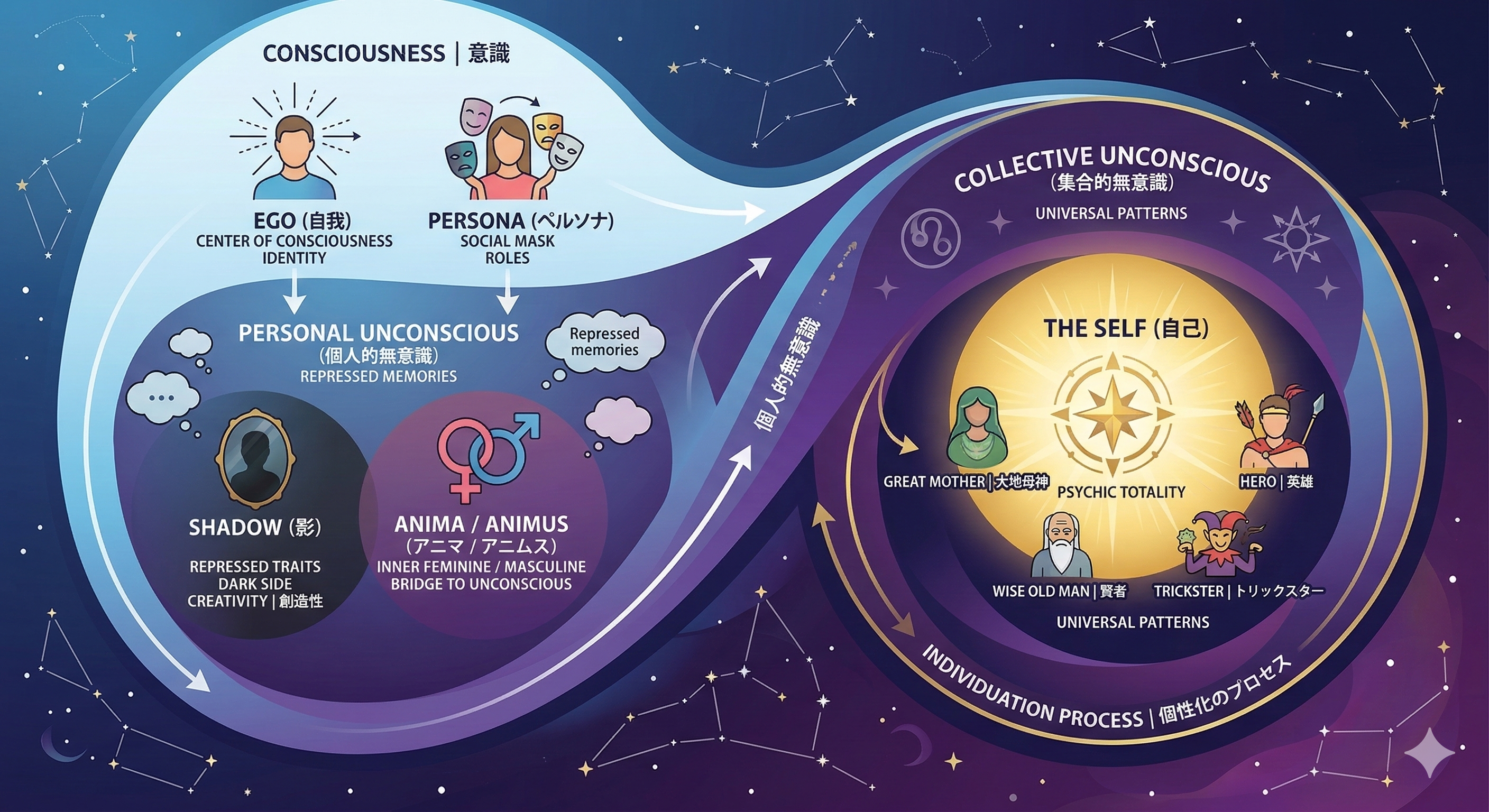
The "Map of the Soul" associated with Carl Jung models the multidimensional architecture of the human psyche like a topographical map. While Jung himself never published a single volume under that exact title, Jungian psychoanalyst Dr. Murray Stein and others systematized Jung's vast oeuvre under this evocative phrase to make the totality of the psyche accessible.
This inner cartography unfolds across concentric layers descending from the daylight surface of consciousness into the deepest abyss of the unconscious:
1. Ego: The Center of Surface Consciousness
Positioned at the outermost surface of the map is the "Ego"—what we ordinarily recognize as "I," governing everyday decision-making and adaptation to the external world. While the Ego serves as the indispensable gatekeeper of daylight awareness, it represents only a tiny fraction of the total psyche (the Self).
2. Persona: The Social Mask
The Persona is the adaptive "mask" we wear to function within society—encompassing professional roles, family responsibilities, and the faces we present to meet collective expectations. While a flexible Persona enables smooth social participation, over-identifying oneself with the Persona alienates us from our authentic inner life.
3. Shadow: The Disowned Counterpart
Directly behind everything the Ego claims as "This is who I am" lies the repressed, unacknowledged "Shadow." Jealousy, raw anger, vulnerability, and traits we wish to disown accumulate here. Yet concealed within the Shadow also lie untapped springs of vitality and creative gold; turning toward the Shadow rather than projecting or banishing it—Shadow Integration—is indispensable for genuine maturation.
4. Anima and Animus: Guides of the Soul
At a still deeper stratum reside the contrasexual archetypes: the inner feminine within a man (Anima) and the inner masculine within a woman (Animus). Frequently encountered first through projections onto others or dream figures, they function as vital psychopomps—"bridges" opening perspective beyond the Ego and leading awareness into the depths of the Collective Unconscious.
5. Personal Unconscious and Collective Unconscious
- Personal Unconscious: Forgotten experiences, subliminal impressions, and repressed biographical memories unique to the individual's life history.
- Collective Unconscious: The transpersonal stratum of primordial images and structural patterns shared across all humankind, housing the universal "Archetypes" that surface across myths, dreams, and sacred symbols worldwide.
6. The Self: Destination and Totality of the Soul
At the innermost center of the map—and simultaneously encompassing its entire circumference—stands "the Self." Whereas the Ego is merely the center of conscious awareness, the Self is "the organizing center and totality of the entire psyche, uniting both conscious and unconscious." Jung understood the deepest purpose of human life as the ongoing process whereby the Ego enters into humble relationship with this deeper Self to realize psychological wholeness—a sacred journey he named "Individuation."
What the Map Reveals: The Journey of Individuation
Jung's "Map of the Soul" is no static taxonomy. Rather, it is "a living guidebook for an inner pilgrimage"—inviting human beings not to remain stranded on the surface of Persona and Ego, but to traverse the dark woods of the Shadow and enter into conscious dialogue with the Collective Unconscious to discover their authentic center (the Self).
Understanding this inner topography illuminates where our seemingly contradictory emotions and inexplicable impulses arise from, empowering a wiser, more integrated way of living.
Below is a structured conceptual overview summarizing Jung's "Map of the Soul" from surface consciousness down to the deepest unconscious layers:
Structural Guide to the "Map of the Soul"
This inner landscape spans multiple strata, from everyday waking "Consciousness" down to the trans-biographical "Collective Unconscious":
- Realm of Consciousness
- Ego: The center of waking consciousness; the everyday sense of "I" mediating engagement with the outer world.
- Persona: The social mask; the adaptive face shaped around vocation, social role, and interpersonal expectations.
- Realm of the Unconscious
- Personal Unconscious: The biographical layer holding forgotten experiences and repressed memories accumulated across one's lifetime.
- Shadow: Situated initially within the personal unconscious (and reaching down into collective depths), comprising disowned traits the Ego refuses to acknowledge—yet simultaneously harboring hidden reservoirs of creativity and life force.
- Anima and Animus: The inner feminine within man (Anima) and inner masculine within woman (Animus), serving as the living "Bridge" leading beyond the personal unconscious into the deeper Collective Unconscious.
- Collective Unconscious: The primordial stratum of universal patterns and symbolic matrices ("Archetypes") shared across all humanity beyond individual experience.
The Pilgrimage of Individuation (Self-Realization)
At the very heart of this mandala abides "the Self." Whereas the Ego centers waking awareness alone, the Self centers the unified totality of consciousness and the unconscious alike. Jung conceived life's ultimate vocation as the process through which the Ego aligns with this deeper Self to fulfill one's whole being—termed "Individuation."
This cartography serves as "a traveler's companion" for moving beyond superficial Persona and Ego, integrating the Shadow, conversing with the Collective Unconscious, and awakening to one's deepest wholeness.
Jung and Buddhism: Comparative Correlation in the Depths of Consciousness
Separated though they are by more than two millennia, C.G. Jung and the Buddha share a profound convergence: both ventured far beneath ordinary egoic awareness into vast, transpersonal depths of mind.
1. The Collective Unconscious vs. Dependent Origination and Emptiness (Śūnyatā)
- Jung's Discovery (Collective Unconscious): Beneath personal memories and traumas, Jung uncovered a universal psychic stratum shared across humanity—the "Collective Unconscious"—populated by primordial "Archetypes" such as the Hero, the Great Mother, the Shadow, and the Wise Old Man/Woman.
- The Buddha's Insight (Śūnyatā / Emptiness): Through penetrative meditative inquiry, the Buddha realized "Dependent Origination" (pratītyasamutpāda)—that all phenomena arise and cease through interdependent causes and conditions—discovering that even the deepest universal patterns are devoid of independent, immutable substance: they are "Empty" (Śūnyatā).
- Core Point of Correlation: Both recognized universal patterns vastly transcending personal ego-awareness; yet whereas Jung mapped the symbolic "contents (Archetypes)" of the deep psyche, the Buddha illuminated the ultimate ontological "nature (Emptiness / non-substantiality)" of consciousness itself.
2. The Collective Unconscious vs. Store Consciousness (Ālayavijñāna)
- Structural Affinity: Numerous comparative philosophers correlate Jung's "Collective Unconscious" with "Storehouse Consciousness" (Ālayavijñāna) in Mahāyāna Buddhist Yogācāra philosophy, wherein latent "karmic seeds" (bījas) of past experiences and habit-energies are stored and ripen across lifetimes.
- Divergence in Methodological Orientation:
- Jung: Investigated archetypes as universal psychological "contents and meaning-structures" organizing human experience.
- Buddhism: Investigated the moment-to-moment dynamic "process" by which contents of consciousness arise and subside, exposing how grasping at them perpetuates existential illusion—and how they undergo radical transformation into wisdom (āśraya-parāvṛtti).
3. Individuation vs. Liberation (Vimukti / Nirvāṇa)
- Shared Transformative Horizon: Both traditions dissolve rigid identification with the narrow Ego to disclose an infinitely more spacious mode of Being:
- Individuation (Jung): Transcending one-sided egoic identification to realize integrated psychological "wholeness."
- Liberation (Buddhism): Complete awakening from the illusion of a separate, substantial self.
- Contemporary Clinical Synthesis: In contemporary contemplative psychotherapy, clinicians increasingly unite Jungian archetypal literacy with Buddhist mindfulness—enabling practitioners to honor symbolic energies as skillful pointers without being overwhelmed by or inflatedly identified with them.
4. Substance or Emptiness? Resolving the Paradox
- Questioning Reification: In his later years, Jung himself cautioned against reifying psychological categories into static metaphysical substances, emphasizing that concepts like the Collective Unconscious and archetypes are heuristic pointers toward an unfathomable living mystery.
- Integrative Synthesis: When the universal archetypal patterns uncovered by Jung are recognized not as rigid, self-existent entities, but as "luminous, interdependent appearances (dependently originated forms)" arising within the open expanse of empty awareness, Jungian depth psychology and Buddhist wisdom harmonize seamlessly.
Comparative Synthesis Matrix
| Dimension | C.G. Jung (Analytical Psychology) | The Buddha (Buddhism) |
|---|---|---|
| Deep Stratum of Mind | Collective Unconscious | Ālayavijñāna (Store Consciousness) / Web of Dependent Origination |
| Universal Principle | Archetypes (Hero, Mother, Shadow, etc.) | Śūnyatā / Emptiness (devoid of independent substance) |
| Primary Focus | Mapping the symbolic "contents" of psyche | Penetrating the fundamental "nature" of awareness |
| View of Selfhood | Integration into "the Self" transcending the Ego | Non-Self (Anātman — no permanent substantial self) |
| Fruit of Praxis | Individuation (psychological wholeness) | Liberation / Nirvāṇa (freedom from illusion) |
How does this comparative view resonate with you? Next, let us examine how these two complementary perspectives manifest concretely in contemporary society—across cinema, social media, and global challenges.
Jung's insight into the "Collective Unconscious (Archetypes)" and the Buddha's insight into "Emptiness (Dependent Origination)" appear intertwined across countless arenas of contemporary life. Based on the source materials, here are concrete illustrations of their interplay:
1. Cinema and Global Storytelling: Timeless Myth and Impermanence
Modern cinema—especially globally resonant mythic storytelling—vividly reflects Jungian archetypes while simultaneously embodying the Buddhist truth of "Impermanence" (anicca):
- Reimagining Universal Narratives: From ancient epics such as the Mahābhārata and the Odyssey down to the modern Marvel Universe, humanity continually retells perennial "archetypal narratives."
- Fluidity of Myth: Yet even these universal myths evolve with each era, pass away when their forms grow rigid, and are reborn anew.
- Manifestation of Emptiness: This reminds us that even the most enduring archetypes are never frozen monuments, but living, ever-changing expressions.
2. Social Media and Digital Culture: Shared Symbols and Fleeting Shadows
Social media serves as a vast contemporary arena where we witness Jung's "shared collective symbols" and the Buddha's "insubstantiality (Śūnyatā)" simultaneously:
- Connection Through Shared Symbols: Digital networks bind millions together instantaneously through viral symbols and collective emotional currents—rendering the Collective Unconscious visibly externalized in cyberspace.
- Insubstantial Patterns: Yet these viral waves arise and vanish like shadows flickering across a wall.
- Transient Phenomena: No matter how overwhelming a digital trend or collective outrage feels in the moment, it arises out of interdependent conditions and dissolves once those conditions pass—an empty, transient phenomenon.
3. Planetary Crises (Climate Change): Dissolving Rigid Fixation
The ecological crises confronting the modern world confront humanity directly with the Buddhist truth of Impermanence:
- Impermanence on a Planetary Scale: Climate transformation brings home the reality of impermanence across the entire biosphere.
- Collapse of Taken-for-Granted Premises: It exposes how fragile our most deeply entrenched collective assumption—clinging to the belief that "our familiar world will remain unchanged forever"—truly is.
4. Living an Integrated Wisdom Today: Engaging Deeply, Holding Lightly
Integrating Jungian and Buddhist perspectives offers practical wisdom for navigating contemporary life with clarity and grace:
- Skillful Engagement with Archetypal Energies: When archetypal energies such as the "Hero" or the "Perfectionist" arise within us, we can recognize them not as rigid identities defining who we are, but as functional "currents of energy" serving a specific context.
- Deep Engagement Without Clinging: We can engage wholeheartedly with universal human meanings and symbols (the Jungian movement) while holding them lightly without reification or attachment (the Buddhist movement).
- Transparent Understanding: All stories, roles, and connections are seen clearly as transparent processes—like waves rising from and subsiding back into the boundless ocean—arising through interdependent conditions and dissolving peacefully when their work is done.
Thus, in contemporary life—across newsfeeds, cinema screens, and daily relationships—we simultaneously experience the "deep subterranean connectedness (Collective Unconscious)" illuminated by Jung and witness firsthand that every arising pattern is an "insubstantial, empty phenomenon (Śūnyatā)" as taught by the Buddha.
Holding "profound interconnectedness" and "radical open-handedness" together empowers us to live richly and compassionately without being imprisoned by our own narratives.