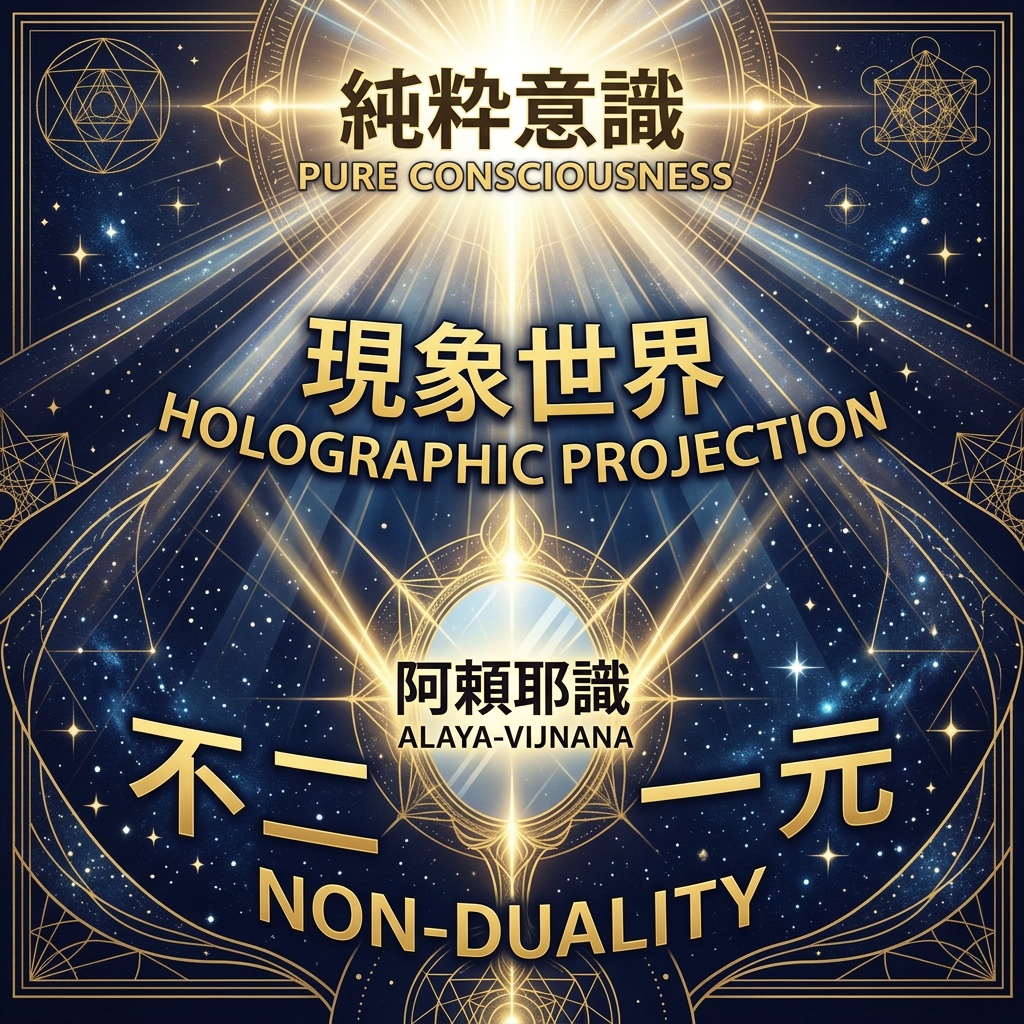
 AI Digest: Beyond "One Person's Dream Play" — Awakening Through Contemplative Insight and Returning to Pure Consciousness
Haeojuui: The Logic of Awakening and Liberation Through Contemplative Insight is a profound dialogue that elucidates the process of attaining liberation (Nirvāṇa) not through mystical trance or self-forgetting ecstatic states, but through thorough contemplation (cognitive discernment and understanding) utilizing the intellect and reason inherent in every human being.
Defining the phenomenal world not as an objective, fixed reality, but as a "succession of still frames (a hologram)" projected moment by moment by the individual unconscious (Ālayavijñāna), it reveals the crucial importance of suspending judgment toward others and phenomena, swallowing the world before oneself whole, and redeeming it from within. It bridges the logic connecting the Buddha's Pratītyasamutpāda (Dependent Origination), Yogācāra's Ālayavijñāna-Pratītyasamutpāda, Plato's Allegory of the Cave, and Advaita Vedānta (Non-duality), exploring a complete roadmap from daily awareness practices to the total surrender of self-effort (Grace) and re-absorption into the ultimate Samādhi.
Please explain in detail how the principle of "Pratītyasamutpāda" (Dependent Origination), which the Buddha is said to have realized, is logically connected to the Yogācāra doctrine that "countless latent attachments (mental impressions) flash forth in the next instant to form the world and then vanish." Please also search and reference scholarly sources.
The cosmic truth of Pratītyasamutpāda (the Law of Dependent Origination) realized by Shakyamuni Buddha and the Yogācāra doctrine (the instantaneous creation and projection model of the universe)—wherein deep consciousness instantaneously manifests and dissolves the world—are connected with supreme logical rigor in the history of Buddhism through the deepening of epistemology: moving from the negation of substantial objective existence (Śūnyatā / Emptiness) into depth-psychological epistemology.
Let us examine from multiple perspectives how these two doctrines form a single, robust logical lineage, drawing upon the viewpoint of "Haeojuui (Awakening through Rational Contemplation and Insight)" and supported by scholarly textual materials.
1. Epistemological Refinement of "Cause, Condition, and Fruit": Elevation into Ālayavijñāna-Pratītyasamutpāda
The foundational proposition of Dependent Origination presented by Shakyamuni is the principle of mutual dependence: "When this exists, that comes to be; with the arising of this, that arises. When this does not exist, that does not come to be; with the cessation of this, that ceases." The Yogācāra school refined this logic of causal arising to its utmost limit as an operating system of human deep cognition, giving rise to Ālayavijñāna-Pratītyasamutpāda (Dependent Origination from the Storehouse Consciousness).
- Bīja (Seeds) as "Direct Cause" (Hetu): In Yogācāra, the "Ālayavijñāna" at the deepest stratum of our unconscious is a vast storehouse (the warehouse of karma) where past deeds, words, and thoughts accumulate as "residual memories" and "latent impressions." These correspond to the "seeds" (bīja), which serve as the direct causes that bring about all phenomenal occurrences.
- Sparśa (Contact) and Cognitive Architecture as "Indirect Condition" (Pratyaya): The mental process (sparśa / contact) wherein the sense organs (indriya) encounter cognitive objects (viṣaya) and consciousness (vijñāna) engages them serves as the "condition" (pratyaya).
- Samudācāra (Active Manifestation) as "Fruit / Effect" (Phala): In the single instant (kṣaṇa) when the "seed" (cause) meets "contact" (condition), it flashes into being on the screen before us like a hologram, emerging as the concrete phenomenal world (samudācāra / active manifestation).
In other words, Yogācāra logically reconstructed Shakyamuni's dynamic of Dependent Origination ("Because this exists, that exists") into a unified projection-geometry model (seeds producing actual manifestation, bīja-samudācāra), wherein subject and object are indivisible.
2. The Logical Nexus of "Impermanence and Momentary Destruction (Kṣaṇa-bhaṅga)" with the "Flip-Book (Still-Frame) Model"
Shakyamuni taught that all conditioned phenomena (saṃskṛta-dharma) established through dependent origination change without remaining still for even a single moment (anitya / impermanence). The Yogācāra school (Vasubandhu, Asaṅga) and Sarvāstivāda Abhidharma substantiated this concept through the rigorous logic of Kṣaṇa-bhaṅga (Momentary Destruction)—the doctrine that all things perish the very instant they arise.
- Instantaneous Annihilation and Recreation: In the Yogācāra projection model, the world does not possess continuous, static existence; rather, it perishes and is newly created with every instant (kṣaṇa). When our mind and sense organs stitch together this ultra-high-speed flickering of "still frames," a powerful illusion of continuous reality—a hologram of time and space where events appear to flow objectively—is generated.
- The Circular Loop of Causality via "Vāsanā (Perfuming / Habitual Impression)": When we cast value judgments ("good or bad," "desirable or undesirable") upon the world projected in the preceding moment, that energy is deeply engraved into the Ālayavijñāna as a fresh "wound of impression (seed)." Just as a line deeply drawn in clay leaves a groove, this intense impression (seed) reproduces a very similar phenomenal world in the next instant. This infinite causal loop—"Ālayavijñāna (Seed) → Phenomenal World (Manifestation) → Re-imprinting onto Ālayavijñāna (Perfuming)"—is the precise logical structure of Saṃsāra (cyclical existence) taught in Buddhism, the very mechanism keeping the wheel of Dependent Origination turning.
3. The Root of Suffering and Delusion: "Avidyā (Ignorance)" and "Manas-vijñāna's Ego-Attachment"
In Shakyamuni's Twelvefold Chain of Dependent Origination (Dvādaśāṅga-pratītyasamutpāda), the root cause giving rise to every tragedy and suffering (duḥkha) of life—such as aging, death, and sickness—is Avidyā (Ignorance), the state of blindness to truth. Yogācāra logically positioned the reality of Avidyā as the functioning of the 7th consciousness, the Manas-vijñāna.
- The Illusion of Subject-Object Separation: The Manas-vijñāna constantly misidentifies the Ālayavijñāna (the underlying substrate and film generating the world) as an unchanging, permanent "I", clinging to it relentlessly. In reality, the world is a single undivided Reality (Non-duality / Advaita), nothing more than a "solo play, scripted and acted by oneself" wherein the inner unconscious projects a holographic world outwardly. Yet through this "ego-attachment" of Manas, the illusion of duality—the separation of subject and object into an "independent I" and an "externally existing world (others) outside of me"—springs forth. This is the true identity of "Avidyā" as indicated by Eastern philosophy.
- The Logic of the Cessation Gate (Nirodha-mukha): Shakyamuni taught that if the root cause, "Avidyā (this)," is extinguished, then the "phenomenal world of suffering (that)" that depended upon it is likewise extinguished (reverse contemplation / the cessation gate). Applying this to Yogācāra: when the ego awakens to its arrogance in believing "I am choosing and acting" (the ignorance of Manas), acknowledges that "all reality before my eyes is a dream play projected by my own unconscious," completely halts judgment (the clinging of Manas), and swallows and accepts the world whole within itself (transformation into the Great Perfect Mirror Wisdom, Ādarśa-jñāna), the imprinting of fresh karma (seeds) stops. The causal chain (the wandering flow of dependent origination) is completely severed, returning to the primordial tranquility (Nirvāṇa).
4. The Path to Liberation: The Paramount Importance of "Haeo (Awakening through Contemplation)"
Just as Shakyamuni, having seen the limits of asceticism and traditional meditative absorption (the ideology of cultivating concentration / Śamatha), forged a new path of reason and reflection under the Bodhi tree—"contemplating, contemplating, contemplating"—and awakened to the sudden path of Pratītyasamutpāda, completely "understanding" this logical linkage (Haeojuui: Awakening through Contemplation and Insight) is the indispensable prerequisite for experiencing liberation.
Logically seeing through the projection mechanism of the world (Ālayavijñāna-Pratītyasamutpāda) with reason and intellect (samyag-dṛṣṭi / right view, samyak-saṃkalpa / right thought), overcoming the ego's defense reactions, and embracing with one's entire being the truth of self-responsibility—that "all is a hologram generated by oneself"—serves as the decisive key to polishing away the dust of societal conventions and karmic conditioning accumulated on the mirror, returning to Pure Consciousness (Ādarśa-jñāna).
🔍 Supplementary Scholarly Research & Thematic Outlook
According to external academic treatises on Buddhist doctrine, historical developments in Mahāyāna Buddhism—such as Vasubandhu's Pratītyasamutpāda-vyākhyā (Explanation of the Dependent Origination Sūtra)—reveal that introducing the Ālayavijñāna into the interpretation of the "consciousness" (vijñāna) link of the Twelvefold Chain logically led to Yogācāra's doctrine of the Three Natures (Tri-svabhāva, such as Paratantra-svabhāva / the dependent nature). The true essence of Yogācāra thought lies in explicating Dependent Origination not as a "static concatenation of discrete elements," but as a "dynamic, non-dual representational process" occurring within the deep psyche of the individual.
I would like to know the concrete contemplative process based on "Haeojuui."
"Haeojuui" (Awakening through Insight/Understanding) is the stance that liberation (Nirvāṇa) is experienced not through sudden, miraculous occurrence driven by some external mystical force, but by thoroughly contemplating and inquiring with the "reason" and "intellect" inherent in every human being, thereby "understanding" cosmic truths—the sudden doctrines such as Dependent Origination, Non-Self (Anātman), Emptiness (Śūnyatā), and the Middle Way (Madhyamā-pratipad).
Just as Shakyamuni, reaching the end of mortification and traditional trances, determined that these were not the path to liberation from birth and death, and carved out a new approach under the Bodhi tree of "contemplating, contemplating, contemplating" to awaken to Dependent Origination, "deeply thinking, understanding, and cognizing (= the process of contemplation)" is the direct highway to enlightenment.
Based on the doctrines elucidated in the source text, here is the concrete five-step contemplative process, spanning from daily awareness reform to the deepest stratum of meditation:
Step 1: Tuning the "Inner Space (Foundation)" to Enable Clear Contemplation
When the daily mind is agitated, jumping endlessly from one object to another, it is impossible to build a clear mental foundation for deep contemplation of truth. Therefore, one must first harmonize the mind, body, and breath.
- Daily Harmonization (Yama & Niyama): Order mental habits and lifestyle conduct in daily life, establishing a strong, calm, and clear mind on a regular basis.
- Releasing Bodily Tension (Āsana): Through intentional repetition of "tension and relaxation" (exerting 100% force and then releasing it all at once), discharge the unconscious emotions and attachments accumulated in the body (muscles and joints), establishing a painless, relaxed, and immovable posture.
- Synchronizing Breath and Sensory Withdrawal (Prāṇāyāma & Pratyāhāra): As the breath is refined into a fine, deep flow, mind and body settle until guided into a state where "breathing halts naturally." When breath ceases, external noise and bodily sensations are completely severed from awareness, retaining the light of consciousness entirely within.
Step 2: Suspending Judgment and "Swallowing the World Whole (Embrace)" in Daily Life
In Haeojuui, while the five objects of the senses—form, sound, odor, taste, touch (rūpa, śabda, gandha, rasa, spraṣṭavya)—exist outside the mind, the mental objects or concepts known as "dharma" (the 6th realm) exist entirely within the mind. Among these mental objects, one performs daily contemplative work to sort out the haphazardly arising "conditioned objects (daily random thoughts)" and correctly cognize the "unconditioned objects (sudden truths)."
- Observing Automatic Reactions: Keenly observe the automatic reactions the mind unconsciously triggers in response to external stimuli (events or other people's words and deeds), shifting and applying an alternative interpretation that prevents unpleasant tension or bodily stiffness from arising.
- Halting the Ego's Judgments: Immediately cease rendering value judgments ("good or bad," "favorable or unfavorable") on the reality unfolding before you.
- Swallowing Whole Within Oneself (Embrace): Accept the absolute truth of self-responsibility—including tragic events or others' suffering—that "nothing appears on the screen (reality) other than the program (latent impressions / seeds) embedded in one's own unconscious (Ālayavijñāna) from the very beginning." Acknowledge that "all of this is a dream play unconsciously created by myself," and with heartfelt gratitude and profound love, swallow it whole and return it into one's own inner being (the True Self / origin).
(Contemplative outcome: By halting judgment, the infinite loop of re-imprinting fresh latent impressions into the Ālayavijñāna terminates, allowing the lake of the mind to become completely clear.)
Step 3: Concentrating on the "I-Consciousness" and Disappearance of the Subject
In the ultimate inner space where mind, body, and breath have fallen still, fix the focal point of concentration onto the "sense of 'I'" itself (I-consciousness, the feeling of existing, the root of the ego).
- The Inquiry "Who am I?": Focus awareness with one-pointed concentration (Dhāraṇā) upon the primordial inquiry: "Who is this 'I' asking this question?"
- Disappearance of the Subject: As concentration deepens to its extreme, the spontaneous feeling of "I who am concentrating (the active subject)" disappears, entering an advanced meditative absorption (Dhyāna) where only the object—the "sense of existing (I-consciousness)"—remains in serene stillness.
Step 4: Shifting Focus to the "Function of Pure Knowing (Prajñā)" Behind the Sense of Existing
Here, a trap awaits where many practitioners indulge in the overwhelming tranquility and pleasant bliss of the "sense of existing," mistaking it for the "True Self (Enlightenment)"—this is the "ego masquerading as the True Self (the clinging of Manas-vijñāna)." The decisive key (critical point) in Haeojuui is the application of sharp intellect (discernment) right here.
- Gently Shifting Focus: Cease concentrating on the object itself—the feeling "I exist." Instead, gently slide the focal point of consciousness "deeper," toward the very function that is quietly aware of and illuminating that sense of existing in the dark (intellect / knowing itself = Prajñā, the Great Perfect Mirror Wisdom / Ādarśa-jñāna).
- Manifestation of the Great Perfect Mirror Wisdom: Align oneself with the pure "light of knowing" that simply reflects everything as it is, undisturbed by mind or conceptual thought.
Step 5: Total Abandonment of Self-Effort and "Surrender (Grace)"
Even upon reaching the Great Perfect Mirror Wisdom (Prajñā) that reflects reality as it is, there remains a final subtle boundary (vibration) between subject and object—namely, the "single point that illuminates and knows." The process of breaking through this final boundary cannot be completed through self-effort (jiriki).
- Relinquishing Everything (Complete Surrender): Completely let go of and abandon all "meditative techniques" and "scriptural knowledge" used up to this point, and even the spontaneous intention or prayer phrase "I want to attain liberation, I want to awaken," becoming pure void.
- Dissolving into the True Self: Maintain a mind like motionless water with supreme humility, simply waiting. When this "total surrender" is fulfilled, the very boundary of "mind (water)" that served as the reflecting medium softly dissolves. Rather than crossing over by one's own strength, "the True Self (the one Reality) approaches from its side and absorbs you whole (Grace)." With this, all contemplative processes are consummated, quietly returning to the ultimate reality of "I who am one with all" (Absolute Samādhi).
Thus, contemplation in Haeojuui is not mere "intellectual chatter," but an exquisitely geometric and stepwise process of "controlling and then releasing the intellect" through observing automatic reactions, halting judgment, and shifting focus behind the I-consciousness.
How to shift focus to the "Function of Knowing (Prajñā)"
In the meditative process, shifting the focus of consciousness from the "sense that I exist (I-consciousness)" to the "function of pure knowing (Prajñā / Transcendent Wisdom) lying further behind it" is the most critical and decisive secret (critical threshold) for breaking through the deepest trap of the ego and reaching ultimate Samādhi.
Let us examine in detail how to perform this discernment and focal shift through four essential keys:
1. Keenly Seeing Through the "Ego Masquerading as the True Self" (The Art of Discernment)
As meditation deepens and the waves of daily thoughts and distractions (the ripples on the lake's surface) completely settle, a stage arrives where only an overwhelming tranquility and an exquisitely pleasant sense of bliss—"I merely exist"—remains in consciousness. Many meditators mistake this deep stillness for the "True Self (Enlightenment)," identifying with it and becoming content. However, in Haeojuui, sharp intelligence (discernment) is applied right here.
- Seeing Through the Misidentification: Realize that the state of "I exist (the sense of being)" is still nothing more than the deepest stratum of the ego (the clinging of Manas-vijñāna), occurring immediately after an extremely subtle separation between "I" and "that which is not I (world/others)" has taken place.
- Do Not Indulge: Stop indulging and resting complacently in that pleasant stillness. See through it with clarity: "This is still merely an observed object (the most subtle frame of the film)," and maintain the resolve to advance further behind it.
2. Grounding in the "Complete Cessation of Sensation" via Natural Breath Suspension
To grasp the extremely subtle and delicate realm of the "function of knowing," an entirely clear inner space devoid of any bodily or sensory noise is indispensable.
- Do Not Forcefully Hold the Breath: Rather than holding the breath by brute force, settle the mind and body to the extreme limit, naturally guiding the breath into a state of spontaneous suspension (Prāṇāyāma).
- Complete Sensory Withdrawal: When the breath naturally halts, external stimuli (sounds, lights) and bodily sensations completely vanish from consciousness (Pratyāhāra). With the light of consciousness no longer leaking outward but retained entirely within, this ultimate stillness becomes an unshakable foundation for the next step.
3. Shifting Focus from the Object (Sense of Existing) to the "Witnessing Intelligence Itself"
In this ultimate inner space where sensation has dropped away, one finally executes the focal shift. This transition is not intellectual discourse via concepts, but an advanced, intuitive discernment akin to "gently adjusting the focal distance of the lens of consciousness deeper."
- Sliding the Focus from "Foreground" to "Depth": Cease concentrating on the sense of existing itself (the object)—the sensation "I exist." Instead, gently slide the focus of awareness deeper, toward the background function that is quietly aware of and illuminating that sense of existing in the dark (intellect / knowing itself = Prajñā).
- Aligning with the Witness: Align yourself not with the observed "sense of existing," but with the very light that is observing (illuminating). This Prajñā (Wisdom) is the manifestation of the pure Great Perfect Mirror Wisdom (Ādarśa-jñāna) that simply reflects all things as they are, unhindered by mind or self-consciousness.
4. The Final Step: "Abandoning Self-Effort and Surrendering Completely"
Even when reaching the Great Perfect Mirror Wisdom (Prajñā) and becoming like a cloudless mirror reflecting everything as it is, there remains a final subtle boundary (vibration) between subject and object—the "single point that illuminates and knows." The process of dissolving this final boundary cannot be accomplished through self-effort (jiriki).
- Surrender Through Grace: Simply maintain the motionless, utterly clear water (mirror) and wait. When this "total surrender (ultimate humility)" reaches fullness, the boundary of the mind (water) that served as the reflecting medium abruptly dissolves. Rather than breaking through by one's own power, "the True Self (the one Reality) approaches from its side and absorbs you whole (Grace)." Pure Consciousness (Ātman) is thus consummated, quietly returning to the ultimate reality beyond words, time, and space (Absolute Samādhi).
💡 Daily Tip for Shifting Focus Deeper
To grasp this sensation of "shifting focus deeper," the moment you notice during meditation that "Ah, I am currently in an extremely peaceful and pleasant state (the sense of existing)," practice asking yourself: "Who (or where) is the one that is 'aware of' this pleasantness?" Turn the arrow of attention 180 degrees inward toward the depth.
What are the keys to halting judgment and swallowing the world whole?
In daily life, "suspending all judgment (value judgments) and swallowing the world before oneself whole (embracing and accepting)" is the single most potent practice for terminating the ego's repetitive loop and returning to the silence of the primordial Pure Consciousness (True Self).
To perform smoothly in daily life this process, which may appear daunting at first glance, here are the four decisive keys (mental orientation and understanding of principle):
Key 1: Thoroughly and Rationally Understand the World's "Solo Play (Scripted by Oneself) System"
The most foundational key is to overturn the very premise of how we perceive the reality before our eyes.
- Do Not Complain to the Screen: We tend to believe that the external physical reality exists "objectively and independently." In truth, however, it is nothing more than the program (latent impressions / karmic seeds) embedded deep in your unconscious (Ālayavijñāna) being projected upon the screen before you as a high-speed flickering hologram at every instant.
- Absolute Realization of Self-Responsibility: Deeply understand (Haeo) the absolute truth of self-responsibility: "Nothing can ever appear on the screen before me other than what exists in my own unconscious." Even unpleasant events happening right in front of you, or tragic occurrences in distant nations seen on the news, are "cognized and received as information" by none other than the domain (programming) of your own unconscious. Fully internalizing that "there is no independently existing external world; all of this is a solo dream play (scripted and acted by myself) projected by my own unconscious" becomes the powerful engine for all practice.
Key 2: Decisively Abandon Escapism into "Convenient Alternative Worlds (Parallel Worlds)"
When reality is unpleasant, we unconsciously tend to think: "If only I had done that back then," or "I want to shift into another, more convenient reality of higher vibration."
- Parallel Worlds Are the Ego's Evasion of Responsibility: The teaching lays bare that such mental movements of fantasizing alternative worlds and seeking to escape into them are merely the "evasion of responsibility" by the ego (Manas-vijñāna), turning away from its own projection.
- Stop Running Away: Decisively abandon the hope of finding a refuge called "another reality." What is vital is the resolute courage to assume full responsibility for the world one has received at this very moment, no matter how unfavorable it may seem.
Key 3: Recognize the Mechanism Whereby "Judgment" Automatically Reproduces the Next Hell
The moment we weigh the reality before us with value judgments ("good or bad," "favorable or unfavorable"), we fall straight into the trap again.
- Judgment Carves Fresh Wounds into the Ālayavijñāna: The moment you cast judgment (rejoicing and lamenting, reacting) upon the image (reality) appearing on the screen, that energy is instantaneously re-imprinted (perfumed) onto the film of the Ālayavijñāna as "fresh karmic scars (seeds)."
- Halt the Automatic Loop: Just as a deep line drawn in clay leaves a permanent mark, an impression carrying intense judgment will automatically reproduce a very similar, distressing scene in the next instant (or future). Understand that "if I judge here, I am reproducing the very same reality (the carousel of hell) by my own hand," and halt the mind's impulse to judge before it takes root.
Key 4: Return It to the Inner Being (True Self) with Sincere "Gratitude and Love"
After halting judgment and simply beholding reality, the sole practice to be performed is "swallowing (redemption)."
- "Only You Can Save the World You Created": Completely cease attempting to control tragic events, others' suffering, or unfavorable conditions as something outside yourself, and stop turning a blind eye to dissociate from them (evading responsibility). Deeply acknowledge: "This was brought forth by my own unconscious. Therefore, no one other than myself can redeem (dissolve) it."
- Dissolve It into the Inner Light Source (Origin): With sincere, profound gratitude, humility, and immense love, swallow those occurrences whole into your own inner silence (the True Self, the origin, the Kingdom of God) and return them home. Rather than denying and rejecting reality, embrace it within oneself and dissolve it (integration).
💡 Concrete Daily Approach You Can Practice Right Now
First, the very instant you watch distressing news or encounter unpleasant words or conduct from another person, keenly observe the automatic reaction (subtle bodily tension or tightness) that flashes through your body and mind.
Then, silently in your heart, cultivate the habit of saying:
"Ah, this is merely a program embedded from the beginning in my inner film (Ālayavijñāna), now projected upon the screen. Thank you for showing it to me. I cease all judgment and return it to where it came from (the silence within me)."
Quietly assume complete responsibility and visualize it dissolving into your inner being.
By repeating this "embrace (unconditional acceptance)," the dust that clouded the Ālayavijñāna is swept away, and the mind transforms into an unclouded, pristine mirror reflecting all things as they are (the Great Perfect Mirror Wisdom).
I would like to know the mental attitude required to invite "Surrender (Grace)."
The final stage leading into "Surrender (Self-Surrender / Grace)" is the point where even the intellectual contemplation and meditative techniques accumulated thus far must be released—the absolute limit of self-effort (jiriki). To cross this threshold and be absorbed whole from the side of the True Self (Grace), an extraordinarily refined and profound "state of being" is required.
Here are the five essential keys defining this state of being:
1. Completely Abandon Even the Final Wish (Intention) to "Attain Liberation" or "Awaken"
The most common trap into which practitioners fall is clinging until the very end to the seemingly pure desire to "attain enlightenment."
- Discard Attachment to Being "Unliberated": Ironically, liberation is brought about only by "not desiring to be liberated." As long as an intention rooted in a sense of lack—that "I am not yet liberated"—persists, it prolongs the activity of the ego under the surface.
- Let Go of Prayer Phrases and the Wish Itself: One must completely release even the spontaneous intention or desire to "awaken and be liberated," and even the inner prayer phrases themselves, becoming pure void.
2. Utterly Discard the "Techniques" and "Knowledge" That Have Aided You Until Now
In Haeojuui, understanding through correct reason and intellect (contemplation) is the path to awakening; yet only in this final step is one required to discard even the contemplative process and its tools.
- Release Attachment to the Tool: The "meditation techniques" and "scriptural knowledge" that guided you thus far are like a raft used to cross a river. Once you have reached the opposite shore, attachment to these excellent self-effort tools must be completely abandoned; all that is required is to maintain a mind as still as a motionless lake (mirror).
3. Simply Wait with "Inconceivable Humility"
At the core of surrender lies an attitude of "inconceivable humility" that far transcends everyday meanings.
- The True Meaning of "Thy Will Be Done": Jesus's final words on the cross, "Father, into your hands I commit my spirit" (self-surrender), and phrases such as "Thy will be done" and "Amen" express the unfathomable depth of this attitude of surrender beyond self-effort.
- Abandon Self-Effort 100% and "Simply Wait": Relinquish all self-effort approaches and control. Clear away even the creatures stirring in the water (the activity of latent impressions and karma in the Ālayavijñāna), maintain an utterly transparent, motionless water surface, and place yourself in the ultimate humility of "simply waiting."
4. Allow the "Boundary of Water (Mind)" to Disappear
No matter how clear the mind becomes, reflecting everything as the Great Perfect Mirror Wisdom, there still remains a subtle division between the "point that illuminates and perceives (the water's surface)" and the "sun that is reflected (the True Self)."
- Do Not Strive to Become the Sun: As long as the mind (water) is present, no matter how purified it may be, the water itself cannot become the light (the sun itself). Cease the effort to "become one with all," and allow the very boundary of "water (mind)" that acted as the reflecting medium to softly vanish—this is the mental posture of surrender.
- Know That "There Is Only That" from the Beginning: This is the posture of prostrating before and aligning with the absolute reality of Advaita (Non-duality): "It is not that there is an 'I' who ought to become one with all; there is only 'I' who am already one with all."
5. Entrust Yourself 100% to the Grace of "Being Swallowed Whole from the Side of the True Self"
Surrender is not an active leap that you take toward somewhere else; it is the pinnacle of passivity: simply allowing yourself to "be approached from the side of the True Self (the one Reality) and swallowed whole (Grace)."
After carrying active sovereignty to its extreme through daily practice—realizing that "the savior is none other than oneself (swallowing without judgment the world manifested by one's own unconscious)"—in the ultimate moment, one reduces the ego to complete "zero (nothingness)" and entrusts everything to the gravitational pull of the Great True Self, returning into Absolute Samādhi.
What kind of state is the "Ultimate Reality" that is said to arrive after "Surrender"?
The "Ultimate Reality (Absolute Samādhi)" ushered in by Grace beyond the limit of self-effort is the supreme state of awakening in Buddhist and Eastern philosophy, completely transcending human words, contemplation, and even space and time.
Let us explore this state from four perspectives:
1. "Simultaneous Vanishing of Object and Consciousness (Viṣaya-vijñāna-prahāṇa)" Where Even the Boundary of the Mirror Dissolves
In previous steps, the mind swept away all karmic dust and was purified into a cloudless mirror (the Great Perfect Mirror Wisdom / Ādarśa-jñāna) reflecting the cosmos as it is. Yet no matter how crystal clear it was, an extremely subtle duality remained between the "reflecting mirror (water)" and the "reflected sun (True Self)."
- Complete Cessation of Subject and Object: What arrives at the moment of surrender is the sudden disappearance of the boundary of "water (mind / mirror)" that served as the reflecting medium. In Yogācāra, this state where both the reflected object (external realm) and the reflecting consciousness (mind) simultaneously vanish is called "Viṣaya-vijñāna-prahāṇa (the mutual dissolution of object and consciousness)." The final thin veil separating oneself from the world tears away, and the confrontation between subject and object is eradicated at its root.
2. Manifestation of "I Who Am One with All (Advaita / Non-Duality)"
We ordinarily strive to "become one with all (to integrate)," but in Ultimate Reality, the very subject (ego) attempting that effort does not exist.
- Absolute Awakening to Advaita: What remains is the absolute truth: "It is not that there is an 'I' who must become one with all; there is only 'I' who am one with all." One awakens to the reality that neighbor, world, and cosmos were never separate, but the undivided, peerless One Reality (the True Self / Ātman). Rather than oneself dissolving into the world, one is filled with absolute peace knowing that from the very beginning, there was only "This (the One Reality)."
3. The "Primordial Silence (Void)" Where the Hologram of Time and Space Has Vanished
The holographic projection system of the "flip-book (ultra-high-speed flickering of still frames)"—wherein the Ālayavijñāna (latent impressions) manifested time, space, and the material world instant by instant—comes to a complete halt.
- Absolute Emptiness as This Very Moment: Mental fantasies of past, future, or convenient alternative worlds (parallel worlds) are swept away, leaving only the absolute reality of "this very moment." This is the return to the "primordial silence (the Void / Kingdom of God / Paradise)" prior to the beginning of creation (the flickering light of consciousness) allegorically depicted in the Old Testament—complete Nirvāṇa (Emptiness) transcending all conditioned change.
4. "Stainless, Everlasting Bliss (Anāsrava-dhātu)" Transcending Thought
This Ultimate Reality is not a mere "blank nothingness." It is replete with dynamic, ineffable bliss that manifests only when the activity of the ego has fallen entirely silent.
- The Dharma of the Buddha as the Great Perfect Mirror: As a result of eradicating attachment to self (kleśāvaraṇa / obstacle of afflictions) and attachment to external objects (jñeyāvaraṇa / obstacle to knowledge), the Ālayavijñāna undergoes complete fundamental transformation (āśraya-parāvṛtti). As recorded in Yogācāra treatises, this is the "stainless realm (Anāsrava-dhātu), transcending conceptual thought, supreme good, immutable and everlasting, overflowing with joy"—a state of the absolute, unshakable liberation body (the Dharma of the Buddha) far surpassing any temporary emotional high.
Upon reaching this Ultimate Reality, the meditator no longer exists as an "individual self observing the world." One dissolves completely into the truth that one was the sole spectator, the stage, the actors, and the very light (Pure Consciousness) illuminating the grand solo drama of the universe all along.
What role does contemplation play in reaching that Ultimate Reality? How far can one awaken through contemplation?
In "Haeojuui," the role played by contemplation (inquiry) and the limit of what can be attained through it (how far one can awaken) are defined with supreme precision:
1. The Decisive Role Played by "Contemplation (Inquiry)" in Reaching Ultimate Reality
In Haeojuui, awakening is not a mystical trance, but "deeply thinking, understanding, and cognizing (comprehending)." Just as Shakyamuni abandoned mortification and traditional absorptionism (Śamatha cultivation) as "not the path to liberation from birth and death" and engaged in "contemplating, contemplating, contemplating" beneath the Bodhi tree to comprehend the Law of Dependent Origination, thorough contemplation through reason and intellect is the only direct highway to experiencing liberation (Nirvāṇa).
Specifically, contemplation plays a decisive role at three stages:
- Becoming the "Sword of Truth" That Slashes Through Ignorance: We normally reside within "Avidyā (fundamental misconception)"—the belief that time, space, and others exist objectively. To sever this illusion and internalize the absolute truth that "the world is a holographic projection (a solo dream play scripted by oneself) manifested instant by instant from the latent impressions of one's own unconscious (Ālayavijñāna)," sharp rational contemplation (a Copernican revolution of consciousness) is indispensable.
- Halting Judgment and Terminating the Infinite Karmic Loop: The moment we judge reality as "good or bad," that energy is re-imprinted (perfumed) onto the Ālayavijñāna as fresh karmic seeds, automatically reproducing the same reality in the next instant. Rationally penetrating this cyclical system, halting all judgment, and swallowing reality whole within oneself (transforming the Ālayavijñāna into the Great Perfect Mirror Wisdom) is also the work of contemplative reason.
- Seeing Through the Deepest Trap of the Ego (Discernment): Penetrating the final trap of the ego (Manas), which mistakes the "sense of merely existing" appearing in deep meditation for the "True Self," and gently shifting the focus of consciousness toward the "function of pure illuminating and knowing (Prajñā / Transcendent Wisdom)" behind it, is also contemplation refined to its utmost limit.
2. How Far One Can Awaken Through Contemplation (Self-Effort) — The Limits and Critical Threshold of Thought
The furthest boundary reachable through contemplation (the conscious regulation of cognition via reason, intellect, and self-effort) is the establishment of the "Great Perfect Mirror Wisdom (Prajñā / the function of pure witnessing and illuminating)", wherein the Ālayavijñāna (the turbid storehouse of karmic seeds) is thoroughly clarified into a cloudless mirror reflecting all phenomena as they are.
However, this is the "absolute limit (critical threshold)" of contemplation.
- The Final Vibration (Boundary) Remaining in Contemplation: Even upon reaching the Great Perfect Mirror Wisdom (Prajñā), there still remains the subtle boundary of "a single point of a subject that illuminates and perceives." As long as the mind (water) is present, no matter how clear the water is and how beautifully it reflects the sun upon its surface, the water itself cannot become identical with the true sun in the sky (the light itself / the reality of Advaita).
- Completely Relinquishing the Framework of Contemplation (The Raft): To pierce this final thin veil (the division between subject and object) and dissolve into the complete "One Reality (True Self)" (Viṣaya-vijñāna-prahāṇa / Absolute Samādhi), one must completely surrender and release all "fruits of contemplation," "scriptural knowledge," "meditation techniques," and even the spontaneous intention or wish to "attain awakening and liberation."
- Absorption Through Grace: When one gives up self-effort 100%, becomes empty space (motionless, crystal-clear water) with supreme humility, and simply waits, the boundary of water (mind) that acted as the reflecting medium softly dissolves. Rather than crossing the boundary by one's own strength, "the True Self (the One Reality) approaches from its side and absorbs you whole (Grace)." Thus, all processes are consummated, dissolving into Ultimate Reality.
Conclusion
Contemplation is the "raft" that carries you to the gateway of Ultimate Reality (Samādhi). Neglecting contemplation (understanding) prevents you from even reaching the gate; yet if you continue clinging to contemplation after reaching the gate, you cannot pass through it.
At the critical threshold of exhaustive contemplation, surrender contemplation itself. This is the flawless roadmap to awakening revealed by Haeojuui.
Please create a "Haeojuui Meditation Roadmap (Study Guide)" that systematically outlines the full picture of the "Roadmap of Awakening Through Contemplation (from daily tuning to ultimate Samādhi and surrender)" walked by Shakyamuni, so that I can intuitively review it at any time and apply it to daily introspection and practice.
We have created the "Haeojuui Meditation Roadmap (Study Guide)", which systematizes the path walked by Shakyamuni Buddha. In addition to outlining the entire process—from daily attunement of mind, body, and breath, to concentration on I-consciousness, focal shift to Prajñā (the function of knowing), and ultimate surrender (Grace) and absorption into Samādhi—it compiles four practical daily exercises for intuitive review.
Haeojuui Meditation Roadmap: Study Guide to the Steps Toward Pure Consciousness
This guide presents a modern reconstruction of the process of "Awakening Through Contemplative Insight" walked by Shakyamuni Buddha. It systematizes the logical and practical steps from daily mental tuning and the purification of the unconscious (Ālayavijñāna), to the ultimate dissolution into Reality (Samādhi) through the total relinquishment of self-effort.
1. The Foundation of Haeojuui: The World as "Your Own Solo" Dream Play
Haeojuui (Awakening through Insight/Understanding) is the standpoint of attaining liberation not through mystical ecstasy, but through profound "contemplation (inquiry)" and "understanding" via the intellect and reason. What Shakyamuni awakened to beneath the Bodhi tree was the logical understanding of the cosmic law of Dependent Origination.
1.1 The World's Projection Model
The world we experience is not an objective substance, but a hologram projected from the latent attachments (latent impressions) residing in the depths of our unconscious.
| Element | Role | Description |
|---|---|---|
| Ālayavijñāna (Film) | Storehouse of Latent Impressions & Karma | The repository of programming where the configurations, qualities, and unfolding of the cosmos up to its outermost edges are stored. |
| Pure Consciousness (Light Source) | True Self (Ātman) | The light of awareness that shines through the film from behind, purely illuminating and cognizing. |
| Phenomenal World (Screen) | Hologram / Solo Dream Play | A succession of creation and annihilation occurring with every instant (kṣaṇa). Still frames resembling a flip-book animation. |
1.2 Parallel Worlds as "Evasion of Responsibility"
The notion of parallel worlds—hoping for "another convenient world"—is merely an "evasion of responsibility," turning away from the truth that the reality before oneself was produced by one's own unconscious. The only true redemption is to swallow the projected world whole within oneself and return it to its primordial silence.
2. The Meditation Roadmap: 6 Steps to Pure Consciousness
Meditation is a process that begins with daily preparation and progressively shifts the focus of consciousness into deeper strata.
STEP 01: Daily Tuning (Yama & Niyama)
Quiet the ripples of the daily mind to enable sustained, profound contemplation. Calm the habitual tendency of chasing external objects and lay the groundwork for clear intelligence.
STEP 02: Bodily Tension Release (Āsana)
Unconscious emotions and attachments (tensions) accumulate in the body's muscles and joints. Release these through intentional cycles of "tension and relaxation," establishing a relaxed, immovable posture.
STEP 03: Breath Synchronization & Sensory Withdrawal (Prāṇāyāma & Pratyāhāra)
Calm the body and mind by refining the breath into a fine, long stream. When regular training leads to "natural breath suspension," external stimuli (sounds, smells, physical sensations) are severed from awareness, bringing about complete inner immersion.
STEP 04: One-Pointed Concentration (Dhāraṇā)
In the inner space where external noise has vanished, sustain unwavering concentration upon a specific subtle object. This trains the mind to exclude all extraneous thought forms.
STEP 05: Concentration on "I-Consciousness" & Disappearance of the Subject (Dhyāna)
Shift the object of concentration to the "sense of 'I'" itself (I-consciousness, the feeling of existing, the root of the ego). Investigating the question "Who am I?" to its depth, the "concentrating I (subject)" eventually vanishes, leaving only the object—the "sense of existing"—in stillness.
STEP 06: Shifting Focus & Surrender (Samādhi)
Shift focus deeper, behind the remaining "sense of existing," to the "function of pure knowing (Prajñā / Great Perfect Mirror Wisdom)." Finally, completely release even the wish to "awaken" (surrender), dissolving into the primordial True Self through Grace.
3. Four Daily Practices for Consciousness Transformation (Polishing the Mirror)
These are daily practices designed to support depth in meditation and wipe away the dust (karma) accumulated on the mirror of the Ālayavijñāna.
- Practice 1: Observing Automatic Reactions and Transforming Interpretation
Keenly observe the exact moment when the mind automatically contracts (tenses) in response to external stimuli. Recognize habitual reactive patterns and consciously apply a higher-dimensional interpretation to prevent unpleasant tension. - Practice 2: Halting Judgment and Embracing / Swallowing Whole
Completely suspend value judgments ("good or bad") toward the world. Acknowledge distressing news and others' suffering as "a dream play projected by one's own unconscious," assume full responsibility without evasion, and swallow them whole into one's inner being (the True Self) with deep gratitude. - Practice 3: Repetition of Intentional Tension and Relaxation
A somatic approach to stripping away deeply ingrained subconscious tension. Exert 100% force throughout the entire body to reach maximum contraction, then release it all at once into complete relaxation. Repeating this wave polishes the mind and body into a clear mirror. - Practice 4: Giving Away All Good Things
Shatter the ego's possessiveness and sense of separation ("I must be satisfied before I can give"). Generously give away whatever good things (health, peace, love) reside within oneself in this moment to the shadows on the screen—the external others.
4. Structural Analysis: Yogācāra Philosophy and Plato's Cave
The roadmap of Haeojuui is structurally congruent with profound philosophies across East and West.
| Concept | Yogācāra Philosophy (Ālayavijñāna-Pratītyasamutpāda) | Plato's "Allegory of the Cave" |
|---|---|---|
| Surface Illusion | Samudācāra (Active images on the screen) | Shadows on the wall |
| Source of Projection | Bīja (Latent impressions / Karma) | Puppets / statues on the parapet |
| Light of Projection | Pure Consciousness (Light source) | The fire behind the wall |
| Ego's Resistance | Clinging of Manas-vijñāna | Dazzle, pain, and vertigo when turning around |
| Ultimate Reality | Tathatā / Ādarśa-jñāna (True Self) | The sun outside the cave |
| The Awakened One's Mission | Redemption by swallowing the world whole | Returning into the cave to liberate fellow prisoners |
5. Conclusion: Awakening as the Savior
"Only you can save the world you created."
The process of meditation is the intellectual deconstruction of the story of separation between "I" and "the world" fabricated by the ego. Through daily practices, one halts the engraving of fresh "wounds (karma)" upon the Ālayavijñāna, and through meditation, one traces consciousness back to the source of light. When the final vestige of self-effort is cast aside, the mirror (mind) undergoes transformation into the Great Perfect Mirror Wisdom that reflects all things exactly as they are.
At that moment, the striving "I who must become one with all" comes to an end, returning into the absolute silence of "I who am already one with all (Advaita / Non-duality)."