
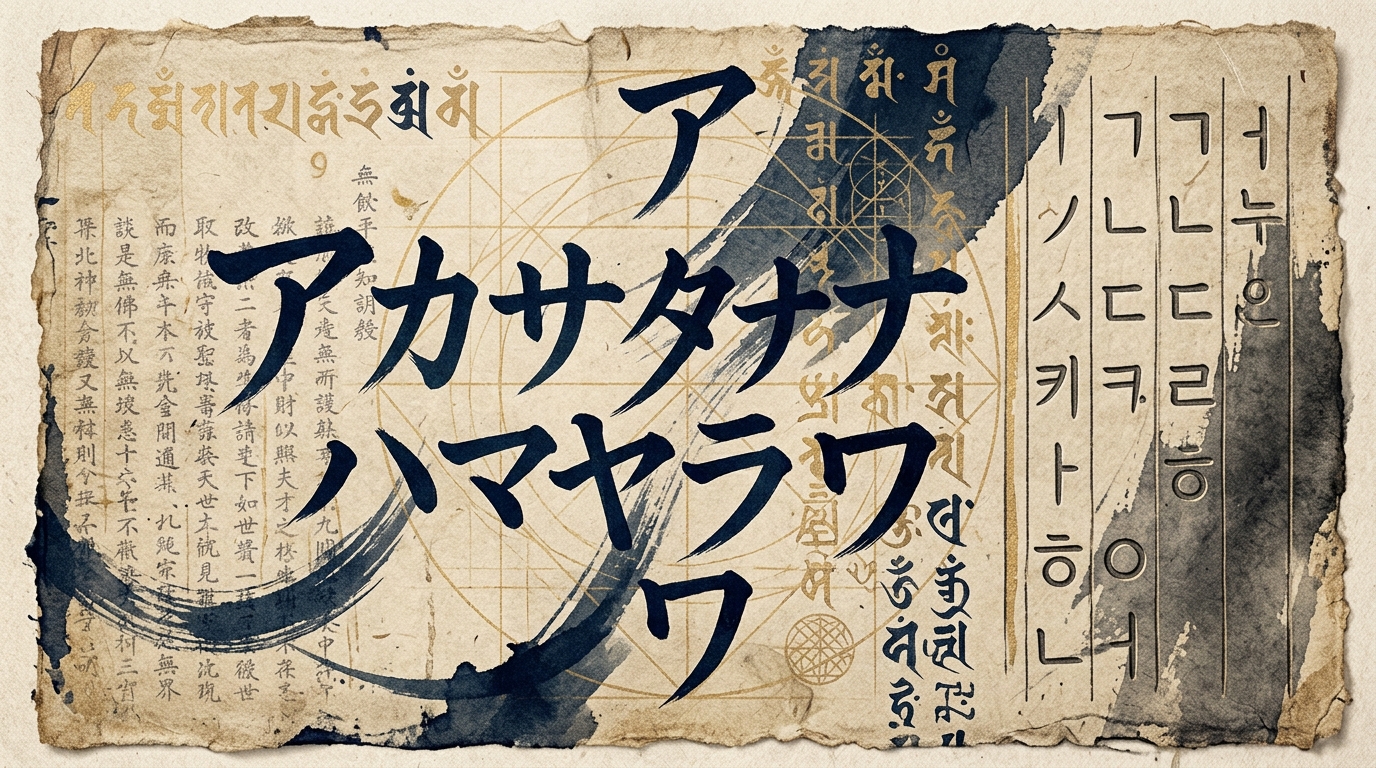
Contents — Architecture of This Dialogue
- Act 1: The Initial Spark — "Could Katakana Be a Geometric Cipher of Consonants and Vowels?"
- Act 2: Testimony of Ancient Manuscripts — Is the "Abbreviated Kanji Theory" a Retroactive Cover Story?
- Act 3: Mirage of the Age of the Gods — The Awa no Uta and Edo Nativist Scholars' Jindai Moji Craze
- Act 4: The Cognitive Trap of Script Geometry — Pareidolia in the "Hebrew-Katakana Common Origin Theory"
- Act 5: The Authentic Historical Plot Twist — Silla's "Invisible Stylus Script (Kugyol)"
- Act 6: The Dual Architecture of Wisdom — Why Didn't Japanese Monks Turn Consonants and Vowels Into an Alphabet?
- Act 7: The Supreme Prayer — The Genius Monk Who Handed the People a "Poem of Awakening (Iroha)" Instead of a Scientific Chart
- Epilogue: Beyond Speculation — What 1,200 Years of Devotion to Script Bequeathed to Us
- Special Appendix: Comparative Matrix of Ancient East Asian & Near Eastern Scripts
- Glossary: Key Concepts in Historical Linguistics & Buddhist Phonology
Special Appendix: Comparative Matrix of Ancient East Asian & Near Eastern Scripts
A comprehensive synthesis of the typology, date and region of origin, design principles, and actual historical relationship to Japanese and Katakana for every script and phonological system explored in this dialogue.
| Script / Phonological System | Date & Region of Origin | Typology | Design Principle & Origin | Actual Historical Relationship to Japanese & Katakana |
|---|---|---|---|---|
| Katakana (片仮名) | Early 9th Century Japan (Early Heian) |
Syllabary / Moraic Script | Created for vernacular reading of Classical Chinese (Kanbun kundoku) by abbreviating components of regular-script Man'yōgana Kanji to 1–3 strokes. | — (Primary Subject of Inquiry) |
| Kugyol (口訣) | Mid-8th Century or Earlier Silla (Ancient Korea) |
Syllabic & Grammatical Glosses | Abbreviated Kanji radicals pressed via stylus (kakuhitsu) or ink for vernacular sutra reading; extant in 8th-c. Silla Mahāparinirvāṇa Sūtra, etc. | [Technological Precursor / Cognate Tradition] Strikingly identical in glyph shape and grammatical function. Either direct transmission of reading technology from Silla to Japan or convergent evolution within shared Buddhist networks. |
| Gojūon-zu (五十音図, 50-Sound Grid) | 10th–11th Century Japan (Mid/Late Heian) |
Phonological Matrix (Phonetic Grid) |
Imported ancient Indian Sanskrit articulatory phonetics (Siddham studies), ordering rows systematically from throat (glottal/velar) to lips (labial). | [Phonological Blueprint] A theoretical phonetic grid rather than a script; guarded as Esoteric Buddhist transmission and later celebrated by Edo Nativist philologists to explain Japanese verbal inflection. |
| Iroha Uta (いろは歌) | Late 10th–11th Century Japan (Mid-Heian) |
Calligraphy Primer Poem / Perfect Pangram | Incorporates all 47 morae once without repetition while poetically transcreating the Mahāparinirvāṇa Sūtra's Verse of Impermanence in 7-5 meter. | [Supreme Pedagogical Poem of Awakening] Concealing Sanskrit phonological mastery within, gifted to the populace not as a dry chart, but as a living Buddhist poem of liberation. |
| Hangul (訓民正音, Hunminjeongeum) | Created 1443 CE Joseon Korea (King Sejong) |
Featural Alphabet | Scientifically engineered from vocal-organ cross-sections (consonants) + I Ching Heaven-Earth-Humanity triad (vowels) + 'Phags-pa syllabic block framing. | [Independent Masterpiece] Not derived from Katakana. Ironically inspired Edo-period Tsushima Shinto priests to imitate Hangul letters in fabricating Ahiru Moji. |
| Awa no Uta (あわの歌, Hotsuma Tsutae) | Legend: Age of Gods History: Late 18th c. (Edo) |
Mythic Pangram Hymn | Transmitted in Woshite script; composed in the post-medieval 48-sound system after the disappearance of Old Japanese's 8-vowel distinctions. | [Early-Modern Kotodama Hymn] Historically an 18th-century composition, yet cherished today as a resonant vocal chant harmonizing breath and articulatory vibration. |
| Ahiru Moji (阿比留文字, Jindai Moji) | 17th–18th Century Tsushima (Edo Japan) |
Alphabetic Script (Apocryphal) | Created by Shinto priests on Tsushima Island by directly imitating and adapting the consonant and vowel letters of Korean Hangul. | [Chronological Inversion] Mistaken by late-Edo Nativists for Katakana's ancient ancestor, when in fact it is an Edo-era adaptation of Hangul—800 years younger than Katakana. |
| Hebrew Script (Square Aramaic Script) | 3rd–2nd Century BCE+ Ancient Near East (Judea) |
Consonantal Alphabet (Abjad) |
Semitic consonantal script descended from Phoenician via Imperial Aramaic, characterized by rectilinear strokes and right angles. | [100% Coincidental Resemblance] Cited in Japanese-Jewish common ancestry lore, yet purely a probabilistic optical illusion (pareidolia) inevitable between minimalist square scripts. |
Glossary
Essential Concepts for Deepening Understanding of Historical Linguistics, Paleography, and Buddhist Phonology
1. East Asian Reading Technologies & Paleography
Kugyol (口訣)
Kugyol / Ancient Korean Vernacular GlossingFormed by paring down Kanji radicals and components, Kugyol exhibits astonishing similarity to Japanese Katakana in both glyph morphology and grammatical usage. The year 2000 discovery of 8th-century Silla stylus Kugyol sparked a landmark reassessment of the origins of Katakana.
Kakuhitsu (角筆, Ivory/Bamboo Stylus)
Kakuhitsu (Dry-Point Stylus)Devised to annotate sacred Buddhist sutras and classical texts without staining them with black ink, stylus marks become legible only when oblique raking light casts shadows across the paper grooves. Decipherment of stylus manuscripts led by Prof. Yoshinori Kobayashi revolutionized the history of ancient East Asian literacy.
Kanbun Kundoku (漢文訓読)
Vernacular Reading of Classical ChineseIndispensable for rendering Classical Chinese (an isolating SVO language) directly into Japanese or Korean (agglutinative SOV languages), the pressing need for rapid interlinear glossing gave birth to both Silla Kugyol and Japanese Katakana.
2. Buddhist Phonology, Philosophy & Spiritual History
Mujō-ge (無常偈, The Verse of Impermanence / Verse of the Himalaya Youth)
Mujō-ge / Mahāparinirvāṇa Sūtra StanzaRooted in the Jātaka account of Śākyamuni's past life as an ascetic youth in the Himalayas (Setsuzan Dōji) who vowed to offer his own body to a demon in exchange for hearing the stanza's liberating conclusion, these four lines were luminously transcreated into the 47-mora Japanese Iroha poem.
Siddham Studies (悉曇学, Shittan-gaku)
Siddham Script & Sanskrit PhonologyIntroduced to Japan in Esoteric Buddhism to ensure the exact phonetic recitation and spiritual efficacy of mantras and dhāraṇīs, it was developed by masters such as Kūkai, Ennin, and Myōgaku. Its anatomical grid—ordered from glottal/velar throat sounds forward to labial lip sounds—became the direct structural matrix of Japan's Gojūon-zu.
Early Japanese Special Kana Usage (上代特殊仮名遣い)
Jōdai Tokushu Kanazukai (Old Japanese 8-Vowel Distinction)Rediscovered in modern philology by Shinkichi Hashimoto, these distinctions were rigorously maintained in the Man'yōgana orthography of the Kojiki (712) and Man'yōshū before merging into the modern 5-vowel system from the Heian period onward. The complete absence of Type A/B distinctions in the Awa no Uta provides decisive linguistic proof of its post-ancient composition.
3. Script Typology & Linguistic Structure
Syllabary vs. Alphabet (音節文字と音素文字)
Syllabary / Moraic Script vs. Phonemic AlphabetBecause Japanese Katakana is a moraic syllabary where カ represents [ka] as an indivisible whole, it cannot be internally split into a [k] stroke and an [a] stroke; whereas the Latin alphabet, Korean Hangul, and Hebrew are phonemic scripts separating consonants and vowels.
Featural Script (特徴素文字)
Featural Writing SystemKorean Hangul is the world's quintessential featural script: its basic consonants depict anatomical cross-sections of the vocal organs, and strokes are systematically added (the principle of gahwa / 加画) to indicate stronger aspiration.
'Phags-pa Script (パスパ文字 / 八思巴字)
'Phags-pa Square ScriptEngineered as a universal imperial script to transcribe Mongolian, Chinese, Uyghur, and Tibetan, it arranged letters vertically into angular syllabic blocks. Transmitted to the Korean Peninsula during the Goryeo era, its geometric block aesthetics are widely considered to have influenced Hangul's syllabic block layout.
4. Intellectual History, Mythic Discourse & Cognitive Perception
Jindai Moji (神代文字, "Scripts of the Age of the Gods")
Pseudo-Archaic Japanese ScriptsChampioned fervently by late-Edo Nativist (Kokugaku) and Restoration Shinto thinkers seeking to assert Japanese cultural primordiality independent of China, archaeological and philological scholarship has demonstrated them to be post-medieval creations—several modeled directly after Korean Hangul.
Japanese-Jewish Common Ancestry Theory (日ユ同祖論)
Nichi-Yu DōsoronOriginating with Meiji-era writer Norman McLeod, it cites visual resemblances between Katakana and Hebrew square letters, perceived parallels between Shinto shrines and ancient Israelite sanctuaries, and phonetic wordplay—though completely unsupported by historical linguistics, paleography, or population genetics.
Pareidolia (パレイドリア / 認知の錯視)
Perceptual Pattern-Recognition IllusionWhen two minimalist square scripts built strictly out of straight lines and right angles—such as the 22 Hebrew letters and ~50 Katakana glyphs—are placed side by side, mathematical probability guarantees several look-alikes, prompting human pattern-seeking perception to project an ancient genealogical connection onto sheer coincidence.