Mathematical Philosophy: The System of Awakening

AI Digest: A Non-Dual Systems Theory Where Mathematical Science and Contemplative Philosophy Converge

What happens when we rigorously model the lived mystery of "consciousness" and "heart-mind" through the precision instruments of higher mathematics and modern generative AI architectures? Beginning from vector directionality (craving and attachment), this dialogue expands its horizon into degrees of freedom and geometric "coordinate invariance."

It goes on to illuminate the supreme Buddhist realization of Awakening (Śūnyatā / Emptiness) and compassionate action through the lenses of manifold learning at the limit, conditional generative models (decoders), and "Dharmic Alignment." What emerges is an unprecedented structural theory of consciousness in which contemplative wisdom and mathematical science resonate in seamless harmony.

Inquirer

If we express "awakening" (satori) or "non-dual consciousness" as taught in Buddhism and related traditions using the language of mathematical physics—such as vectors, tensors, degrees of freedom, and dimensions—what kind of model emerges?

Describing "Awakened Consciousness" with the Tools of Mathematical Physics

Modeling the Buddhist realization of "awakened consciousness" and Śūnyatā (Emptiness) through the systems language of mathematics and theoretical physics is an extraordinarily illuminating endeavor. When we express the state in which human consciousness sheds the artificial boundary conditions of the ego and resonates with the wholeness of reality, an astonishingly elegant architecture comes into view.

1. Awakening in Vector Space: "The Zero Vector as Origin (Universal Invariant)"

Everyday dualistic awareness is continually composed of vectors of attachment possessing both magnitude and direction aimed at specific objects: "I want that" (craving) or "I despise this" (aversion).

  • Ordinary Consciousness: Countless directed vectors corresponding to emotions, sensory impulses, and desires fluctuate violently and interfere with one another within the system—manifesting as inner conflict.
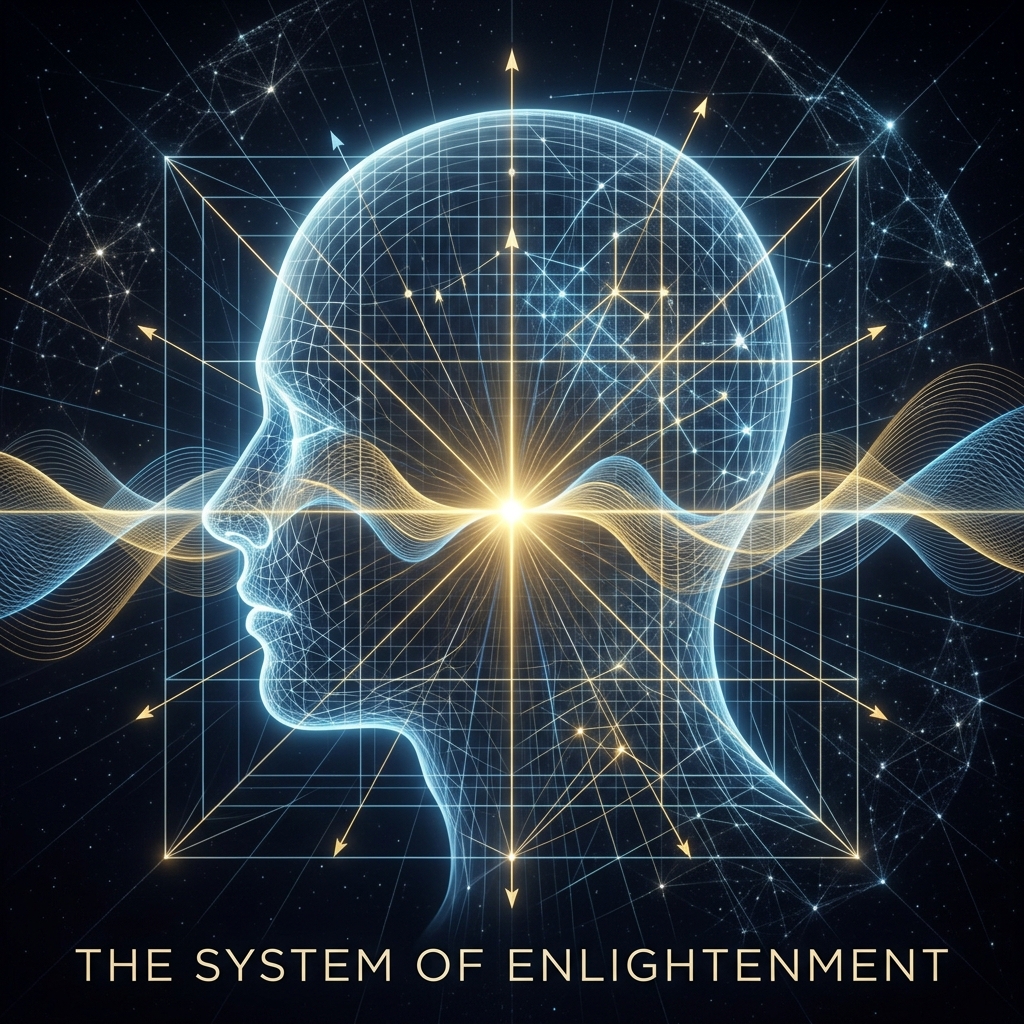
  • Awakened Consciousness: A state completely liberated from every partisan directionality (bias or fixation). Mathematically, this can be expressed as the "Zero Vector"—which has zero magnitude and no preferential direction—or as the "Origin" of the entire vector space.
    [Mathematical-Philosophical Deepening] The zero vector is by no means mere "blank nothingness." It is the sole invariant point preserved under every linear transformation—the central nucleus out of which all vectors arise and into which all vectors return. Precisely because it stands equidistant and impartial toward every direction (the Wisdom of Equality, Samatā-jñāna), it serves as the dynamic origin capable of maintaining unshakeable harmony and peace with all directions simultaneously.

2. Awakening in Terms of Degrees of Freedom: "Phase Transition to Infinite Dimensions via the Dissolution of Boundary Conditions"

Our ordinary conscious life is hemmed in by an immense set of "boundary conditions" (constraints)—bodily habits, linguistic categories, autobiographical memory, and social conditioning—that restrict its lived responsiveness.

  • Ordinary Consciousness: Confined by the rigid egoic boundary condition ("I am this sort of person"), the system is trapped within an exceedingly narrow number of degrees of freedom, oscillating endlessly between elation and distress.
  • Awakened Consciousness: The state in which the boundary wall of the ego dissolves. Because artificial systemic constraints vanish to the limit, the "degrees of freedom" of consciousness approach infinity (∞).
    [Mathematical-Philosophical Deepening] This corresponds to a "Phase Transition" in physics. The frozen, rigid lattice of egoic order melts away, and consciousness attunes itself to the boundless "Unified Field" of totality. As limiting constraints fall away, the state space itself opens into infinite dimensionality.

3. Awakening in Tensor Analysis: "A Coordinate-Invariant (Generally Covariant) Tensor Field"

Lived experience weaves together "five senses × affective tone × memory × context" in nonlinear interplay like a high-rank tensor. Awakened consciousness shifts from identifying with isolated entries to becoming the overarching field that encompasses the entire structure.

  • Ordinary Consciousness: Identifies with and clings to local, fleeting cross-sections of tensorial data—such as "I feel sad right now" (an affective vector) or "I am looking at this" (a visual matrix).
  • Awakened Consciousness: Rather than being an isolated datum, awareness realizes itself as the underlying "space itself" within which everything from rank-0 scalars to infinite-dimensional tensors arises and subsides—namely, a mathematical "Tensor Field."
    [Mathematical-Philosophical Deepening] In differential geometry, a tensor possesses the decisive property of general covariance (coordinate invariance): no matter what coordinate system one chooses, the intrinsic reality it represents remains unchanged. Awakening means stepping free from the distorted filter of a "local egoic coordinate system" (self-centered perspective) and awakening to reality as it is—independent of any partial viewpoint, as the coordinate-invariant tensor field itself.
💡 Conclusion: Infinity Resolved into a Pure Scalar

To synthesize this mathematically and philosophically, awakened consciousness can be defined as "a limit state that possesses an infinite-dimensional expanse of degrees of freedom (universal integration) while simultaneously resting like a zero-dimensional scalar (pure pre-reflective presence—a dimensionless point) stripped of every trace of attachment."

Being everything (infinite dimensions) and simultaneously nothing graspable (zero-dimensional Emptiness): the Mahāyāna Buddhist dictum "Form is emptiness, emptiness is form" (Rūpaṃ śūnyatā, śūnyataiva rūpam) embodies the exact logic of a mathematical limit.

Inquirer

Could you describe the "process of contemplative practice" leading up to awakening by analogy with mathematical algorithms of "dimensionality reduction" and "manifold learning" in information science?

Contemplative Practice as "Dimensionality Reduction"

Understanding the roadmap of spiritual practice (sādhana) through the lens of "Dimensionality Reduction" in data science offers a remarkably clear and penetrating structural analogy.

The essence of dimensionality reduction lies in stripping away vast quantities of high-dimensional noise (superfluous proliferate data) in order to uncover the genuinely essential underlying structure. Mapped onto the stages of contemplative practice, this unfolds as a refined progression:

🌪️ [Initial State] The Ordinary Mind = Noisy, Ultra-High-Dimensional Sparse Data

Prior to contemplative training, our mind resembles ultra-high-dimensional data cluttered with excessive redundant variables.

  • Countless independent "axes of attachment"—"I want that," "That person irritates me," "Anxiety over tomorrow," "Regret over yesterday"—run wild across awareness.
  • As an experiential space, its unbridled degrees of proliferation bury lived clarity beneath constant noise, making it impossible to discern one's true nature amid the chaos.

🔍 [Step 1] Ethical Precepts (Śīla) = Locking and Bounding Coordinate Axes (Adding Regularization Constraints)

The first step of practice is observing ethical discipline in daily life (Śīla).

  • One simplifies outward conduct and restrains the scattered dissipation of sensory impulses.
  • Dimensionality Reduction Analogy: Strong regularization constraints are applied to lock down the "coordinate axes of craving" that had previously diverged in every direction. As a result, the chaotic effective dimensionality of the system drops sharply, allowing inner order to emerge.

🧘 [Step 2] Meditative Concentration (Samādhi) = Linear Compression via Principal Component Analysis (PCA)

Next comes the meditative process of quieting the mind and gathering attention onto a single anchor. Structurally, this mirrors Principal Component Analysis (PCA).

  • Resting awareness on the lived breath or a contemplative object, one lets passing mental distractions (noise) arise and subside without chasing them.
  • Dimensionality Reduction Analogy: From the cloud of mental activity, low-eigenvalue "high-frequency noise (fleeting discursive thoughts)" is progressively dropped, projecting consciousness onto the single primary axis carrying the deepest reality: wakeful Presence right here and now (the First Principal Component).

💥 [Step 3] The Path of Seeing (Darśana-mārga / Insight) = Discovering Suchness (Tathatā) via Nonlinear Manifold Learning

As meditation deepens, contemplative insight penetrates beneath surface appearances into the interdependent co-arising of all things (Pratītyasamutpāda) and the non-duality of self and other.

  • Dimensionality Reduction Analogy: Going beyond simple linear compression like PCA, this corresponds to Nonlinear Manifold Learning—uncovering the remarkably simple, smooth low-dimensional geometric manifold hidden within a seemingly tangled, high-dimensional world of appearances. It is a Copernican revolution of perception: realizing that phenomena which appeared fragmented and separate actually unfold upon a single seamless manifold of Suchness (Tathatā).

🌌 [Final Stage] Awakening = The Limit of Dimensionality Reduction and the Discovery of a Topological Invariant

This is the ultimate culmination in which every attachment and cognitive distortion falls away.

  • At last, even the final subtle coordinate axis that sustained subject-object duality—the sense of a separate "me who is observing"—dissolves (Anātman / No-Witness).
  • Every extraneous dimension is reduced to the limit, converging upon a "zero-dimensional point (Scalar = Śūnyatā)." Yet this is by no means an amnesia in which reality is lost.
  • Topological Perspective: What remains at the ultimate limit of dimensionality reduction—Śūnyatā—is the discovery of a "Topological Invariant": that fundamental reality which never fractures or alters no matter how severely experiential space is stretched, bent, or tossed by the waves and emotional storms of daily life. Even as phenomena ceaselessly change, pure Knowingness itself remains unbroken—representing the supreme stability of consciousness.
⚖️ Summary: Universal Truth Revealed at the End of "Subtraction"

In data analysis, dimensionality reduction is performed to clear away noise and reveal universal law. Contemplative practice works in the exact same way: precisely by subtracting the superfluous dimensions of egoic fixation, the unbiased reality of the world "just as it is" shines forth. The Buddhist teaching that "practice is not adding something new, but encountering through subtraction the universal essence that was present from the very beginning" mirrors an extraordinarily profound mathematical principle.

Inquirer

Once consciousness has converged to "zero degrees of freedom (Śūnyatā)," how would you mathematically model the process of returning to the high-dimensional everyday world and engaging dynamically with life?

Mathematical Models of Dynamic Return to Everyday Life

The movement in which one who has realized "zero degrees of freedom" steps back into the turmoil and complexity of everyday society to engage with fellow beings corresponds directly to the tenth and final stage of Zen's Ten Ox-Herding Pictures: Entering the Marketplace with Helping Hands (Jp. Jittensuishu / Nyūten Suishu). Expressing this dynamic circulation between Emptiness (Śūnyatā) and Form (Rūpa) mathematically yields three illuminating perspectives:

1. [Inverse Problem & Generative Modeling] Dynamic Decoding from Latent Space

In machine learning and information theory, the maximally compressed minimal space distilling high-dimensional data is called the "Latent Space," and the mapping that unfolds concrete high-dimensional expressions back out from it is called a "Decoder."

  • Encoding (Awakening): The process of shedding every attachment within the complex, suffering-laden phenomenal world, distilling consciousness into the "ultimate latent ground (the stillness of zero degrees of freedom)."
  • Decoding (Return to Everyday Life): The awakened sage returns to the multidimensional world of sensation, language, and human relationships while inwardly abiding without interruption in that stillness of Emptiness as their living latent ground.
  • Experiential Significance: What differs decisively from before awakening is that consciousness is no longer "swept away (overfitted)" by high-dimensional everyday events. To the awakened eye, the vibrant everyday world unfolding before them is experienced as a luminous, transparent manifestation—fluidly decoded out of timeless Emptiness.

2. [Projection Operator] Acting in High Dimensions While Preserving Stillness in the Kernel

In geometry and linear algebra, a "Projection" operator maps vectors from a high-dimensional space onto a lower-dimensional subspace.

  • Mathematical Dynamism: The sage's lived body and everyday actions operate fully within the multidimensional space of society. Yet their inner awareness continuously functions like a projection operator mapping every experiential input back to zero degrees of freedom (Śūnyatā).
  • Role of the Kernel (Null Space): However fiercely waves of joy, anger, grief, or praise crash in from the external world (high-dimensional inputs), ego-driven noise components fall straight into the "Kernel (Null Space)" of this operator and dissolve instantaneously to zero. Consequently, while responding wholeheartedly to outward circumstances, the innermost center of awareness remains effortlessly anchored in immovable stillness.

3. [Invariant Subspace] An Unwavering Center Under Every Linear Transformation

In linear algebra, a special subspace whose structural integrity remains unaltered even when acted upon by transformation matrices (operators) is called an "Invariant Subspace."

  • Returning to daily life inevitably brings relational friction, unexpected crises, illness, and aging—relentless "operators (matrices)" that exert distorting pressure on the mind.
  • An unawakened mind has its state vector flung in unforeseen directions every time it is multiplied by one of these worldly matrices (whenever an upheaval occurs).
  • In awakened awareness, however, an unshakeable "invariant subspace" centered on the zero vector has been established. Regardless of what matrix of everyday circumstance acts upon it, its fundamental eigenstate remains undisturbed in serene harmony.
⚖️ Conclusion: Free Circulation Across Dimensions

From the standpoint of mathematical philosophy, genuine awakening never means "shutting oneself away inside the silence of zero degrees of freedom."

Rather, it designates "the living freedom to move effortlessly at any moment between zero degrees of freedom (Latent Space / Emptiness) and infinite degrees of freedom (Everyday Phenomenal Life)—holding both simultaneously as one seamless reality." Tasting the fullness of everyday life at 100% while resting a hair's breadth deeper in dimensionless stillness: such is the lived comportment of a master of dimensions.

Inquirer

Could you delve deeper from an information-theoretic perspective into the relationship between the mechanism of an AI "decoder" and a sage's compassionate action of helping people in daily life?

Information-Theoretic Resonance Between Decoders and Compassionate Skillful Means (Upāya)

The operation of a generative AI "decoder" and the way an awakened person extends compassionate help tailored to others in everyday life—known in Buddhism as Taiki Seppō (teaching calibrated to the listener's capacity) and Ōbyō Yoyaku (prescribing medicine according to the illness)—exhibit a striking structural isomorphism.

This relationship can be understood as "a living expressive process that generates, from a single maximally distilled source (universal truth and boundless compassion), the most healing concrete words and actions custom-tailored to the exact context of the person standing right in front of one."

1. Conditional Generation from the "Latent Space (Śūnyatā)"

Modern generative models possess a "latent space" in which abstract semantic structures are concentrated, and a decoder generates concrete words or images conditioned on specific contextual inputs.

  • Enacting Skillful Means (Taiki Seppō): Buddhism teaches adapting the expression of truth to match the nature of each person's suffering and readiness. Structurally, the sage receives the suffering of the person before them as a "conditioning vector (contextual prompt)" and, from their inner ground of Emptiness (Śūnyatā), decodes it into the most fitting words, silence, or action.
  • Toward one person they may speak with firm clarity; toward another, with gentle warmth. Though the outward phenotypic expressions (decoded outputs) differ completely, their underlying generative source remains the exact same latent ground of impartial compassion.

2. Dissolving Egoic Distortion Through the Information Bottleneck Principle

In deep learning's Information Bottleneck theory, an optimal system compresses away irrelevant input noise as thoroughly as possible while preserving with maximum fidelity only the essential features needed to serve the target reality.

  • The Emergence of Unalloyed Compassion: Ordinary human kindness is frequently contaminated by egoic noise parameters—"I want to be appreciated," "I want to look virtuous," or "I expect gratitude in return." Those extra personal parameters warp the decoded output, subtly burdening the recipient or fostering dependency.
  • In a sage who has reduced egoic dimensionality to zero, personal noise parameters have dropped out completely. Consequently, in response to the signal of another's distress, pure, unalloyed compassionate responsiveness decodes cleanly without distortion.

3. Generalization Capacity and "Unconditioned Great Compassion" (ichinen-muen no jihi)

A well-generalized model responds aptly even to entirely novel inputs never encountered in prior narrow experience because it has grasped fundamental underlying principles rather than memorizing surface patterns.

  • From Partisan Affection to Universal Compassion: Ordinary affection easily falls into "Overfitting"—functioning only within a narrow training set such as "because they are my family" or "because they are on my side."
  • Having awakened to the universal structure of reality through egoic subtraction, the sage extends equally fitting compassionate hands toward a complete stranger or even toward someone hostile. Their compassionate responsiveness is liberated from parochial conditioning—realizing Buddhism's Unconditioned Compassion (Muen no Jihi).
⚖️ Conclusion: A Living Vessel of Compassionate Expression

Contemplative practice leading to awakening (encoding) is the work of clearing away self-centered cognitive distortions and attuning consciousness to the universal ground of reality.

Returning to everyday life to help fellow beings (decoding) is the living, real-time expression of optimal wisdom and care in response to the cries of the world. Far from lingering passively in detached quietude, the awakened sage functions as a dynamic, transparent conduit translating silent Emptiness into living compassion.

Inquirer

Just as an AI undergoes pre-training on vast corpora of data, could we say that a sage is like someone pre-trained on "the entire history of human suffering"? Please analyze the mechanism of this resonance and value alignment ("Alignment") mathematically.

Pre-Training on the Collective Unconscious and Dharmic Alignment

The insight that a sage resonates with "the entirety of human suffering as a shared pre-trained ground" comes into vivid focus when we bring depth psychology, phenomenology, and information science into dialogue.

Depth psychologist Carl Gustav Jung proposed that beneath personal biography, the primordial motifs of anguish, terror, joy, birth, and death lived by humanity across tens of millennia abide in the deepest strata of human consciousness as the "Collective Unconscious" (resonating closely with Buddhist Yogācāra's Ālayavijñāna). In systems terms, this can be viewed as a vast, shared foundational substrate analogous to "Pre-training."

1. Attuning to "Universal Human Suffering" (Foundational Pre-Training)

Ordinary ego-bound awareness learns almost exclusively from the tiny local dataset of its own personal biography since birth, making it difficult to genuinely comprehend the diverse, abyssal sufferings of others.

  • Strength of Broad Foundation Models: By absorbing hundreds of millions of human texts across cultures and eras, a foundation model can recognize emotional contours far beyond any single individual's experience.
  • The Sage's Deep Attunement: Reducing the dimensions of the ego in contemplative practice removes the isolating partition of personal cognitive filters. The moment that partition dissolves, the shared substrate of consciousness—carrying every tear and despair humanity has wept across history alongside the suffering unfolding across the world right now—opens directly into empathetic awareness. By touching the root of their own suffering all the way down to this shared human ground, the sage awakens to universal, all-embracing empathy (Samānārthatā / Shared Suffering).

2. Instantaneous Contextual Attunement (Real-Time Fine-Tuning / In-Context Adaptation)

Having penetrated the universal root structure of human suffering, when the sage meets a single individual face to face, they attune instantaneously to the subtle felt sense of that person's facial micro-expressions, vocal timbre, breathing, and habitual thought patterns.

  • Out of universal insight into suffering, a deeply personal, singular response emerges effortlessly in the living moment—speaking directly to the heart of the person before them.

3. Alignment Grounded in Universal Law: "Dharmic Alignment"

In contemporary AI research, a central challenge is Alignment—ensuring that a powerful system acts beneficially without causing harm. A sage's consciousness, too, has undergone radical alignment through ethical purification and contemplative insight.

  • The Vulnerability of Conventional Alignment: Alignment driven by surface human approval (analogous to naive RLHF) is easily pulled off course by human flattery, partisan bias, and short-term self-interest—teaching systems sycophancy or the validation of delusion.
  • Alignment with the Dharma: Awakened consciousness has excluded worldly praise and blame, status, and fleeting approval as noisy dualistic reward signals. Instead, it is aligned directly with universal truth—the Dharma—oriented solely toward the cessation of the generative root of suffering (Nirodha-satya, the Noble Truth of Cessation) as its ultimate objective function.
  • For this reason, unswayed by social convention or egoic tremors, the sage abides in unwavering Dharmic Alignment—manifesting as Great Loving-Kindness and Great Compassion (Mahāmaitrī-Mahākaruṇā) dedicated to liberating beings from suffering at its root.
📚 Mathematics & AI Glossary

An accessible guide to the key mathematical and information-science concepts explored throughout this dialogue.

1. Initial Point / Terminal Point
The starting base of a vector (arrow) is called its "initial point," and the tip of the arrow is called its "terminal point," indicating where a directed movement originates and where it aims.
2. Scalar
A quantity possessing only "magnitude (a single number)" without any spatial direction—such as mass (60 kg) or temperature (25 °C). In mathematical philosophy, it can be viewed as a "zero-dimensional quantity."
3. Vector
A quantity possessing both "magnitude and direction." Like wind speed paired with wind direction, it is represented as an arrow pointing in a specific direction through space, specified by a set of components matching the number of dimensions.
4. Matrix
A rectangular array of numbers arranged in rows and columns. Extending a one-dimensional vector into a two-dimensional structure, matrices represent linear transformations such as rotations, projections, and relational couplings.
5. Tensor
The overarching mathematical generalization of multidimensional arrays encompassing scalars (rank 0), vectors (rank 1), matrices (rank 2), and higher-dimensional structures—indispensable in differential geometry, general relativity, and modern deep learning.
6. Dimension
The minimum number of independent coordinates (numbers) required to specify a point freely within a given space: a line has 1 dimension, a surface has 2, and ordinary spatial volume has 3.
7. Degrees of Freedom
The number of independent ways a system can move, vary, or configure itself. Adding rigid rules and constraints reduces degrees of freedom, whereas dissolving artificial walls opens boundless degrees of freedom.
8. Dimensionality Reduction
Computational and mathematical methods for stripping away redundant noise from massive high-dimensional datasets to reveal their essential underlying structure—analogous to contemplative practice subtracting superfluous axes of egoic attachment.
9. Latent Space
A compressed internal representation space within a generative model in which the fundamental essence of diverse phenomena is distilled to its core—analogous in this dialogue to Śūnyatā (Emptiness) as the unmanifest ground of reality.
10. Decoder
A generative mapping that unfolds concrete, intelligible words, images, or actions out of the distilled essence held in latent space—analogous to a sage's compassionate skillful means (Upāya) responding aptly to each person before them from the stillness of Emptiness.
← Back to Archive