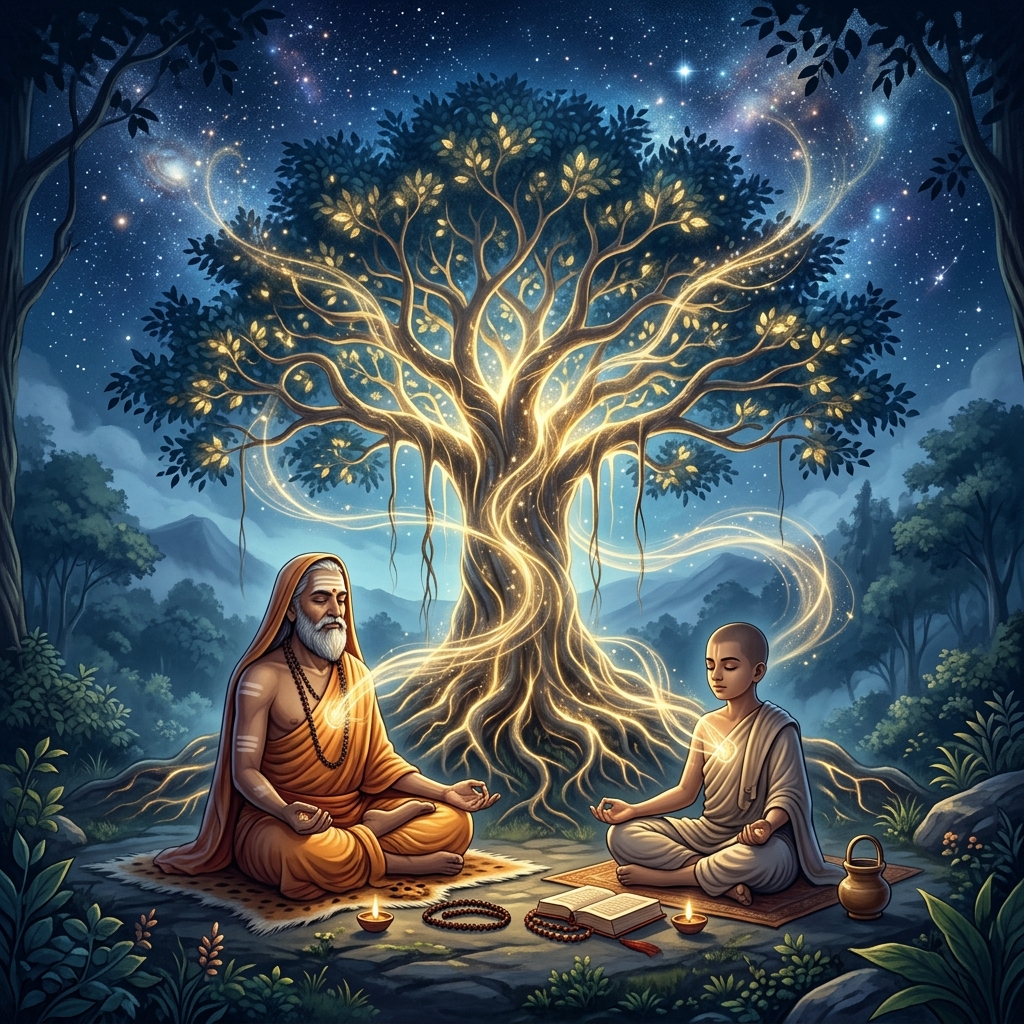
 AI Digest: Discovering the True Self (Ātman) and Advaita Non-Dualism
The source material explored here is the classic English translation of the Upadeśasāhasrī ("A Thousand Teachings"), the foundational independent treatise of Advaita Vedānta composed by Śaṅkara (Śrī Śaṅkarācārya). This masterwork sets forth a systematic pedagogical method for discriminating the True Self (Ātman) from the non-Self—such as the physical body and mental faculties—piercing ignorance, and attaining liberation (Mokṣa). Cast in the living form of dialogues between teacher and disciple, the text demonstrates that one's true Self is eternal, changeless Pure Consciousness (Brahman) and counsels relinquishing the attachments that breed suffering. Swami Jagadananda's translation also incorporates detailed scholarly notes tracing citations from the Upaniṣads and the Bhagavad Gītā. Throughout, the work underscores that phenomenal multiplicity is an illusion born of ignorance (Avidyā), illuminating the immediate recognition of our authentic non-dual nature.
In the Upadeśasāhasrī ("A Thousand Teachings"), could you explain in detail the concrete roadmap and step-by-step pedagogical process through which a qualified aspirant is guided to "liberation" (Mokṣa)?
The Concrete Pedagogical Process Leading an Aspirant to Liberation
In the Prose Part of the Upadeśasāhasrī, the path guiding a seeker toward liberation (Mokṣa) is unfolded as a rigorous, step-by-step sequence of instruction and inward discernment:
1. Prerequisites of the Disciple (Preparatory Stage)
First, the aspirant seeking liberation must purify and prepare body and mind:
- Possessing tranquility of mind and mastery over the senses (śama and dama), together with compassion toward living beings.
- Having thoroughly relinquished attachment to everything transient—pleasures in this world or heavenly realms hereafter, wealth, progeny, and social prestige.
- Having entered the life of a wandering mendicant (paramahaṃsa-parivrājaka) and approached a qualified teacher (Guru) in the prescribed manner.
- Being endowed with steadfast faith (śraddhā) and an ardent yearning for liberation (mumukṣutva).
The teacher, likewise, must be well-versed in the Upaniṣadic scriptures, firmly established in Brahman, free from pride or deceit, and motivated solely by selfless compassion to liberate others.
2. Scriptural Study and Instruction in "Oneness"
The teacher begins by imparting Upaniṣadic passages proclaiming the strict "oneness (identity)" of the inner Self (Ātman) and Supreme Brahman—such as "In the beginning, my dear, this universe was Being alone, one only without a second" (Chāndogya Upaniṣad 6.2.1) and "The Self alone is all this." Furthermore, the teacher instills scriptural definitions of Brahman as "Not this, not this" (Neti, Neti), "neither gross nor subtle," and "transcending hunger and thirst."
3. Severing the Self from Body and Social Identity (The Inquiry: "Who Are You?")
After teaching the scriptural definitions, the master tests the disciple's understanding by asking: "My child, who are you?"
- If the disciple answers, "I am the son of such-and-such a Brahmin family, formerly a celibate student or householder, now wishing to cross the ocean of birth and death (saṃsāra)," the teacher counters: "When your body dies, it will be eaten by birds or turn into earth right here—how then do you expect to cross beyond transmigration?"—exposing that the disciple is still conflating the Self with the physical body.
- If the disciple replies, "Like a bird entering a nest, I merely entered this body due to past karma (merit and demerit), and am distinct from the gross body," the teacher presses further: "Then why did you just identify yourself with bodily lineage and social status by saying, 'I am born of such-and-such a family'?"
- The teacher then systematically explains how the physical body is formed out of the five elements, demonstrating that caste (varṇa) and life-stages (āśrama—student, householder, renunciant) and their associated rites pertain exclusively to the body, whereas the birthless, lineage-free True Self (Ātman) is utterly distinct from the body—thereby dissolving the confusion.
4. Negation of "Duality (Perception of Difference)"
When the disciple protests, "Surely I am different from the Supreme Lord—bound by ignorance and experiencing pleasure and pain—and therefore wish to worship Him through ritual duties so as to cross saṃsāra," the teacher strictly forbids the perception of difference (dualistic thinking that posits a divide between oneself, God, and others):
- Citing the Upaniṣads—"He who worships another deity thinking, 'He is one, and I am another,' does not know" (Bṛhadāraṇyaka Upaniṣad 1.4.10) and "He goes from death to death who sees any multiplicity here" (Kaṭha Upaniṣad 2.1.10)—the teacher demonstrates that dualistic thinking is the very root of bondage.
- The disciple is led to see that liberation is realized solely by awakening to the non-dual truth that one's own Self and Supreme Brahman are identically one: "Thou Art That" (Tat Tvam Asi).
5. Isolating the Attributes of Pleasure and Pain (Locating Where Pain Resides)
When the disciple objects, "Yet the pain of bodily burns or cuts, along with hunger and thirst, are directly perceived within myself!", the teacher isolates the locus of pain and mental impurities within the "intellect" (buddhi):
- Pain is an objective phenomenon localized in a specific bodily region (such as the head, chest, or abdomen), never in the perceiving subject (the Self) itself. Just as the eye cannot see its own color, if pain were an intrinsic property of the Self, the Self could never perceive pain objectively.
- Desire, aversion, fear, grief, and pain—every fluctuation and blemish—are strictly attributes of the intellect (buddhi), never of the pure "Knower" (Ātman). Logical inquiry reveals the Self as perpetually stainless and untouched.
6. Renunciation of Action and Its External Means (Saṃnyāsa)
Having awakened to the knowledge that the Self is changeless (kūṭastha) and never an agent of action, the disciple must renounce all ritual and worldly actions—Vedic sacrifices, caste duties, and ritual insignia such as the sacred thread—together with their external means (Saṃnyāsa):
- Rituals and duties spring from the egoic ignorance "I am a doer," which is fundamentally incompatible with the knowledge of non-dual oneness ("I am changeless Brahman").
7. Practice of Discriminative Repetition and Contemplation (Parisaṅkhyāna)
For seekers whose minds are still troubled by lingering habitual tendencies or past impressions, Śaṅkara presents discriminative contemplation (Parisaṅkhyāna) to render Self-knowledge unshakeable:
- Whenever sensory objects—sound, touch, form, taste, or odor—impinge upon experience in daily life, the practitioner contemplates inwardly: "I am Pure Consciousness, subtler than ether, devoid of sound and touch, fearless and changeless; I can neither be harmed nor augmented by any of these."
- Through this lucid discrimination, lingering false identifications (impurities) in the mind are burned away, establishing unshakeable certainty in one's identity as Brahman—eternal peace (Mokṣa).
What metaphors did Śaṅkara employ to refute the misunderstandings regarding "pain" and "action" into which disciples readily fall? In particular, please explain in detail the metaphors used to cleanly separate the "intellect (mind)" that registers pain from the pure "Self (Ātman)" that silently witnesses it.
Metaphors Separating the Pain-Perceiving "Intellect" from the Pure "Self"
To draw an unmistakable line between the "intellect" (buddhi)—which undergoes pain and mental agitation—and the pure "Self" (Ātman)—which simply witnesses them unharmed—Śaṅkara deploys five remarkably intuitive, razor-sharp metaphors in the Upadeśasāhasrī.
When the disciple stubbornly insists, "Pain and suffering are undeniably felt right inside myself," the teacher unravels the illusion as follows:
1. Metaphor of "The Eye's Own Color and the Eye Itself" (Proof That Pain Does Not Belong to the Self)
To prove that pain cannot be an intrinsic property of the Self, the teacher invokes the structure of visual perception:
- The Metaphor: Our eyes possess the inherent nature that "the eye can never directly see its own color or defect with that very same eye" (rather, only what stands apart from the eye as an object can be seen).
- Philosophical Meaning: If pain were an intrinsic quality of the "perceiving subject (the Self)" itself, the Self could never observe pain as an object. In actual lived experience, however, we clearly point to pain objectively: "My head hurts," "My stomach aches." The very fact that pain is an "observed object" is decisive proof that pain is not an attribute of the Self, but an event occurring elsewhere (in the body and intellect).
2. Metaphor of "The Cooking Pot in Which Rice Is Boiled" (The Receptacle of Pain)
If pain does not reside in the Self, where does it reside? Śaṅkara illustrates this with the metaphor of cooking:
- The Metaphor: For grains of rice to soften and cook (undergo transformation), there must be a "vessel (cooking pot)" holding the rice in which that transformation takes place.
- Philosophical Meaning: Pain and its residual memory-impressions (saṃskāras) are "modifications (effects)" that arise and pass away. The changeless Self can never serve as a mutable receptacle for modifications. What serves as the "vessel" undergoing and retaining modifications (pain, pleasure, and memory) is not the Self, but the "intellect" (buddhi).
3. Metaphor of "Sunlight and the Sun-Warmed Body" (The Illuminated Object)
- The Metaphor: When sunlight shines upon a body and warms a limb, the "heated limb" is merely an external object relative to the sun (the illuminator).
- Philosophical Meaning: The Self is pure "Light (Consciousness)" itself. Sensations of "pain" or "pleasure" arising in the body and intellect—just like a limb warmed by sunshine—are merely "objects" illuminated by the Sun of the Self; the illuminating Sun (the Self) itself never grows hot, cold, or wounded.
4. Metaphor of "A Face Reflected in a Mirror" (The Mechanism of False Identification)
This is Śaṅkara's supreme metaphor explaining why pain occurring in the intellect is mistakenly felt as "my own pain":
- The Metaphor: When your face is reflected in a mirror, if the mirror's surface is tarnished, pitted, or warped, the reflected face likewise appears stained or distorted. Yet your actual face standing outside the mirror is never scratched or sullied by the blemishes of the glass.
- Philosophical Meaning: When blemishes of pain or grief arise in the "mirror" of the intellect, the reflection of Consciousness (ābhāsa / the ego-self) cast within it appears wounded and afflicted. Because the unawakened seeker mistakes that "reflection in the mirror (the ego)" for their true Self, they cry out in anguish—whereas the authentic Self (Ātman) stands wholly independent of the mirror's blemishes, forever spotless and unharmed.
5. Metaphor of "Red-Hot Iron and Flying Sparks" (Why the Inanimate Intellect Seems Sentient)
Why does the intellect—which in Advaita ontology is subtle, insentient matter (jaḍa)—appear to feel pain and act like a conscious subject?
- The Metaphor: A cold lump of iron emits no light of its own; yet when thrust into a blazing furnace, it turns into "red-hot iron," and even the sparks flying from it appear to glow and burn of themselves.
- Philosophical Meaning: Although the intellect in itself is an insentient instrument, because it is pervaded by the reflected light of Pure Consciousness (the Self), the intellect begins to behave as though it possessed consciousness of its own—masquerading as the "subject (doer and experiencer)" of pain and pleasure. Yet all luminosity belongs solely to the Self; the intellect possesses zero independent awareness.
Through these five interlocking metaphors, Śaṅkara leads the disciple to an unshakeable experiential realization: "Every pain and sorrow you feel is merely a passing shadow inside the 'vessel' of the intellect, while you yourself—the Pure Consciousness illuminating it—remain unscarred Light from beginning to end."
Śaṅkara's theory of the "reflection of Consciousness" (Ābhāsa) seems to hold the master key to how the Self can remain utterly changeless while worldly experience still takes place. Could you analyze in detail the epistemological mechanism whereby Pure Consciousness gets deceived by the "blemishes on the mirror (pain and suffering)" into mistaking them for its own pain?
How Consciousness Appears Deluded by the "Blemishes of the Mirror (Pain)"
In the Upadeśasāhasrī (especially Chapter 18 of the Metrical Part), the apparent delusion whereby Pure Consciousness—the Self (Ātman)—mistakes the intellect's blemishes (pain and grief) for its own affliction is analyzed with surgical epistemological precision through three concepts: "Reflection of Consciousness" (Ābhāsa), "Mutual Superimposition" (Adhyāsa), and "Non-Discrimination" (Aviveka).
1. The Architecture: Light Source, Mirror, and "Reflection"
Within our inward life stand two principles of diametrically opposite nature:
- The Self (Ātman): Self-luminous, changeless Pure Consciousness (the Light Source). It performs zero actions and undergoes zero modifications.
- The Intellect (Buddhi): A subtle, transparent instrument (the Mirror) evolved from the five elements and sustained by food—in itself wholly insentient (jaḍa).
By the mere proximity of Pure Consciousness to the transparent intellect, a "reflection of Consciousness" (cid-ābhāsa) arises within the intellect. Pervaded by this reflected light, the insentient intellect lights up and functions as if it were a conscious perceiving agent—just as black iron heated in fire glows red-hot. This reflected consciousness fused with the intellect is what we experience daily as the "ego" (ahaṃkāra / "I").
2. The Mechanism of Delusion: Non-Discrimination and Mutual Superimposition
Why, then, do we mistake pain arising in the intellect for "my own pain"? Because the reflected consciousness (ego) in the mirror of the intellect and the original Self stand in intimate, continuous proximity, we fail to discriminate between the "original Self" and its "reflection in the mirror (ego)"—a failure called "Non-Discrimination" (Aviveka). Out of this lack of discrimination springs "Mutual Superimposition" (Adhyāsa):
- Projecting the "Mirror's Blemishes (Modifications of the Intellect)" onto the Self: When modifications (blemishes) such as pain, grief, or craving ripple across the mirror of the intellect, the reflected light (ego) appears warped and darkened. Mistaking that reflection for our true Self, we falsely project the intellect's afflictions onto the Self, crying out, "I am suffering! I am in pain!"
- Projecting the "Consciousness of the Self" onto the Intellect: Conversely, attributing the Self's intrinsic "knowing light" to the insentient intellect creates the illusion that the mind itself knows and chooses autonomously.
3. Logical Proofs That "Pain" Is Never an Attribute of the Self
Śaṅkara establishes three rigorous logical proofs demonstrating that pain and sorrow belong exclusively to the objective intellect, never to Ātman:
- Pain Is Always a "Perceived Object": When experiencing a headache or stomachache, we localize it objectively. This proves that pain stands on the side of the "seen object" over against the "seeing Witness (subject)." Just as the eye cannot see its own color, if pain belonged to the Seer itself, it could never be objectified.
- The Intellect Alone Is the "Receptacle" of Pain: Pain and its memory traces (saṃskāras) are transient modifications that come and go. Because the changeless Self cannot undergo modification, pain and its impressions reside exclusively in the mutable vessel of the intellect.
- Empirical Proof from Dreamless Sleep (Suṣupti): During deep dreamless sleep, when the mirror of the intellect temporarily subsides into latency, zero pain or sorrow is experienced—even if the physical body is ill. This proves conclusively that suffering depends upon the activity of the intellect and is completely foreign to the intrinsic nature of the Self.
Conclusion: Breaking Free from the Optical Illusion
Liberation from this spell requires establishing unwavering discrimination (Viveka): "I am neither the intellect (the mirror) nor its reflection (the ego); I am the changeless Witness (Pure Consciousness) effortlessly illuminating both."
Just as your true face outside the mirror remains untouched no matter how scratched, muddied, or shaken the mirror becomes, no matter what fierce pain ripples through the intellect, the pure Self remains ever stainless and free. When this truth is directly realized through scriptural insight, we cease being fooled by blemishes on the glass and rest in eternal peace (Mokṣa).
To step free from the reflected "ego" in the mirror and return to the authentic Self, how did Śaṅkara instruct seekers to practice "sensory restraint" and "the renunciation of all actions" (Saṃnyāsa)? Please outline the concrete practices and steps.
The Concrete Practice of "Renunciation of All Action" (Saṃnyāsa)
In the Upadeśasāhasrī, Śaṅkara's doctrine of "the renunciation of all actions" (Saṃnyāsa) is far more than retreating physically into a forest; it is a rigorous, systematic discipline aimed at uprooting the false egoic conviction "I am a doer" (kartṛtva-abhimāna).
Because the True Self (Ātman) performs zero actions, undergoes no change, and has no connection with caste or life-stage, realizing the Self requires relinquishing all worldly and ritual actions enjoined under ignorance (Avidyā)—together with their outward ritual insignia.
Below are the six concrete steps of Saṃnyāsa set forth by Śaṅkara:
1. Renouncing the Threefold Desires (Eṣaṇā-traya)
First, the aspirant must wholly cast off inward craving for activities that yield only transient, perishable fruits (cf. Bṛhadāraṇyaka Upaniṣad 3.5.1, 4.4.22):
- Desire for progeny (sons and family continuity)
- Desire for wealth and possessions
- Desire for worlds—both status in this earthly realm and attainment of heavenly realms hereafter through ritual sacrifices. Through Upaniṣadic study, the seeker gains unshakeable conviction that eternal liberation can never be manufactured through finite action (karma).
2. Renouncing Social Identity (Caste and Life-Stage)
Next, the seeker strips away every social self-definition:
- One ceases identifying oneself with caste (varṇa) and stage of life (āśrama)—dropping thoughts such as "I am born of such-and-such a noble lineage" or "I am a student / householder."
- One recognizes clearly that all such designations belong exclusively to the perishable physical body compounded of the five elements, whereas the changeless Self possesses neither ancestry nor social rank.
3. Physical Renunciation of Ritual Insignia (Sacred Thread and Topknot)
One of the most striking, concrete hallmarks of Śaṅkara's Saṃnyāsa is discarding the physical "instruments" and "emblems" of ritual agency:
- Discarding the Sacred Thread (Yajñopavīta): Physically removing and casting away the sacred cord worn by upper-caste men as the badge of eligibility to perform Vedic sacrifices and obligatory rites.
- Shaving Off the Ritual Topknot (Śikhā): Removing the tuft of hair at the crown of the head that likewise symbolizes ritual agency.
- Logical Rationale: Continuing to wear the sacred thread and perform rites constitutes an active affirmation of egoic ignorance—"I am a ritual agent belonging to a specific caste"—which stands in irreconcilable contradiction with the knowledge of non-dual oneness ("I am Brahman").
4. Embracing the Life of a Wandering Mendicant
Having relinquished outward status and ritual emblems, the practitioner adopts a radical simplicity of life:
- Entering the order of the supreme wandering mendicant (Paramahaṃsa-parivrājaka) without fixed abode or possessions, begging only enough alms to sustain the body.
- Maintaining unwavering mental tranquility and sensory restraint (śama and dama), non-violence, and impartial compassion toward all beings.
5. Abandoning Worldly Talk and Contemplating "Aum"
In daily comportment and solitary contemplation, the renunciant refines mental focus:
- Ceasing all idle chatter and disputation concerning non-Self topics (worldly affairs, bodily concerns, or ritualistic debates).
- Devoting oneself instead to contemplating the sacred syllable "Aum" (Praṇava)—the supreme symbol pointing directly to pure Brahman—and meditating deeply upon one's own Self as Pure Consciousness, the substratum of all that is.
6. Renouncing Subtle Mental Doership
Finally, beyond outward physical acts, even subtle inward claims of agency are relinquished:
- Even subtle mental postures—"I am meditating right now," "I have renounced all karma"—are recognized as egoic stirrings and let go.
- One abides effortlessly solely as the changeless Witness (Sākṣin / Pure Consciousness) silently illuminating the movements of the intellect.
Conclusion
Thus, in Śaṅkara's vision, "renunciation of all action" (Saṃnyāsa) is not mere withdrawal from society; it is severing both the outward ritual emblems of bodily identity and the inward egoic impulse of agency, standing firmly in the absolute truth: "I am changeless Brahman, and have never performed a single action."
Why did Śaṅkara argue with such uncompromising logic that "knowledge of the true nature of the Self" (Vidyā) and "ritual or worldly action" (Karma) are as mutually contradictory as light and darkness, and can never be combined? Please explain the philosophical background of this debate and the decisive differences between the two.
Why Knowledge (Vidyā) and Action (Karma) Are "Mutually Opposed Like Light and Darkness"
Against rival schools (such as Mīmāṃsā ritualists and advocates of jñāna-karma-samuccaya, the "combination of knowledge and ritual action" for liberation), Śaṅkara demonstrates throughout the Upadeśasāhasrī that Knowledge (Vidyā) and Action (Karma) are as irreconcilable as light and darkness. This rests upon a penetrating analysis of egoic agency, epistemology, and ontology across four decisive axes:
1. Fundamental Contradiction of Underlying Premises (Presence vs. Absence of Doership)
Action and Knowledge rest upon diametrically opposite conceptions of the Self, making it logically impossible for both to coexist within the same locus:
- Premise of Action (Karma): Action is possible only when one takes oneself to be an agent ("I am the doer of this rite") driven by desire ("I want to obtain a desirable fruit or avert an undesirable one").
- Premise of Knowledge (Vidyā): True Upaniṣadic knowledge reveals with certainty that "the Self (Ātman) is changeless, actionless Pure Consciousness, One without a second."
Consequently, the instant true Knowledge dawns—"I am changeless Reality, never a doer"—the false egoic premise "I am a doer" is necessarily annihilated. For one who realizes oneself as actionless to simultaneously perform ritual action as an agent is logically impossible—as absurd as "finding coldness inside blazing fire."
2. Difference in Epistemological Dependence (Agent-Dependent vs. Reality-Dependent)
Action and Knowledge differ fundamentally in what governs their validity:
- Action Is "Person-Dependent" (puruṣa-tantra): An action depends upon human free will and effort—one can choose to perform it, not perform it, or perform it differently.
- Knowledge Is "Reality-Dependent" (vastu-tantra): Authentic knowledge does not bend to human willpower; it depends solely upon "the objective reality as it already is" revealed through a valid means of knowledge (pramāṇa, such as perception, inference, or Upaniṣadic testimony). No exercise of willpower can turn a wooden desk before your eyes into a non-desk, or fire into ice.
Thus, voluntaristic "action" governed by subjective desire and objective "knowledge" governed solely by Truth belong to wholly incompatible orders.
3. Opposite Effects Upon Ignorance (Avidyā)
Śaṅkara emphasizes that action can never destroy fundamental ignorance (Avidyā):
- Action Coexists with and Reinforces Ignorance: Because action springs out of the ignorant misidentification "I am an embodied doer," performing actions presupposes and further entrenches ignorance rather than uprooting it. Even a million ritual sacrifices cannot eradicate Avidyā.
- Knowledge Alone Destroys Ignorance: Darkness can never be swept out with a broom (action); darkness is dispelled solely by introducing Light (Knowledge). Just as clear perception of dry desert sand instantaneously extinguishes the mirage of water, direct knowledge that "I am Brahman" alone eradicates the root ignorance driving saṃsāra.
4. Decisive Difference in Their Fruits
Finally, the outcomes yielded by action and knowledge stand at opposite poles:
- Fruits of Action (Variable & Impermanent): Whatever is produced, attained, modified, or purified by action (earthly prosperity or even celestial realms) fluctuates according to the quality of performance and inevitably perishes in time.
- Fruit of Knowledge (Changeless & Eternal): Liberation (Mokṣa) revealed by knowledge is never a newly manufactured product; it is the immediate rediscovery of the eternal, imperishable Self (Ātman) that was always already present.
Conclusion
For Śaṅkara, action belongs to the nocturnal dream of "I am a finite doer" (Darkness), whereas knowledge is awakening to "I am changeless, infinite Consciousness" (Light). Hence the seeker of liberation relinquishes all bodily caste obligations and ritual instruments (Saṃnyāsa) to stand unveiled as pure Light itself.
I am deeply intrigued by Śaṅkara's analysis of "dreamless deep sleep" (Suṣupti). If changeless Pure Consciousness (Ātman) is eternally present, why do we feel nothing and see nothing during deep sleep? Please share Śaṅkara's logical explanation.
Why Nothing Is Seen or Felt in Deep Sleep Despite Changeless Consciousness
If Pure Consciousness (Ātman) never flickers out, why do we neither see nor feel anything during dreamless deep sleep (Suṣupti)?
In the Upadeśasāhasrī (echoing Bṛhadāraṇyaka Upaniṣad 4.3.23), Śaṅkara answers this classic question with luminous rigor: not because Consciousness disappears, but solely because all objects of perception (the operations of mind and senses) have temporarily subsided.
1. The Self-Refuting Contradiction of Saying "I Was Unconscious"
Śaṅkara points out that claiming "Consciousness was absent in deep sleep" involves a blatant logical self-contradiction. Why? Because immediately upon waking, everyone testifies from direct memory: "I slept soundly; I saw nothing and knew nothing whatsoever."
Had Consciousness truly been extinguished during deep sleep, who was present to register that "absence of objects," and how could you subsequently recall and report, "There was nothing"? Memory is possible only of what was directly experienced. Therefore, the pure Witnessing Consciousness (Ātman) that silently illuminated the "absence of all mental modifications" remained uninterruptedly awake throughout deep sleep. What vanished was merely the perceived object, never the knowing Consciousness itself.
2. A State Where the "Mirror (Intellect)" Has Been Temporarily Put Away
Returning to our earlier metaphor of the mirror makes this crystal clear:
- During Waking and Dreaming: The "mirror" of the intellect (buddhi) is active, reflecting sensory worlds, dream images, and blemishes of pleasure and pain.
- During Dreamless Deep Sleep (Suṣupti): Both the sensory faculties and the intellect temporarily resolve back into their causal latency, ceasing all modification. It is a state in which "the mirror itself has been temporarily put away."
Once the mirror is removed, naturally neither "blemishes (pain)" nor "worldly scenes" are reflected anymore. Yet the Light Source (Pure Consciousness—what you truly are) that formerly shone upon the mirror has not dimmed in the slightest. You simply abide as pure Light in the absence of anything to illuminate.
3. Metaphor of Sunlight in Empty Interstellar Space
Śaṅkara illustrates this through the metaphor of sunlight: imagine vast outer space devoid of dust, planets, or any physical surface to reflect light. To an ordinary eye looking for illuminated objects, that expanse looks pitch-dark ("nothing is seen")—not because sunlight is absent, but solely because there is no reflecting surface present. Consciousness in deep sleep is identical: because the mind—the object normally illumined—has subsided in sleep, no specific cognition arises, yet the self-luminous Light of the Seer (Ātman) shines on without a split second's interruption, as constant as the sun.
Thus, Śaṅkara demonstrates that the very experience of "feeling nothing in deep sleep" is decisive phenomenological proof that changeless Pure Consciousness exists wholly independent of both the mind and the physical body.
It is often said that the serene peace and refreshment felt upon waking from deep sleep—"Ah, how blissfully I slept!"—is actually a glimpse of Brahman's intrinsic "Bliss" (Ānanda). How does Śaṅkara explain the link between the repose of deep sleep and the essential Bliss of the Self?
The Repose of Deep Sleep and the Intrinsic Bliss (Ānanda) of Brahman
Throughout the Upadeśasāhasrī, the Self (Ātman) / Brahman is defined as intrinsic "Unlimited Bliss" or "Knowledge-Bliss" (Vijñāna-Ānanda). While the elaborate later post-Śaṅkara scholastic formula analyzing the waking recollection "I slept happily" (sukham aham asvāpsam) is developed further in subsequent Advaita manuals, the Upadeśasāhasrī itself lays down the exact foundational principles and mechanism linking deep sleep's peace to the Self's innate Bliss:
1. The Essence of Deep Sleep as "Repose" (Viśrāma)
In the dialogue, the disciple observes that while repeatedly buffeted by mental and bodily afflictions across waking and dream states, living beings experience "intervals of rest in deep sleep" (viśrāma) during which all suffering ceases. That deep sleep provides natural, effortless relief from distress stands as an experiential touchstone of the text.
2. The Ever-Present "Bliss of the Self" Sustaining Deep Sleep
The True Self (Ātman) is untouched by hunger or thirst, grief or delusion, old age or death—it is "Unlimited Bliss" itself. Śaṅkara affirms that the Self is changeless and eternally fulfilled in its own "Bliss of the Self" (Ānanda).
3. Why Unclouded Peace Prevails in Deep Sleep (Cessation of Duality)
In dreamless sleep, both objective phenomena (the world of duality, fear, and lack) and the restless modifications of the pain-bearing "intellect" temporarily subside:
- Every "pain" and "misery" that torments us during waking and dreaming is an adventitious impurity belonging strictly to the mutable vessel of the intellect.
- Because the intellect ceases operating in deep sleep, zero pain, anxiety, or sorrow can arise.
- Unclouded by the mirror's agitation, self-luminous, changeless Pure Consciousness (the Self) abides alone in its native peace.
4. What Waking Recollection Reveals—and Transcending Even the "Sheath of Bliss"
Recalling upon awakening that "I saw nothing and suffered nothing in deep sleep" attests to the unbroken presence of the Witnessing Consciousness throughout sleep. At the same time, following the Taittirīya Upaniṣad's inquiry into the five sheaths (pañca-kośa), Śaṅkara reminds us that Pure Brahman transcends not only the gross body, vital breath, mind, and intellect, but even the subtle "sheath of experiential bliss" (ānandamaya-kośa—the conditioned pleasure-impression enjoyed in sleep), abiding as unconditioned Reality itself.
In sum, the profound, effortless refreshment experienced in deep sleep—despite the absence of every sensory pleasure—is explained by the temporary cessation of the intellect's dualistic agitation, leaving the intrinsic, unconditioned Bliss-Consciousness of the Self shining unimpeded.
If our True Self is "Unlimited Bliss" from the very beginning, why do we completely forget this during everyday waking life and actively manufacture our own suffering? Please walk through the epistemological process whereby "Ignorance" (Avidyā) generates false identification and "Superimposition" (Adhyāsa).
The Mechanism of "Ignorance" (Avidyā) That Obscures Innate Bliss and Breeds Everyday Suffering
Why, despite being "Unlimited Bliss" in our very essence, do we lose sight of this truth in waking life and spin our own wheel of misery? In the Upadeśasāhasrī, Śaṅkara dissects this with extraordinary precision through the epistemological chain of "Ignorance" (Avidyā) and "Mutual Superimposition" (Adhyāsa / Adhyāropa):
1. The Precondition of Forgetfulness: "Non-Discrimination" (Aviveka)
In the waking state, our intellect (buddhi) and mind (manas) stream outward to engage sensory objects—sound, touch, form, taste, and scent. In the midst of this bustling cognitive activity, two utterly heterogeneous realities—"changeless Pure Consciousness (the Self)" and "the mutable material instrument (the intellect)"—appear so intimately fused that we fail to distinguish one from the other. This failure of discernment is called Non-Discrimination (Aviveka), the starting line of every existential error.
2. Birth of the False Self (Ego) via the "Reflection of Consciousness" (Ābhāsa)
In themselves, the intellect and physical body are insentient modifications of food and the five elements, devoid of awareness. Yet through the sheer proximity of Pure Consciousness, the light of the Self casts a "reflection" (ābhāsa) into the transparent medium of the intellect. Śaṅkara compares this to mistaking a physical object illuminated by sunlight as possessing luminosity of its own. Suffused with reflected awareness, the insentient intellect masquerades as an autonomous, conscious agent—giving birth to the "ego" (ahaṃkāra) and cementing the dualistic split between "I" and "mine" across daily life.
3. Solidifying Suffering Through "Mutual Superimposition" (Adhyāsa)
Out of this confusion, a two-way superimposition (Adhyāsa) occurs instantaneously in the mind, lending visceral sting to suffering:
- Superimposing the "Consciousness of the Self" onto the "Intellect": Projecting the pure witnessing light of the actionless Self onto the active intellect, we misidentify ourselves as "I am the doer (kartṛ)."
- Superimposing the "Blemishes (Modifications) of the Intellect" onto the "Self": Conversely, transient modifications arising in the mirror of the intellect—craving, aversion, fear, bodily pain, caste, and mortality—are mistaken for attributes of our core Self, breeding the agonizing conviction: "I am suffering; I am finite, inadequate, and bound." Unlike a pure grain of gold boiled in water—which undergoes no inward softening or alteration even while the water churns—because we falsely appropriate the intellect's agitation as our own, we experience ourselves as genuinely wounded.
4. The Self-Perpetuating Wheel: Action (Karma) and Re-Embodiment
Once the ignorant premise "I am an incomplete, suffering doer" takes hold, it drives compulsive action (karma) throughout daily life:
- Desire and aversion flare up—"By doing this, I will secure pleasure and ward off pain!"—impelling actions through body, speech, and mind.
- These ego-driven actions accumulate fresh karmic impressions of merit (puṇya / dharma) and demerit (pāpa / adharma).
- Accumulated karma inevitably fashions further "conjunction with a body" (rebirth as well as ongoing somatic bondage in daily life) so those fruits may be reaped.
- Embodiment in turn guarantees fresh encounters with pleasure and pain, igniting renewed attachment and aversion, which propel still further actions.
Thus, the relentless causal wheel—Ignorance → Superimposition (Doership) → Desire & Action → Embodiment → Pleasure & Pain → Attachment & Aversion → Further Action—revolves ceaselessly as saṃsāra, veiling our innate Bliss behind self-generated turmoil.
5. The Contrast Between Waking and Deep Sleep—and the Sole Exit
When we sink into dreamless sleep, we taste effortless peace only because the "mirror of the intellect" temporarily shuts down, suspending dualistic projection. Upon waking, however, latent seeds of unextinguished ignorance stir anew, restarting the drama of superimposition.
Therefore, the sole way to sever this cycle at its root is never by piling up further rituals or worldly efforts, but by directly realizing—through Upaniṣadic inquiry and the logical method of agreement and difference (Anvaya-Vyatireka)—the liberating truth of "Thou Art That" (Tat Tvam Asi): "I am neither the mirror of the intellect nor its egoic reflection; I am changeless Brahman silently illuminating them all."
Once true knowledge is established—"In reality, I am the actionless non-doer"—why must all previously accumulated karma as well as everyday ritual and caste duties inevitably vanish "like darkness before light"? Please organize the logical necessity behind this.
Why Establishing Non-Doership Necessarily Dissolves Karma and Everyday Ritual Obligations
In the Upadeśasāhasrī, once the non-dual knowledge "I am Brahman, the actionless non-doer" stands unshakeably established, the cessation of both past karmic bondage and obligatory caste/life-stage duties—"like darkness vanishing before the sun"—is not an arbitrary lifestyle choice, but a strict fourfold logical necessity:
1. Collapse of the Foundational Premise: Total Negation of the "Doer-Ego"
Every everyday social rule of caste (varṇa) and ritual obligation of life-stage (āśrama) presupposes the self-conception: "I belong to this caste, possess this body, and am the agent (doer) bound to execute these duties." True scriptural knowledge, however, establishes the objective fact: "The Self (Ātman) is devoid of caste and lineage, changeless, actionless Pure Consciousness (Brahman)." Because the false belief "I am a doer" (ignorance) and the true realization "I am intrinsically a non-doer" (knowledge) are direct contradictories, they can never inhabit the same consciousness simultaneously. The instant non-doership is realized, the "doer-ego" vanishes—leaving no agent upon whom ritual injunctions could possibly bind.
2. The Logic of Mutual Exclusivity: "Light and Darkness"
Śaṅkara demonstrates the incompatibility of Knowledge and Action through the axiom of Light and Darkness:
- Action (Karma): Springs from subjective egoic desire and agency, coexisting with and feeding upon ignorance.
- Knowledge (Vidyā): Reveals objective Reality (Brahman) wholly independent of human whim. For someone who has awakened to oneself as changeless Brahman to continue performing ritual duties as though one were an agent is as logically incoherent as "expecting coldness inside fire" or "expecting immortality from a corpse." Once the Light of true knowledge dispels the Darkness of ignorance, ignorance-born action loses every foothold.
3. Loss of Eligibility as the Addressee of Vedic Injunctions
Ritual injunctions of the Karma-kāṇḍa ("Perform this sacrifice; refrain from that") are addressed exclusively to unenlightened persons who still conflate the Self with the body and crave finite fruits in this world or heaven. For one awakened to the non-dual identity of Ātman and Brahman, however, no qualified addressee (adhikārin) remains. Were ritual duties still binding after realization, countless Upaniṣadic declarations teaching "Tat Tvam Asi" ("Thou Art That"), affirming attribute-less changeless Brahman, and condemning dualistic perception would be rendered meaningless falsehoods. Hence, for the awakened sage, every injunction loses its jurisdiction.
4. Severing the Causal Chain (Annihilation of Past Karma)
Past actions (karma) have the power to generate future rebirth and suffering solely so long as their root soil—"Ignorance" (Avidyā)—remains intact:
- Incineration of Unmanifest Accumulated Karma (The Metaphor of "Roasted Seeds"): When Self-knowledge dawns, the root ignorance sustaining the karmic storehouse (saṃcita-karma) is consumed in the fire of wisdom. Śaṅkara invokes the classic metaphor: "Seeds roasted in fire can never sprout again" (to produce future bodies or sorrow). Vast stores of karma accumulated across countless past lives are rendered wholly sterile in a flash.
- Neutralization of Currently Operating Karma (Prārabdha-karma): The momentum of karma that fashioned the present physical body and has already begun bearing fruit continues until the natural exhaustion of the body's lifespan—just like an arrow already shot from a bow. Yet because the awakened sage no longer identifies with the body as an experiencer, bodily events are beheld with serene detachment, like "garments worn by another person." Meanwhile, zero new future-binding karma (āgāmi-karma) can ever accumulate again.
Conclusion
Accordingly, when an awakened renunciant lays down ritual emblems like the sacred thread (yajñopavīta) and relinquishes worldly and ritual obligations (Saṃnyāsa), it is neither caprice nor sectarian convention—it is the inescapable logical consequence of awakening to the absolute fact: "From eternity, I have never performed a single action."
How is the inward contemplation known as "repetition and discriminative reflection" (Parisaṅkhyāna), practiced by a seeker establishing oneself as the non-doer, distinguished from ordinary ignorance-driven "ritual or worldly action" (Karma)? And how does it ultimately function right amidst everyday sensory experience?
Distinguishing Parisaṅkhyāna Contemplation from Ritual Action and How It Functions in Daily Life
In Chapter 3 of the Prose Part of the Upadeśasāhasrī, Śaṅkara introduces "discriminative repetition and reflection" (Parisaṅkhyāna) for seekers aspiring to render their non-dual insight unshakeable amidst sensory life. It is sharply distinguished from ordinary ignorance-based ritual or worldly action (karma) and operates in an entirely different manner within awareness:
1. Three Decisive Distinctions from Ordinary Ritual Action
- Presence vs. Absence of an Egoic Premise
- Ordinary Action: Presupposes egoic identification—"I am the doer and the enjoyer of fruits"—driven by craving for outcomes.
- Parisaṅkhyāna: Proceeds directly from scriptural wisdom already heard: "I am changeless Pure Consciousness, performing zero actions and wholly unentangled with sensory objects." Its vector runs directly counter to ego-reinforcement.
- Difference in Aim and Nature of Result
- Ordinary Action: Aims to newly manufacture or acquire transient, finite rewards—earthly prosperity or heavenly realms hereafter.
- Parisaṅkhyāna: Aims solely to neutralize lingering impressions of merit and demerit and prevent fresh karmic binding from arising. Rather than producing something new, it acts as a lucid intellectual shield dismantling transmigration.
- Difference in Means and Locus of Practice
- Ordinary Action: Executed at prescribed times and places as a caste or life-stage obligation, requiring physical insignia (such as the sacred thread) and active exertion of body, speech, and mind.
- Parisaṅkhyāna: Depends on no external place, time, or ritual implement; it unfolds silently within awareness at the very instant sensory impressions arise in daily life—an effortless, razor-sharp contemplative discernment.
2. How Parisaṅkhyāna Functions Amidst Everyday Sensory Life
In daily life, Parisaṅkhyāna functions as a luminous filter (shield) preventing habitual superimposition (false identification) from flaring up when the senses meet the world:
- Disentangling Sensory Stimuli from the Self:
The instant praise or harsh blame strikes the ear (sound), or physical pain, heat, or pleasure touches the skin (tactile sensation), habitual conditioning moves to claim it as "my pain" or "my triumph." Right in that moment, the practitioner inwardly reflects and affirms:"I am Pure Consciousness—devoid of sound, touch, form, taste, and scent—subtler than space, fearless and changeless; I can neither be harmed nor augmented by any of these."
- Uprooting Attachment and Aversion:
Through this clear discernment, incoming pleasure, pain, praise, or insult is instantaneously recognized as a purely objective phenomenon (non-Self) powerless to stain the Witnessing Subject. Once stripped of personal ownership, neither craving (attachment) nor hostility (aversion) finds ground to sprout. - Severing the Generation of New Karma:
Without attachment or aversion, no ego-driven impulse arises to grasp or retaliate—completely halting the accumulation of fresh karma that would otherwise bind one to future embodiment. - Unshakeable Establishment in Oneness with Brahman:
As this lucid discrimination matures, residual habitual tendencies (impurities of the mind) burn away completely. Dualistic perception dissolves without remainder, leaving the sage unshakeably established in the changeless Brahman, One without a second—eternal peace (Mokṣa).
It is an astonishing logical claim that at the very instant a prepared seeker hears the Upaniṣadic declaration "Thou Art That" (Tat Tvam Asi), immediate liberation occurs without requiring any further spiritual practice or repetitive meditation. Drawing on Śaṅkara's famous parable of the "Tenth Man," could you unpack the logic of this instantaneous liberation?
The Logic of Instantaneous Liberation Illuminated by the Parable of the "Tenth Man"
In Chapter 18 of the Metrical Part of the Upadeśasāhasrī, the seemingly paradoxical truth that a prepared seeker awakens to full liberation instantaneously upon hearing the scriptural mahāvākya "Thou Art That" (Tat Tvam Asi)—without needing any subsequent action or repetitive meditation—is demonstrated with crystalline brilliance through Śaṅkara's celebrated parable of "The Tenth Man" (Daśamas tvam asi).
1. The Story of the "Tenth Man"
Ten travelers swam across a swollen river together. Reaching the far bank, one of them counted the group to make sure no one had drowned. However, forgetting to count himself (the counting subject), he counted only nine! Stricken with horror—"Only nine of us are here; our tenth companion has drowned in the river!"—they beat their breasts and wept in bitter grief.
A wise passerby saw their distress, immediately understood their blunder, had the man count his nine companions again, and pointed straight at him: "You are the Tenth!" (Daśamas tvam asi). At the very instant those words struck his ears, the man recognized himself as the missing tenth—and his grief (born entirely of miscounting) vanished instantaneously without a trace.
2. The Logical Necessity of "Immediate Liberation" (Sadyomukti)
Through this unforgettable parable, Śaṅkara illuminates the exact ontology of human ignorance and awakening:
① Liberation Is Never "Newly Manufactured" (Rediscovery of What Already Is)
To "become" the tenth man, the weeping traveler did not have to perform a ritual, travel to a distant shrine, or swallow a magic elixir—because before crossing, while miscounting, and while weeping in despair, he was already the tenth man all along. Nothing lacked except the removal of ignorance—his failure to include the counting subject itself.
In the exact same way, our True Self (Ātman) has always been Brahman—eternally liberated and changeless from the outset. Seekers suffer under the delusion "I am finite, ignorant, and bound" solely because their attention is mesmerized by objective phenomena (the "nine"—body, senses, mind, and world), overlooking the very Subject doing the knowing (the "Tenth"—Ātman). Because liberation is not becoming something new, but recognizing what was always already the case, it is complete the instant ignorance drops.
② Verbal Pointing Alone Suffices When Properly Understood
Were liberation an effect newly produced by action (karma)—like planting grain and waiting months for harvest—gradual stages of labor over time would be indispensable. Yet just as the passerby's words "You are the tenth!" dispelled grief on the spot, the Upaniṣadic declaration "Thou Art That" generates direct, immediate knowledge ("I am Brahman") instantaneously upon comprehension. Once a valid verbal pointer reaches a prepared mind and its meaning is grasped, neither a time lag nor "additional effort" has any room to intervene.
3. Why Demanding "Subsequent Repetitive Meditation" Is Self-Contradictory
In Śaṅkara's era, rival Vedāntic thinkers (known as Prasaṅkhyānavādins) argued that even after comprehending the Upaniṣadic sentence, scriptural language yields only indirect conceptual knowledge, so one must still practice prolonged repetitive meditation (prasaṅkhyāna) as an enjoined mental act to attain liberation. Śaṅkara refutes this position incisively:
- Once told "You are the tenth!" and seeing the truth directly, would the traveler need to sit down on the riverbank chanting for hours, "I am the tenth, I am the tenth..." in order to become the tenth? Such repetition would be utterly comical and superfluous.
- Furthermore, to claim that after hearing the truth one remains obligated to perform repetitive meditation presupposes that one is still an "enjoined agent (doer)"—reinstating the very root ignorance that "Thou Art That" just negated!
Direct realization ("I am actionless Brahman") and ritual obligation ("I am a doer duty-bound to meditate") cannot coexist any more than sunlight and darkness. Hence, for one in whom clear comprehension has dawned, no further injunction, duty, or meditative repetition remains; liberation is immediate and unconditional.
Conclusion
The parable of the Tenth Man proves with mathematical elegance that liberation is never an achievement earned through doing (karma), but the effortless self-revelation of ever-present Reality (Vidyā) the instant false misidentification is dispelled. That is why a fully prepared disciple can awaken at the very moment the Sadguru utters the sacred word.
How can the scriptural sentence "Thou Art That" (Tat Tvam Asi) itself bridge the vast conceptual gulf between "Thou (a finite human individual)" and "That (transcendent cosmic Brahman)" so as to reveal a single indivisible Pure Consciousness? Please explain Śaṅkara's refined philosophy of language and epistemology—specifically "grammatical apposition" (sāmānādhikaraṇya) and "secondary / implied indication" (lakṣaṇā).
The Linguistic and Epistemological Mechanics of "Thou Art That" (Tat Tvam Asi)
In Chapter 18 of the Metrical Part of the Upadeśasāhasrī (celebrated in Advaita scholarship, including Sengaku Mayeda's landmark studies, as the pinnacle of Śaṅkara's philosophy of language), Śaṅkara demonstrates through a breathtakingly rigorous linguistic analysis how the sentence "Tat Tvam Asi" shatters the conceptual wall between "a distant Creator God" and "a suffering human individual" to reveal one indivisible, non-dual Reality.
This semantic breakthrough unfolds across three precise stages:
1. Grammatical Apposition (Sāmānādhikaraṇya) and the Metaphor of the "Blue Horse"
First, in the Sanskrit sentence Tat tvam asi ("That thou art"), "Thou" (tvam) and "That" (tat) stand in the identical nominative case—bound in co-referential apposition (sāmānādhikaraṇya), pointing to a single referent. Śaṅkara illustrates how apposition works using an everyday phrase:
- The Example of "This Is a Blue (Dark) Horse" (nīlo 'śvaḥ): When we say "a dark-blue horse," the adjective "blue" and the noun "horse" share the same grammatical case. Here, "blue" excludes all non-blue colors (white, bay, chestnut), while "horse" excludes all blue objects that are not horses (such as a blue lotus or blue cloth). Mutually qualifying and excluding incompatible possibilities, the two words converge seamlessly to designate one single concrete entity.
- Application to "Thou Art That": In the same manner, linking "Thou" and "That" in apposition via the verb "art" (asi) signals that the sentence is not equating two separate things, but pointing to one single, seamless substratum (Ātman = Brahman).
2. Why Words Cannot Denote the Self "Directly" — Implied Meaning (Lakṣaṇā)
In Śaṅkara's epistemology, no word can ever denote the pure Self (Ātman) as a direct literal object (abhidhā). Why? Because literal word-reference functions only where an object belongs to a class/genus (jāti), possesses qualities (guṇa), engages in action (kriyā), or stands in relation—whereas Pure Consciousness is wholly free of all four.
How, then, can "Thou Art That" awaken Self-knowledge? Through "secondary / implied indication" (lakṣaṇā—specifically partial-abandonment implication, jahad-ajahal-lakṣaṇā). In everyday usage, the word "I" or "Thou" literally denotes the ego—the intellect tinged with the reflection of Consciousness (cid-ābhāsa). Yet while shedding its literal limitation (the insentient intellect), the word retains its core luminous element to indirectly (impliedly) point straight to the self-luminous, inward Pure Consciousness standing immediately behind the ego.
3. Mutual Cancellation of Incompatible Attributes
When the sentence "Thou Art That" enters an attentive, prepared mind, the two terms enact a dynamic mutual cancellation of contradictory overlays:
- "That" (Tat) Purifies "Thou" (Tvam):
In the Upaniṣads, "That" signifies Supreme Brahman—eternally free from hunger, thirst, sorrow, and mortality. Placed in apposition with "Thou" (one's directly experienced inward Self), "That" strips away every false egoic limitation—"I am finite, afflicted, and bound"—superimposed upon "Thou." Thereby, "Thou" stands revealed as suffering-free Pure Consciousness. - "Thou" (Tvam) Brings "That" (Tat) Home into Immediate Presence:
Conversely, "Thou" signifies the most intimate, immediately self-evident inward awareness right here and now. Placed in apposition with "That," "Thou" cancels out the illusion of "mediacy, remoteness, and otherness"—the notion that Brahman is a distant Cosmic Principle or external Deity "out there." Thereby, "That" stands revealed as none other than one's own immediate Self right here.
Once "the remoteness (otherness) of Brahman" and "the finitude (suffering) of the individual self" cancel each other out without remainder, their shared, non-contradictory essence—indivisible, attribute-less Pure Consciousness—shines forth directly through implied indication (lakṣaṇā). This is the living linguistic enactment of Upaniṣadic negation: Neti, Neti ("Not this, not this").
Conclusion: Why Awakening Happens at the Very Instant of Hearing
Just as the words "You are the tenth!" did not hand the traveler a new person, "Thou Art That" confers nothing previously absent. Simply by being heard and lucidly comprehended, the sentence instantaneously cancels out the twin illusions of personal sorrow and divine distance, pointing directly to the eternally free Self (Brahman) that was always already here—completing awakening on the spot without requiring a single subsequent act.
When ignorance is consumed by the "implied meaning" of the scriptural word, how do "all doubts" in the heart and "all past karma" vanish in a single instant? In particular, could you clarify the mechanism of "severing the knot of the heart" (hṛdaya-granthi), whereby the conflation of Self and ego is permanently untied?
Instantaneous Extinction of Doubt and Karma Through the "Severing of the Knot of the Heart"
In the Upadeśasāhasrī (invoking the celebrated verse of Muṇḍaka Upaniṣad 2.2.8: bhidyate hṛdaya-granthiś chidyante sarva-saṃśayāḥ, kṣīyante cāsya karmāṇi), Śaṅkara explains how—at the very moment ignorance is burned away by the implied meaning (lakṣaṇā) of "Thou Art That"—every doubt and store of past karma vanishes simultaneously through "the severing of the knot of the heart" (hṛdaya-granthi-bheda):
1. The True Nature and Rupture of the "Knot of the Heart"
What is this "knot of the heart"? It is the tight, beginningless entanglement of Mutual Superimposition (Adhyāsa) whereby changeless Pure Consciousness—the Self (Ātman)—and mutable, insentient matter—the intellect and ego (buddhi / ahaṃkāra)—are fused together in lived experience through ignorance. When the scriptural mahāvākya is directly comprehended and the Self stands unveiled in its pristine purity, this knot of false identification in the intellect ("heart") snaps in an instant. Once the root knot gives way, the entire chain of doubts and karmic bondage anchored to it collapses simultaneously.
2. How Every "Doubt" Vanishes Instantaneously
All lingering existential doubts—"Am I truly Brahman, or am I a mortal soul subject to sorrow and rebirth?"—evaporate the instant non-dual identity is realized:
- Irreversible Certitude of Valid Knowledge: The realization "I am Brahman" arises from the unimpeachable valid means of knowledge (pramāṇa) of Upaniṣadic revelation confirmed in immediate self-evidence. Just as once you clearly see a rope in bright daylight, the sensory optical illusion of a snake can never convince you again, unconditioned Self-knowledge can never be sublated or overturned by ordinary dualistic appearances ("I am a bound doer").
- Irreversible Dispelling of Ignorance: Once awakened to one's nature as Brahman, no contrary error can ever re-establish itself; hence all doubts are cut through in a single stroke.
3. How All "Past Karma" Is Dissolved Instantaneously
Vast stores of karma accumulated across innumerable lifetimes are simultaneously stripped of binding power through four interconnected principles:
- Eradication of the Root Soil (Ignorance): Every karmic bond presupposes the ignorant belief "I am an agent." Liberating knowledge eradicates that root ignorance completely.
- The Metaphor of "Roasted Seeds" (Sterilizing Unmanifest Karma): When the fire of Self-knowledge consumes ignorance, all unmanifest karmic impressions stored from past lives become like "seeds roasted in fire, which can never germinate again" into future rebirth or sorrow.
- Total Release from Both Merit and Demerit: The awakened sage transcends both past religious merit (puṇya) and demerit (pāpa) born of ignorance, never again tormented by remorse ("Why did I leave good undone? Why did I commit wrong?").
- Complete Cessation of Future Karmic Accumulation: Free of egoic doership ("I am acting") and desire for fruits, no future action can ever stick to or bind Pure Consciousness.
4. Why It All Completes in a "Single Instant"
Why is there zero temporal gap or gradual waiting period between hearing the truth, snapping the knot of the heart, dispelling doubt, and dissolving karma? Because the mahāvākya "Thou Art That" yields direct, immediate self-recognition. Just as the weeping traveler told "You are the tenth!" needed zero extra time or effort for his grief to vanish on the spot, once preparatory obstacles have been cleared, at the very instant the sacred word reaches the ear, understanding, freedom from doubt, and liberation complete themselves simultaneously in one timeless flash.
About Śaṅkara (Ādi Śaṅkarācārya)
Śaṅkara (also revered as Ādi Śaṅkarācārya; traditionally dated c. 788–820 CE, or placed in the first half of the 8th century by modern Indological scholarship such as Sengaku Mayeda) stands among the towering philosophical geniuses of Indian history as the definitive consolidator of Advaita Vedānta (Non-Dualism).
Born in Kalady in the southern region of Kerala, he took monastic renunciation in early youth and walked the length and breadth of the Indian subcontinent during a brief 32-year lifespan, engaging leading thinkers of diverse schools in rigorous philosophical debate. Alongside the Upadeśasāhasrī, he authored monumental, foundational commentaries (Bhāṣyas) on the ten principal Upaniṣads, the Bhagavad Gītā, and the Brahma Sūtras.
Śaṅkara demonstrated that the ultimate ground of the cosmos (Brahman) and the innermost essence of the individual (Ātman) are eternally, indivisibly one—and that ignorance (Avidyā) of this ever-present Reality is the sole cause of transmigration and suffering. Tradition also credits him with establishing four cardinal monastic seats (Maṭhas) across north, south, east, and west India, laying the enduring intellectual and institutional foundations of Advaita Vedānta down to the present day.