Throughout history, the path to spiritual awakening (kenshō, liberation, enlightenment) has often been conceived as an uncompromisingly solitary endeavor — a solitary seated meditation in remote mountain hermitage or vow of silence in isolated caverns. Yet human beings are fundamentally born into an intricate web of relational conditioning (pratītyasamutpāda / dependent co-arising) and forge their sense of self solely through the gaze of the other. No matter how crystalline a state of equanimity one may attain in lonely silence, how acutely have we all experienced the sudden, violent resurgence of ancient defenses and fires of anger the moment we re-enter the marketplace and encounter the unreasonable speech of a living other?
This essay undertakes an integral bridging between the humanistic psychology of Carl Rogers' "Encounter Groups," Irvin Yalom's existential group psychotherapy, Gendlin's experiential felt sense and somatic phenomenology, the depth-psychology of Yogācāra and Advaita transcending neuro-medical reductionism, and the timeless wisdom of Zen kōans and the Ten Bulls. When living human beings sit in a circle, casting aside agendas and masks to directly face the abyss of the "Here and Now," how does a group transform into a sacred vessel that catalyzes the deconstruction of the ego and the real-time manifestation of Ultimate Reality? Herein, we examine its theoretical foundation, clinical methodology, insidious pitfalls, and the dynamic unfolding of genuine awakening.
Introduction: Beyond Solitary Meditation — Why Genuine Encounter with the Other Opens True Awakening
Modern individuals inhabit an era of unprecedented information overload and ubiquitous digital hyper-connectivity, yet inwardly endure profound soul-isolation. Confined within the solitary prison of compulsive thinking and conceptual mazes, the ego endlessly ruminates upon past regrets and future anxieties, driving the organism into chronic hyper-arousal or numbed dissociation. Daily conversations deteriorate into functional, utilitarian exchanges of data, wherein scarcely anyone dares reveal their raw vulnerability or authentic presence, clinging steadfastly to their protective persona.
Exhausted by this estrangement, many turn to meditation, mindfulness, yoga, or non-dual philosophies for salvation. Sitting in solitude, closing one's eyes, and witnessing the flow of the breath undeniably brings immense grace by stilling surface turbulence. Yet a critical blind spot frequently goes unnoticed: when sitting entirely alone, the ego remains its own private censor.
In solitary introspection, we unconsciously filter our awareness, attending only to what we are willing to see and tolerate. The "Blind Spot" quadrant in the Johari Window — that which is visible to others but obscured from oneself — is exceedingly difficult to unlock through solitary meditation alone. The ego's most recalcitrant knots — self-deception, subtle spiritual pride, intellectualized defenses, and habitual victimhood — reveal their contours only when reflected in the living, unpredictable mirror of another, through unavoidable friction and raw contact.
"Without the mirror of the Thou, man cannot behold the true countenance of his own Being. Sacred solitude bears authentic fruit only after passing through genuine encounter with the other."
— Meditations on Martin Buber's I and ThouIn the 1960s, the Encounter Group emerged from the Humanistic Psychology movement championed by Carl Rogers. It was precisely an experimental collective crucible designed to melt rigid character armor and restore authentic selfhood through whole-person encounters. Dispensing entirely with predetermined agendas, structured lectures, and authoritarian guidance, participants sat in a circle to voice whatever raw feelings arose in the "Here and Now." This radical transparency sent shockwaves through both psychiatry and society at large.
Nevertheless, conventional encounter groups predominantly aimed at interpersonal skill development, assertiveness training, or organizational sensitivity (T-groups) — staying mostly within the personal domain of ego-adaptation and psychological rehabilitation. What this essay explores is a horizon pushed one step further: the Encounter Group as a direct catalyst for deconstructing the very structure of the ego, awakening into pure awareness, non-self, and cosmic wholeness.
From psychotherapy's restoration of the wounded ego to Eastern philosophy's transcendence of the ego: how can these two great streams be integrated within a single, living group process? Let us embark upon this comprehensive inquiry.
Chapter 1: The Depths of Group Process — Deconstructing Defenses and Manifesting the Psychological Container
1. Shifting the Gaze from Content to Process
Nearly all ordinary human discourse is preoccupied with content (what is being discussed). Discussions regarding the weather, economic indicators, politics, or academic psychology theories serve primarily to fixate attention on external objects, functioning as intellectualized defenses to evade immediate inner vulnerability and the palpable tension between self and other.
In sharp contrast, the core of the encounter group demands a 180-degree reversal of awareness: dropping the conversational topic altogether to attend to the group process (the relational dynamics) — what emotions are shifting between whom, and how energy is circulating or stagnating in this immediate moment.
2. Carl Rogers' 15-Stage Process of Personal and Collective Growth
When individuals enter an unstructured, non-directive basic encounter group, the collective invariably moves through a universal progression of chaos and awakening. Rogers' meticulous formulation of the 15 stages chronicles the shedding of the ego's armor and the bare disclosure of the soul:
- Milling Around: Acute confusion, awkward silence, and frustration arising from the facilitator's refusal to provide an agenda or leadership.
- Resistance to Personal Expression: Reluctance to reveal personal struggles; defensive posturing.
- Description of Past Feelings: Evading immediate presence by narrating safe stories from the past ("There and Then").
- Expression of Negative Feelings: Shattering the polite silence by directing anger toward the facilitator or other members (the emergence of genuine emotional energy).
- Expression of Personally Meaningful Material: The cracking of the defensive dam, allowing long-hidden shame, loneliness, and feelings of inadequacy to pour forth.
- Direct Expression of Immediate Interpersonal Feelings: Unvarnished expression of affection, fear, rivalry, or aversion toward specific individuals present in the room.
- Development of a Healing Capacity in the Group: Members naturally begin offering profound empathy, reassurance, and intuitive holding without relying on the facilitator.
- Self-Acceptance and the Beginning of Change: Experiencing unconditional acceptance from others, enabling participants to embrace their own disowned shadow and weaknesses (incongruence shifting to congruence).
- The Cracking of Façades: Pretense, intellectualization, and defensive posturing collapse; individuals sit as unvarnished human beings.
- The Receiving of Feedback: Non-defensively hearing how one is experienced by others in real time.
- Confrontation: Compassionate yet uncompromising direct confrontation of inauthenticity and defensive games.
- The Helping Relationship Outside Group Sessions: Organic mutual support blossoming beyond the formal boundary of the circle.
- The Basic Encounter: Two human souls making direct, unshielded contact in the depth-dimension of shared consciousness.
- Expression of Warmth and Closeness: The entire circle is suffused with profound cohesion, unconditional love, and a unified field of presence.
- Behavior Changes and Everyday Integration: Returning to everyday relationships and societal roles anchored in authentic presence.
3. Reinterpreting Tuckman's Model and Yalom's Curative Factors
Bruce Tuckman's developmental model — Forming → Storming → Norming → Performing → Adjourning — mirrors the stages of spiritual maturation in a contemplative monastery.
Many conventional social clubs and sterile corporate groups, dreading the chaos of "Storming" (authentic conflict and clash of shadows), retreat into a superficial pseudo-community disguised as "Norming." However, reaching true "Performing" — where egos become transparent and profound stillness, insight, and prayer are shared effortlessly — requires walking through the storm, where the helplessness and vanity of the ego are exposed to the bone.
Furthermore, among Irvin Yalom's 11 therapeutic factors, Universality and Existential Factors are paramount for spiritual awakening. The isolating illusion that "I alone harbor such wretchedness, fear of death, and unworthiness" is shattered the moment one witnesses another shivering before the identical existential abyss. The personal, neurotic drama dissolves into the universal condition of human incarnation, melting personal self-pity into the vast ocean of compassion.
Chapter 2: The Existential Stance of the Facilitator — Effortless Accompaniment and Negative Capability
1. The Death of the Leader, the Birth of the Catalyst
In conventional educational seminars, the teacher or group leader dispenses knowledge, moderates discussions, and navigates toward pre-packaged answers. In an encounter group oriented toward awakening, this authoritarian posture is the single most toxic obstacle. The moment a facilitator feigns having the "answers," participants regress into dependent childhood, abdicating their innate Buddha-nature and self-actualizing tendency.
The facilitator is not an instructor, but one who trusts the collective's inherent wisdom to navigate chaos more deeply than anyone else, anchoring their presence unshakably in the center of the storm. Every form of manipulation, pedagogical steering, and theatrical design must be thoroughly abandoned.
2. Living Carl Rogers' Three Core Conditions Existentially
Rogers' three conditions for psychological growth are not conversational techniques; they represent the existential stance (level of being) of the facilitator:
1. Congruence (Genuineness / Transparency)
The facilitator's internal felt reality (confusion, the heaviness of silence, fear, boundless affection) is in complete alignment with their external expression. Shedding the pretense of "being the wise professional," they remain transparent as a vulnerable human presence.
2. Unconditional Positive Regard (Prizing the Other)
Holding every manifestation — silence, rage, withdrawal, boredom, cynicism — without moralistic judgment or condemnation, embracing each reaction as a sacred, desperate attempt of the soul to protect its fragile existence in that moment.
3. Empathic Understanding (Accurate Sensing)
Stepping into the inner subjective world of the other, feeling their terror and pain "as if" it were one's own, while maintaining the clear witness of non-dual presence without becoming drowningly enmeshed.
3. Negative Capability: Holding the Weight of Uncertainty
Coined by the poet John Keats and elevated in psychoanalysis by Wilfred Bion, Negative Capability — the capacity to remain in uncertainties, mysteries, and doubts without any irritable reaching after fact and reason — is the supreme virtue of an awakening facilitator.
When a heavy silence persists for thirty minutes, or when a frustrated participant lashes out demanding direction, an immature facilitator panics and prescribes an exercise or delivers a mini-lecture to alleviate their own anxiety. In contrast, the true facilitator drops their breath into the lower abdomen (danjeon / hara) and remains seated in the center of the vacuum, knowing that this unbearable pressure is the very fertile soil where deep inner contemplation germinates.
4. Navigating Interpersonal Impasses: A Clinical Dialogue Script
The following transcript illustrates how a facilitator intervenes during a classic stalemate, transmuting projective attack into an opening for authentic presence:
Chapter 3: Confronting the Abyss of Existence — The Death Workshop and the Awakening to Finitude

1. Yalom's Four Ultimate Concerns
No matter how much wealth an individual amasses, how high their social standing climbs, or how sophisticated their psychological jargon becomes, there exist four inescapable boundary conditions of human existence, articulated by Irvin Yalom:
- Death: The inevitable physical cessation and finitude of oneself and everything one holds dear.
- Existential Isolation: The unbridgeable gulf that, regardless of how deeply we love, each of us enters existence alone and must depart alone.
- Freedom and Responsibility: The terrifying absence of any pre-ordained grand design; the radical truth that one is the unmitigated author of one's own life and choices.
- Meaninglessness: The realization that the cosmos provides no built-in, ready-made purpose; any meaning must be forged by oneself.
The everyday ego stays perpetually busy with trivial dramas — consumerism, gossip, prestige, and minor grievances — precisely to evade these four abysses. True awakening occurs only when these existential realities are faced squarely and the false floorboards of self-deception give way entirely.
2. Anatomizing the Death Workshop
Among experiential exercises in existential encounter, the "Death Workshop" (derived from the hospice movement and existential therapy) yields the most radical shift in consciousness. Rather than contemplating mortality intellectually, participants write down their most cherished attachments across sixteen separate cards and surrender them one by one through a guided somatic narrative.
| Phase | Surrendered Cards (16 Total) | Psychodynamics & Consciousness Shift |
|---|---|---|
| Act I: Faltering Normality | Surrendering 4 Cards (Possessions, hobbies, plans) |
Diagnosis of a terminal illness. Denial gives way to the first visceral realization that the predictable everyday world is slipping away. |
| Act II: Loss of Autonomy | Surrendering 4 More Cards (Career, professional roles) |
Hospitalization and bodily decline. The collapse of the competent, self-sufficient persona; facing the humiliation of dependence. |
| Act III: The Narrowing World | Surrendering 4 More Cards (Wider circle of friends, health) |
Confinement to bed. The universe shrinks to a sterile mattress; vocal and physical strength fade into silence. |
| Act IV: The Final Departure | Remaining 4 reduced to 2, then to 1 | Shallow, labored breath. Parting with the deepest attachments — spouse, children, or core beliefs. |
| Act V: Acceptance of Death | The final card slips from fingers | Total Emptiness (Śūnyatā). Silence without an owner. Returning to the unconditioned, primordial void. |
| Act VI: Rebirth & Reintegration | Inhaling fresh air; gathering cards back | Resurrection. The staggering epiphany of being alive right now; unconditional reverence and boundless gratitude for existence. |
3. The Mechanics of Existential Transformation
The climax of this journey arrives in Act V, after the very last card slips from between trembling fingers into the void, followed by complete, unbroken silence.
When name, wealth, family, reputation, memories, and self-image are all gone, and the breath has ceased — what remains? Materially, nothing. Yet what remains luminously present is the vast, unstained awareness itself (pure witnessing consciousness) that observes the total absence of things. What one previously identified as "I" was merely sixteen slips of paper — a bundle of conditioned mental attachments. The true Subject is the boundless screen of Emptiness that remains ever-untouched even when all objects dissolve.
When participants take their first deep breath in Act VI and open their eyes to the wooden floor and the faces of fellow seekers, the world is radically transfigured. The returned cards are no longer chains of identity to cling to defensively; they are received as unearned, miraculous gifts of this immediate moment. Heidegger's "Being-towards-Death" (Sein-zum-Tode) is realized not as an abstract philosophical treatise, but as a lived somatic awakening.
Chapter 4: The Ultimate Sickness Blocking Awakening — Dismantling Spiritual Bypassing and Integrating the Shadow
1. John Welwood's Exposure of the Ultimate Spiritual Defense
In contemplative circles and spiritual communities, the most pervasive and insidious disease is Spiritual Bypassing, a term coined in 1984 by psychotherapist and Buddhist teacher John Welwood.
Welwood defined spiritual bypassing as "the tendency to use spiritual ideas, practices, and beliefs to sidestep or avoid facing unresolved emotional issues, psychological wounds, attachment trauma, and developmental tasks." Individuals trapped in this dynamic frequently appear exceptionally holy, serene, and detached, yet beneath their transcendent vocabulary lies a desperate defense mechanism to avoid the raw vulnerability and messy grief of human incarnation.
2. Five Cardinal Manifestations of Spiritual Bypassing
3. Integrating the Jungian Shadow and Landing in the Lived Body
Why are seekers so easily seduced by spiritual bypassing? Because confronting early childhood neglect, the terror of rejection, and the agony of bodily mortality is excruciating. It is infinitely more seductive to escape upward into disembodied concepts of "Light," "Void," and "Cosmic Love," amputating the messy, hurting human reality below.
Yet as C.G. Jung famously warned, enlightenment is not achieved by imagining figures of light, but by making the darkness conscious.
"No tree, it is said, can grow to heaven unless its roots reach down to hell."
— Carl Gustav JungIn an encounter group oriented toward awakening, the facilitator must ruthlessly dismantle these high-altitude escapes. When a member smiles serenely and professes, "I hold only unconditional love for my betrayer," the facilitator must guide them down: "While speaking those beautiful words, why is your throat trembling? What is happening in the pit of your stomach? Can you drop below the spiritual armor and make room for the murderous rage and agonizing sorrow buried there?" Awakening requires descending into the dark earth of the lived body before it can blossom into authentic transcendence.
Chapter 5: The Alchemy of Hot Spots — Dismantling the "Window of Tolerance" and Attuning the Body Through Experiencing
1. The Promise of the Hot Seat and the Peril of Re-traumatization
In Gestalt therapy and intensive encounter groups, placing a member in the central "Hot Seat" to focalize the collective awareness upon an unresolved emotional knot (Hot Spot) is nothing short of soul-surgery.
Yet this approach carries a grave clinical hazard: when protective defenses are torn away prematurely, the organism's capacity to integrate is overwhelmed, precipitating severe re-traumatization or protective freezing (dissociation).
A crucial trap is the illusion of formal consent. When asked, "Do you want to work on this?", a participant's verbal "yes" often stems from social compliance, a masochistic desire for self-punishment ("break me down!"), or intellectual vanity. The facilitator must look past the verbal affirmation and delicately assess whether the participant's lived bodily container is truly capable of holding that emotional charge without collapsing into dissociation.
2. Dismantling the Mechanistic Dogma of the "Window of Tolerance" — From Psycho-Engineering to Gendlin's "Experiencing"
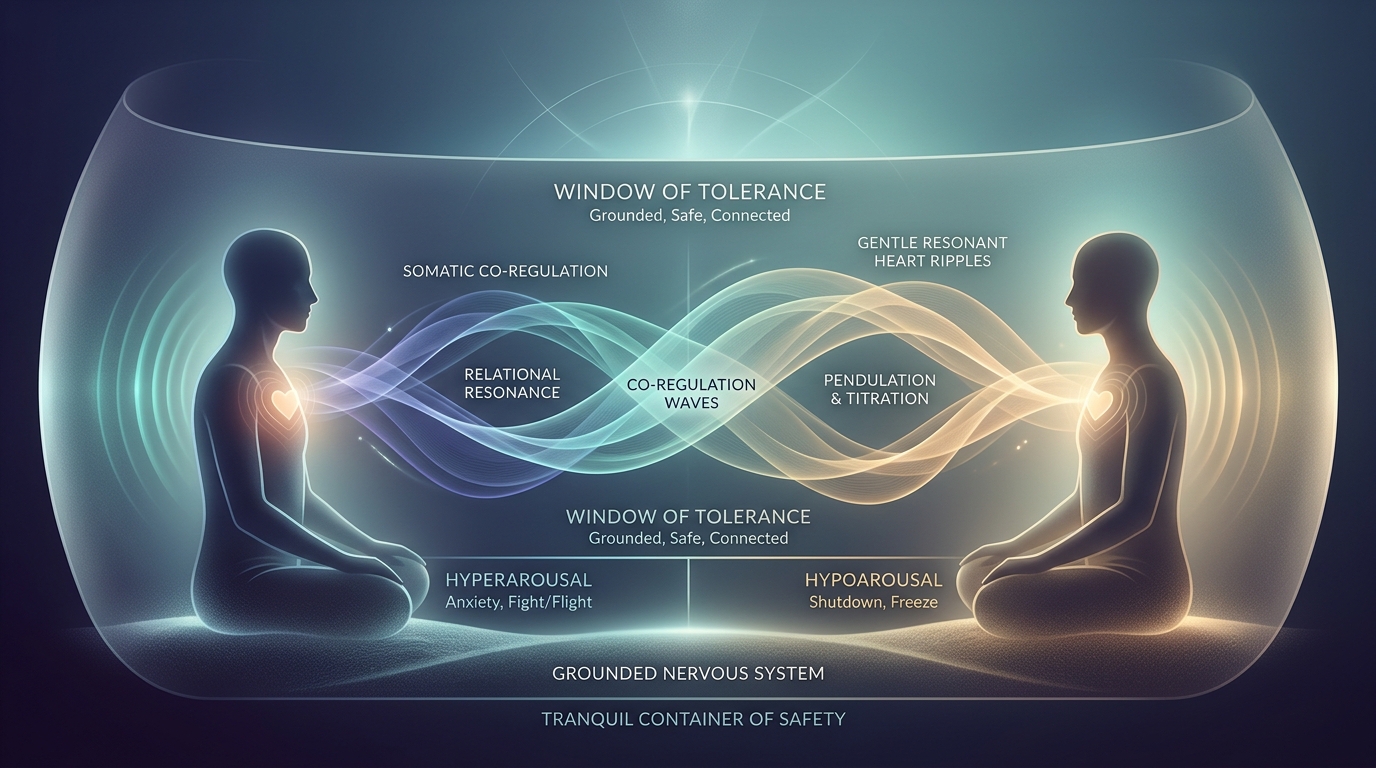
In contemporary trauma therapy and somatic psychology, Dr. Daniel J. Siegel's model of the Window of Tolerance is widely revered as dogma. It segments human arousal into three zones: "Hyper-arousal" (panic/rage), "Optimal Zone" (within the window), and "Hypo-arousal" (freeze/collapse), striving to "keep emotions inside the window" and "widen the window."
Yet, examined from the ontological vantage point of authentic awakening, this model is fundamentally steeped in the engineering and managerial ideology of Western modernity, which objectifies the human being as an electrical circuit with a current rating or a container with volume limits. Subjective, lived experience is degraded into an external biometer to be monitored, manipulated, and regulated, covertly preserving the modern ego's desperate need for self-control and domination.
Even more pernicious is how this framework pathologizes and standardizes emotional storms or frozen silences as mere "dysregulation" and "aberrant firing outside the window." In doing so, it risks castrating the very sacred crises (Spiritual Emergencies) and egoic deaths (the Zen "Great Death") through which consciousness shatters its narrow shell to undergo radical transmutation.
This engineering reductionism is shattered by philosopher and psychologist Eugene Gendlin through his Process Model, Experiencing, and philosophy of the lived body.
According to Gendlin, the body is not an anatomical carcass (Körper / a bundle of neurological wiring); it is the lived body (le corps vécu / Leib) that directly interacts with the environment and others, continuously generating implicit meaning. It is felt directly from within as a pre-conceptual, holistic bodily sense — the Felt Sense.
An overwhelming storm of affect or a frozen silence is never a mere "capacity overload" or "mechanical fault" of the nervous system. Rather, it is the implicit totality of life, not yet differentiated into concepts, crying out with its whole somatic being to carry forward into fuller realization.
Therefore, the master facilitator does not seek to police affects or force them back into a narrow "window." Rather, they hold deep reverence for the non-verbal felt sense carried by the body, attuning to its silent plea, and simply "being with" the process as a safe relational container so that life may unfold and carry forward of its own accord.
| Mode of Experience (Waves of Life) | Neuro-Medical & Window View (Engineering Management) |
Experiential & Phenomenological View (The Lived Body / Leib) |
Essential Facilitation in Encounter |
|---|---|---|---|
| Turbulent Affective Eruption (Rage, Terror, Tempest) |
"Hyper-arousal" Out-of-window aberrance. Immediate calming and suppression required. |
The implicit cry of life seeking to Carry Forward. Repressed, undifferentiated experiencing striving to restore wholeness. |
Do not get swept up in the surface drama; gently and steadily guide awareness to the core felt sense (the trembling throat, burning chest). |
| Arising of Peace & Stillness (Reconciliation, Resonance) |
"Window of Tolerance (Optimal)" Functional, self-regulated normal zone. The goal of control. |
The clearing where lived bodily boundaries become transparent. Non-dual realization of self and other as an interconnected web of life. |
Refrain from intellectualizing; allow the entire group to savor the sacred silence and fullness in wordless communion. |
| Collapse, Numbness, Silence (Freeze, Immobilization) |
"Hypo-arousal" Neural shutdown. Judged as defensive numbness and pathological dissociation. |
The profound somatic wisdom safeguarding egoic limits. The organism's dignified protective action to survive overwhelming distress. |
Never force exposure or speech; anchor presence through the ground beneath the feet and warm gazes, affirming safety to exist. |
3. Phenomenological Reframing of Pacing: Pendulation and Titration
In misguided self-exploration groups, violent catharsis — weeping loudly or screaming — is often lauded as proof of "deep transformation." Yet violent catharsis achieved by forcibly breaching somatic defenses without readiness is mere violation and overwhelm, leaving behind deep depression and addictive craving for emotional highs.
Practices such as "Pendulation" and "Titration" from Peter Levine's Somatic Experiencing reveal their true spiritual power only when understood not as mechanistic tools of neural control, but as compassionate phenomenological scaffolding that listens to the subtle experiential process, providing a grounded haven so the lived body can carry forward at its own sacred pace.
1. Pendulation — Oscillation Between Distress and Ground
Immediately after touching a burning knot of trauma (Hot Spot), awareness is gently swung back to an anchor of safety in the present (the solid floor beneath the feet, the room's silence, the compassionate eyes of a companion). By oscillating like a pendulum between distress and grounded safety, the lived body digests unprocessed affective charge without being engulfed.
2. Titration — Micro-Dosing the Felt Sense
Just as an alchemist adds a single alkaline drop to neutralize acid, massive blocks of trauma are never detonated all at once. Instead, attention is focused upon a microscopic bodily sensation: not "the entirety of being terrorized by a parent," but "just the tightening of the right wrist on the doorknob." By meeting experience in micro-units, the knot unfolds organically.
Chapter 6: Transcending Neuro-Medical Reductionism — Yogācāra Depth-Dynamics and Advaitic "Sky and Waves"
1. The Aporia of Physicalism in Polyvagal Theory and "Neuroception"
Stephen Porges' Polyvagal Theory has gained widespread acclaim in modern psychosomatics and trauma clinical practice. Yet when exploring awakening from a rigorous philosophical standpoint, we must subject its implicit dogma of physicalist, materialist reductionism to decisive critique.
At the base of Porges' theory lies a strict bottom-up determinism: the phylogenetic evolution of the autonomic nervous system is presumed to unilaterally dictate and constrain human emotion and consciousness. The assertion that "the autonomic state precedes, and consciousness is merely its post-hoc narrative" is nothing but an epiphenomenalist fallacy that reduces the boundless reality of consciousness to an anatomical secretion.
Yet an undeniable aporia (internal contradiction) lies at the heart of the theory itself, crystallizing around Porges' coined concept of Neuroception:
"Neuroception describes how neural circuits distinguish whether situations or people are safe, dangerous, or life-threatening without requiring conscious awareness."
— Stephen W. Porges, The Polyvagal TheoryEven in a room that is objectively safe and peaceful, a traumatized person perceives imminent threat. In truth, humans do not passively register an external, ready-made reality (the delusion of Naïve Realism); rather, they inhabit a subjective universe actively constituted through conditioned interpretive webs.
Yet Porges falls into a glaring double standard: while demonstrating that perceived reality is a neural construct, he uncritically assumes that anatomical nerves, organs, and synapses are absolute, objective physical entities existing outside of consciousness. Dismantling naïve realism epistemologically while retreating into naïve physicalism ontologically is the insurmountable impasse of modern neuroscience.
2. The Depth-Dynamics of Yogācāra — Not Neural Glitches, but the Shaking of Manas and Eruption of Ālaya Seeds
Against the inverted modern dogma that "the brain generates consciousness," the profound Mahāyāna philosophy of Yogācāra (Mind-Only) presents a radical ontological reversal.
The foundational axiom of Yogācāra is "Mind and Object are Non-Dual; Mind Only, No External Object" (境識不二・唯識無境). Physical bodies (indriya / 根身) and the material environment (bhājana-loka / 器界) do not exist independently outside; they are manifestations and projections of the primordial ground of Consciousness (vijñāna / 識).
From this perspective, the terrifying trembling, panic, or emotional collapse experienced in the Hot Seat is by no means a superficial "nervous system dysregulation." It is the manifestation of an awe-inspiring depth-psychological dynamic:
In daily life, the seventh consciousness, Manas (末那識), tenaciously clings to the illusion of an autonomous "I," obsessively defending its fortress through self-delusion, self-view, self-pride, and self-love. But when a seeker faces the unshielded, authentic presence of others in the encounter circle, the fortress of Manas cracks and trembles.
As this defensive wall buckles, countless karmic seeds (bījas / 種子) — unassimilated trauma, primal dread, and latent impressions stored in the deep ocean of the eighth consciousness, the Ālayavijñāna (阿頼耶識 / Storehouse Consciousness) — erupt into conscious awareness all at once.
While neuro-medicine attempts to tranquilize this as "excessive firing" and "falling outside the window," Yogācāra points in the opposite direction. When this torrent of seeds is held within the compassionate intersubjective container of the group without repression, the egoic grasping of Manas shatters, and the Ālayavijñāna itself is transmuted into pristine, mirror-like wisdom. This is the sublime fruition of Mahāyāna Āśraya-paravṛtti (転依: The Radical Transmutation of the Basis of Existence).
3. Advaita and the "Sky and the Waves" — Transcending the Cage of the "Window" into Boundless Awareness
Furthermore, the non-dual realization of Advaita Vedānta and Tibetan Dzogchen pierces straight through the poverty of the "Window of Tolerance" framework.
The "Window" model traps human beings inside a cramped box, inciting egoic anxiety whenever waves rise too high and urging endless labor to "expand the window." But from the vantage point of genuine awakening, we must ask: "Who is measuring the dimensions of this window? Who is trying to squeeze inside it?"
As sages like Ramana Maharshi and Nisargadatta Maharaj point out, awakening is the direct realization that we are not the wave (the transient feeling or sensation); we are the boundless Sky (Pure Awareness / Space / Rigpa) in which all waves arise, dance, and dissolve.
"You are not the wave; you are the ocean itself. No matter how violently the storm of feelings may rage, the Space (Sky) itself can never be stained, wounded, or destroyed."
— Echoing the Teachings of Sri Nisargadatta MaharajPillars of rage, tsunamis of fear, rays of bliss, or dark voids of silence — all are merely fleeting ripples appearing and disappearing within the open expanse of empty Awareness. There is no need whatever to constrain the wave to the dimensions of a "window." No matter how titanic the surge, the Sky itself remains eternally unblemished, unconstricted, and utterly pure.
The true nature of "Co-regulation" experienced in the encounter circle is not an animal reflex of autonomic synchronization. It is the direct realization that the illusion of separate boundaries has dissolved, and all participants resonate as one non-dual field of life (the Enso / Indra's Net) — resting together as the boundless Open Space of Awareness itself.
Chapter 7: The Essence of Eastern Encounter — Zen Dokusan, Kihō, and Ashram Satsang Piercing Non-Self
1. Horizontal Dialogue vs. Vertical Encounter
While Western psychological encounters operate horizontally among peers to heal the ego and forge a healthy identity, the traditional encounters of the East operate along a vertical axis aimed at an entirely different dimension:
| Dimension | Western Psychological Encounter | Eastern Encounter (Zen Dokusan / Satsang) |
|---|---|---|
| Relational Axis | Horizontal & egalitarian (participants among peers, therapist as facilitator) | Vertical & asymmetrical (disciple meeting the Master / Guru) |
| Focus of Inquiry | "My" personal history, emotional wounds, defenses, relationships | "Who is this entity that calls itself 'I'?" (The illusory nature of the self) |
| Role of Language | Verbalizing feelings, empathy, meaning-making, narrative repair | Shattering concepts, kōan paradoxes, radical silence |
| Ultimate Aim | Self-acceptance, psychological health, clear boundaries | Total collapse of the ego; awakening to Non-Self (Anattā) / True Self (Ātman) |
| Ontology | Individual psyche rooted in naturalism | Pure Awareness, Emptiness (Śūnyatā), Non-Duality (Advaita) |
2. Zen Dokusan and Kihō: Decapitating Conceptual Intellect
In Zen (particularly the Rinzai lineage), Dokusan (private encounter between Master and disciple) is not warm counseling; it is an unsparing duel of flashing blades.
Confronted with kōans such as "What is the sound of one hand clapping?" or "Does a dog have Buddha-nature?", the disciple wrestles with conceptual thought for days. When they enter the Dokusan room armed with an ingenious philosophical answer, the Master does not even listen. A thunderous shout ("Katsu!"), a strike of the stick (keisaku), or the immediate ring of the bell casts them out.
Why does Zen treat discursive intellect so violently? Because the conceptualizing mind is the master architect of the ego's fortress, divorcing human beings from immediate reality. When every conceptual escape route is sealed and the student is driven into the ultimate cul-de-sac of the Great Doubt (Daidan), the floor of the ego suddenly gives way. This is the moment of "The Great Death and the Resurrection" (大死一番、絕後蘇生) — only when the personal ego has died completely does the unconditioned Life awaken.
3. Ashram Satsang: The Relentless "Who Am I?"
In the Advaita Vedanta tradition exemplified by Sri Ramana Maharshi and Nisargadatta Maharaj, Satsang (association with Truth) reverses the arrow of inquiry entirely.
When a seeker arrives weeping over familial betrayal or past trauma, the Guru does not analyze the story:
"Who is it that suffers? Trace the sense of 'I' back to its source, before thought arose."
— Sri Ramana MaharshiBy questioning the reality of the narrator itself (Ātma-Vichāra), the seeker discovers that the personal "I" is merely a phantom bundle of fleeting thoughts, and suffering dissolves for lack of a substantial subject. Moreover, the heart of Satsang lies in saturating oneself in the boundless field of the Guru's silent Presence. Beyond words, the silent transmission calms the turbulent waves of the seeker's mind like a tuning fork.
4. The Shadows of the Vertical Model
Yet the vertical paradigm harbors perilous shadows. The disciple's total idealization and demand for absolute surrender (bhakti), when intersecting with a teacher's unintegrated shadows (greed, sexuality, thirst for power), historically degenerates into psychological abuse, sexual exploitation, and cultic subjugation.
Without the horizontal wisdom of Western psychology — egalitarian feedback, healthy psychological boundaries, and clinical ethics — the vertical path of awakening constantly borders on catastrophe.
Chapter 8: No Transcendence Without Ego Formation — Ken Wilber's Pre/Trans Fallacy and the Dialectic of the Ten Bulls
1. Jack Engler's Timeless Warning
In modern spiritual culture, no error causes more psychological ruin than the confusion between ego-formation and ego-transcendence. The psychiatrist and Vipassanā teacher Jack Engler crystallized this in a famous dictum:
"You have to be somebody before you can be nobody."
— Jack EnglerWestern psychology and Eastern wisdom are not antagonistic doctrines; they describe sequential stages in human consciousness development.
2. Ken Wilber's Pre/Trans Fallacy
Philosopher Ken Wilber organized consciousness development into three broad realms:
- Pre-personal: The infant state of undifferentiated instincts, oceanic boundarylessness, and unintegrated impulses.
- Personal: The mature adult state featuring a cohesive ego, reality testing, clear interpersonal boundaries, and rational agency.
- Trans-personal: Conscious dis-identification from the ego, transcending into non-dual Emptiness, Pure Awareness, and universal compassion.
Wilber unveiled the Pre/Trans Fallacy: because both pre-personal states and trans-personal states are "non-egoic" (outside the ordinary rational ego), observers routinely commit one of two disastrous errors:
Error 1: The Reductionist Fallacy (Reducing Trans to Pre)
Orthodox Freudian psychoanalysis typifies this error: dismissing authentic mystical union, samādhi, and non-dual realization as mere infantile regression to the "oceanic feeling" of the womb, pathologizing higher spiritual realization as primitive pathology.
Error 2: The Romantic Fallacy (Elevating Pre to Trans)
The perennial trap of New Age spirituality: glorifying borderline personality fragmentation, lack of boundaries, and impulsive irresponsibility as "holy egolessness" and "living in the flow." Inability to hold a job or sustain committed relationships is rationalized as being "too spiritual for this mundane world."
If one dynamites the foundation of an unfinished shanty, the structure simply collapses into rubble (psychotic break or severe dissociation). Only a firmly constructed building (a healthy, resilient ego) can provide the sturdy roof from which one may safely launch into the boundless sky of the transpersonal.
3. The Zen Ten Bulls as an Integral Developmental Blueprint
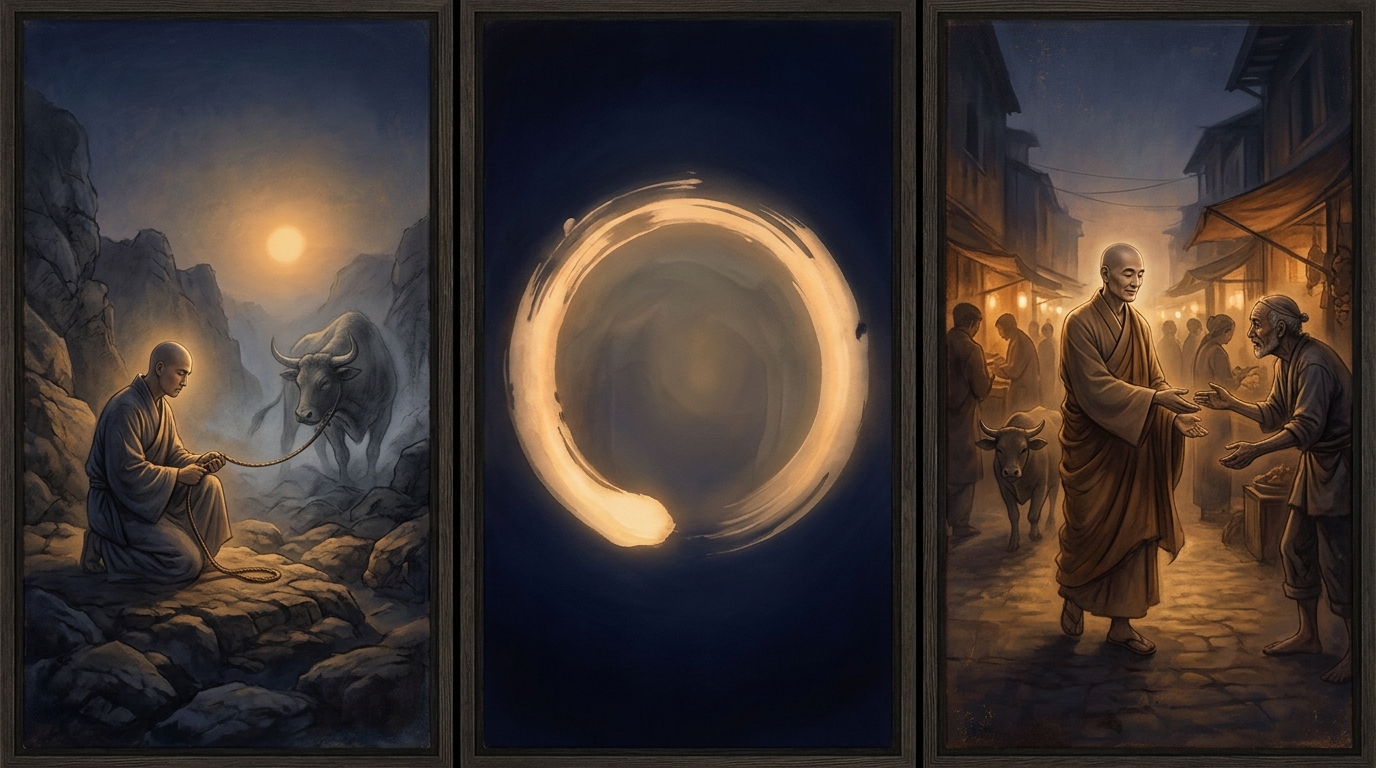
Zen masters intuited this developmental ladder centuries ago in the classic allegory of the Ten Bulls (Jūgyūzu).
The herdsman searches for the wild bull (the unruly mind), catches it (Stage 4), tames it (Stage 5), and rides it home in harmony (Stage 6). This is the rigorous cultivation of a disciplined, healthy, and integrated ego. One cannot bypass this stage.
Only after the bull is thoroughly mastered does the herdsman enter Stage 7 ("The Bull Forgotten, the Man Remaining") and Stage 8 ("Both Man and Bull Forgotten" — the pristine white circle of total Emptiness). This is the transpersonal breakthrough into non-duality and non-self.
Yet Zen's ultimate genius is that it does not terminate in the void. After Stage 9 ("Returning to the Origin"), the journey culminates in Stage 10: "Entering the Marketplace with Helping Hands" (入鄽垂手). Barefooted, chest bared, carrying a wine gourd, the sage walks joyfully into the dusty, chaotic city streets. Laughing with fishmongers and drinking with rogues, they embody transcendence not by escaping the world, but by serving ordinary life with open arms.
Transcend and Include: returning to the mundane as an ordinary human being, suffused with effortless compassion. This is the ultimate ground of awakening.
Conclusion: The Emergence of the Mindfulness Encounter Group (MEG) — Non-Dual Compassion and the Return to Everyday Life
1. The Sacred Vessel of the Mindfulness Encounter Group
At the confluence of humanistic psychology, existential therapy, somatic attunement, and Eastern depth-philosophy, the vision of the Mindfulness Encounter Group (MEG) emerges with luminous clarity.
MEG is not casual socializing, nor is it an arena for sensational emotional catharsis, nor an academic seminar on non-duality. It is a sacred vessel where living human beings awaken to the subtle movements of self and other in the Here and Now, meeting without armor in authentic communion.
2. From Automatic Rumination to the Spark of Direct Presence
In habitual relating, our minds function as high-speed reactive algorithms. Hearing a provocative word ("You never keep your promises"), the ego within milliseconds triggers an avalanche of assumptions: "I am attacked → I must defend myself → I am furious → Attack them back!" Within moments, relationships devolve into battlegrounds of mutual resentment.
MEG drives a golden wedge of mindfulness into this automatic cascade. When anger surges, one pauses for just three seconds, refusing to retaliate. Sinking awareness into the body like soaking in a hot bath, one fully tastes the raw hurt, fear, or shame beneath the defensive rage. When this unvarnished vulnerability is spoken with clarity, dialogue miraculously leaps from defensive warfare into sacred intimacy.