AI Digest: A Precision Anatomy of "Non-Self" Surpassing East-West Psychology
Abhidhamma (Abhidharma) is the monumental philosophical and phenomenological system that analyzes and organizes the Buddha's vast teachings down to their irreducible constituents. Rejecting the notion of an immutable soul or ego-self, it apprehends mind and lived body as a ceaselessly transforming flow of conditioned data-processes—a rigorous science of Non-Self (Anattā).
Drawing upon the lectures of Sri Lankan Theravāda Elder Alubomulle Sumanasara, this dialogue dissects the razor-sharp laws of the cognitive continuum (citta-santāna): how a practitioner ascends step by step through the "Seven Purifications" (Satta-visuddhi), sees through the alluring mystical traps of the "Ten Corruptions of Insight" (Vipassanupakkilesa), and arrives at the complete stillness of "Attainment of Cessation" (Nirodha-samāpatti) and the mechanism of an Arhat's final death-consciousness (cuti-citta).
Inquirer
How does Abhidhamma psychology analyze human existence, and how does it proceed with the purification of the mind? Please explain the ladder of the "Seven Purifications."
Deconstructing Subjectivity into "Nāma-rūpa" Data and the Seven Stages of Cleansing the Mind
The core of the Abhidhamma (the Basket of Higher Doctrine) lies in dismantling our everyday conventional concepts (paññatti—conceptual designations) of "I" and "ego-self," thereby unveiling ultimate realities (paramattha-dhamma) that cannot be broken down any further. These are the four ultimate realities: Consciousness (citta), Mental Factors (cetasika), Matter / Corporal Form (rūpa), and Nibbāna (Nirvāṇa).
The process by which a practitioner's mind is progressively purified through Vipassanā (insight) meditation is explained in Abhidhamma with extraordinary precision as the ladder of the "Seven Purifications" (Satta-visuddhi). Much like washing a soiled garment step by step—shaking off loose dirt, soaking, scrubbing, rinsing, and spinning dry—this represents a systematic, experiential procedure for cleansing consciousness.
1. Purification of Virtue (sīla-visuddhi):
The foundational stage of ordering one's verbal and bodily conduct so that one ceases to be a slave to reactive passions (greed, hatred, delusion) and reclaims ethical clarity. By abstaining from falsehood, divisive speech, harsh words, and idle chatter, and activating the wholesome mental factors of moral shame (hiri—conscience regarding oneself) and moral dread (ottappa—wise concern regarding harmful consequences), one prevents coarse defilements from agitating the mind.
2. Purification of Mind (citta-visuddhi):
The stage of halting the runaway momentum of discursive thoughts and fantasies that obstruct observation, stabilizing awareness. Through sustained mindfulness (sati), the "Five Hindrances" (pañca-nīvaraṇa: sensual desire, ill will, sloth and torpor, restlessness and worry, and skeptical doubt) that impede spiritual maturation are temporarily placed into dormancy, establishing unshakable concentration at the level of neighborhood concentration (upacāra-samādhi) or absorption.
3. Purification of View (diṭṭhi-visuddhi):
The stage of directly discerning through embodied experience (nāma-rūpa-pariccheda) that what we call "my living self" is nothing other than the arising and passing away of two streams of objective experiential processes: "Mind" (nāma: consciousness and feeling/mental factors) and "Matter" (rūpa: physicality and somatic processes). This shatters the wrong view of a substantial "I" and dissolves inner conflict.
4. Purification by Overcoming Doubt (kaṅkhāvitaraṇa-visuddhi):
The stage of experientially verifying that nāma and rūpa arise and pass away not by "chance" or "divine fiat," but through subtle laws of cause and conditionality, dispelling all perplexity (vicikicchā) regarding past, future, and present existence. A practitioner who reaches this stage is called a "Lesser Stream-Enterer" (cūḷa-sotāpanna), establishing an irreversible foundation in practice.
5. Purification by Knowledge and Vision of What Is the Path and Not-Path (maggāmagga-ñāṇadassana-visuddhi):
As one contemplates phenomena in light of the Three Marks of Existence (impermanence, suffering, non-self), powerful mystical experiences arise—such as brilliant illumination, rapturous joy, and profound tranquility—known as the "Ten Corruptions of Insight" (Vipassanupakkilesa). In this stage, one sees through their trap, rightly discerning: "These are merely transient conditioned phenomena, not liberation," thereby confirming the authentic Path leading to awakening.
6. Purification by Knowledge and Vision of the Way (paṭipadā-ñāṇadassana-visuddhi):
The stage of sequentially maturing the "Nine Insight Knowledges"—from Knowledge of Arising and Passing Away up to Conformity Knowledge—advancing straight down the one-way expressway toward liberation.
7. Purification by Knowledge and Vision (ñāṇadassana-visuddhi):
Passing through "Change-of-Lineage Consciousness" (gotrabhū-citta), which transcends the status of an ordinary worldling (puthujjana), the single-moment "Path Consciousness" (magga-citta) arises to uproot defilements forever, immediately followed by "Fruition Consciousness" (phala-citta) directly realizing Nibbāna—the culmination of wisdom.
Inquirer
In the fourth stage, "Purification by Overcoming Doubt," it is said that one overcomes doubts about time and perplexity regarding causal law. How is causality actually experienced within meditation?
The Gapless Immediacy (Anantara) of Arising and Passing, and Evolution into a "Lesser Stream-Enterer"
The "doubt" (vicikicchā) that a practitioner must overcome in kaṅkhāvitaraṇa-visuddhi is not healthy rational inquiry; rather, it is the half-heartedness, vagueness, and intellectual laziness lurking in the mind that refuses to verify reality firsthand. Within meditation, causality is directly experienced through three primary steps of phenomenological observation.
Step 1: Linear Conditionality Between Intention (Nāma) and Movement (Rūpa)
The practitioner brings conceptual rumination to a complete halt and directs mindfulness (sati) to the real-time arising of mind-body causality. Because the "intention to lift the foot" (mind / nāma) arises, the physical movement of "the foot lifting" (matter / rūpa) occurs as its result. Conversely, the instant "pain" (rūpa) contacts the lived body, one witnesses an aversive reaction of "dislike!" (nāma) automatically springing up in consciousness.
Step 2: Verifying Simultaneity and Multi-Dimensional Conditionality
One experientially verifies the Buddha's formula of Dependent Origination: "When this is, that is; with the cessation of this, that ceases." When intense somatic pain (vedanā) arises, irritation or anger is born from it; yet the very instant the pain subsides, one confirms that the mental factor of anger vanishes in a flash. Through this, it is objectively demonstrated within direct experience that the immediate condition sustaining the anger was the pain itself.
Step 3: Direct Experience of Gapless Contiguity (Anantara) and Refuting Eternalism and the Intermediate State
Most crucial in Abhidhamma is discovering the principle of "Contiguity / Gaplessness" (anantara): when change occurs, there is not even a split-second gap or interval between the cessation of the preceding phenomenon and the arising of the succeeding one. Just as there is no temporal pause when burning paper turns into ash, the instant one moment of consciousness perishes, the next new moment of consciousness arises immediately.
Because consciousness transforms incessantly without the slightest gap (anantara), coarse, unmindful perception (ayoniso-manasikāra) falls under the illusion that "one unchanging 'I' (an eternal soul) persists continuously." However, by observing this gapless arising and passing away exactly as it is (yoniso-manasikāra), eternalism (belief in an abiding soul) is shattered. Simultaneously, the conventional belief in an "intermediate state" (antarābhava / bardo)—positing a blank interval of suspended consciousness between death and the next rebirth—is completely refuted by the gapless contiguity of causal conditioning.
Inquirer
Why do the "mystical experiences" that appear as practice deepens become the greatest pitfall (hindrance) on the path? Please explain in detail how to overcome them.
The True Identity of the "Ten Corruptions of Insight" and Rewiring Cognitive-Experiential Pathways
When contemplation of the Three Marks (impermanence, suffering, non-self) deepens to an extreme degree, the faculties of mind and embodied awareness become astonishingly heightened, causing extraordinary phenomena to arise spontaneously. Because these manifest only in diligent "honor-student" meditators whose practice is progressing well, they easily breed intense attachment. These are known as the "Ten Corruptions of Insight" (Vipassanupakkilesa).
■ The "Ten Corruptions of Insight" That Beguile Meditators
① Illumination (obhāsa): During meditation, a dazzling orb or field of radiant light appears within awareness and follows one everywhere—tempting the practitioner to interpret, "This must be the light of enlightenment!" and abandon further inquiry.
② Analytical Knowledge (ñāṇa): Because every phenomenon is seen dissecting itself seamlessly into impermanence, suffering, and non-self with razor clarity, one falls into the premature self-judgment (wrong view): "I am already enlightened."
③ Rapturous Joy (pīti): Waves of overwhelming, pure rapture well up spontaneously like a fountain through every cell of the lived body, tempting one to drown in blissful sensation.
④ Tranquility / Pliancy (passaddhi): Bodily heaviness and pain vanish completely, and one clings to an absolute sense of ease as though one had dissolved into pure stillness.
⑤ Bliss / Happiness (sukha): Pervaded by quiet, deeply saturating comfort and immense security, one settles down complacently within that pleasant state.
⑥ Resolution / Faith (adhimokkha): Unshakable conviction arises toward the Triple Gem and the law of conditionality, leading one to conceptually conclude that one has already become a noble sage.
⑦ Exertion / Energy (paggaha): Drowsiness disappears entirely and prodigious energy surges forth, allowing one to meditate for hours on end until effort itself spins into overdrive.
⑧ Established Mindfulness (upaṭṭhāna): Mindfulness (sati) operates effortlessly on autopilot without deliberate exertion, breeding subtle conceit (māna) in one's meditative prowess.
⑨ Equanimity (upekkhā): Reaching an unruffled poise untouched by changing phenomena, one mistakes this imperturbability for Nibbāna and stalls there.
⑩ Subtle Attachment (nikanti): The most elusive, microscopic fondness and clinging directed toward the preceding nine sublime experiences and toward meditative practice itself.
■ The Methodical Way to Overcome These Corruptions
The Buddha acknowledged these as "genuine experiential phenomena arising from heightened mental clarity," yet pointed out sharply: "The experience itself is a fact, but the storyline and interpretation you spin from it—'I have attained enlightenment!'—is an error."
The key to overcoming them is to introduce zero narrative or self-congratulatory interpretation: if light appears, simply note "light"; if rapture arises, simply note "rapture"—impartially registering each as an objective, transient phenomenon that arises and passes away, and letting it flow by.
To use a metaphor from contemporary cognitive science, the Ten Corruptions resemble newly forged, high-clarity cognitive pathways beginning to fire; however, this new wiring has not yet penetrated all the way down to uproot the primordial survival drives (greed, hatred, and delusion) at the root of consciousness. If one grows complacent and clings to these sublime states, the transformation remains unfinished. One must coolly discern: "This experience too is impermanent; clinging to it is the Not-Path (amagga) that breeds suffering," and resolutely choose the authentic "Path" (magga) of continuing bare observation right here and now.
Inquirer
In the final stage of mental cleansing, "Purification by Knowledge and Vision," at the exact moment one is reborn from an ordinary worldling into a noble sage (the moment of awakening), what is taking place inside the mind?
The Split-Second Cognitive Process (Inheritance of Jhāna Factors) and the Moment Consciousness Takes No Phenomenon as Object
In paṭipadā-ñāṇadassana-visuddhi, once the practitioner has verified to the very marrow of their bones that "all conditioned phenomena are impermanent, perilous, and devoid of substantial worth" (Knowledge of Equanimity Toward Formations and Conformity Knowledge) and experiences utter disenchantment toward clinging, consciousness undergoes a dramatic, moment-by-moment cognitive revolution (magga-vīthi) that instantaneously switches its orientation to the supramundane reality of "Nibbāna."
■ Mechanics of the Cognitive Process (Citta-vīthi) at the Moment of Awakening
1. Arising of Change-of-Lineage Consciousness (gotrabhū-citta):
A single moment of consciousness that, while still belonging to the mundane plane, shifts the mind's orientation away from conditioned phenomena (nāma-rūpa) and turns for the very first time toward "Nibbāna." It is the passport stepping across the lineage of an ordinary worldling (puthujjana) into the "family of the Noble Ones" (ariya).
2. Arising of Path Consciousness (magga-citta):
Immediately following gotrabhū-citta without gap, this supramundane consciousness arises once—and only once per stage—for a single mental moment (eka-cittakkhaṇa). In that single flash, it instantaneously accomplishes the task of uprooting latent defilements forever. (In the first awakening of Stream-Entry Path Consciousness, it completely detonates and eradicates three fetters: identity view [sakkāya-diṭṭhi], skeptical doubt regarding the Teaching [vicikicchā], and clinging to mere rules and rituals [sīlabbata-parāmāsa].)
3. Arising of Fruition Consciousness (phala-citta):
Two or three moments of supramundane consciousness arising immediately after Path Consciousness. Because Path Consciousness has cleared away the obstructing defilements, Fruition Consciousness directly realizes and savors the unconditioned peace of "Nibbāna" without hindrance. It is the moment of ultimate relief: "Nothing more needs to be chased within the round of rebirth."
■ Why Does Previous Mundane Consciousness Cease at the "Moment of Awakening"?
By definition, consciousness (citta) is "the activity of cognizing an object"; therefore, in ordinary life it always operates by grasping some conditioned object—a sight, a sound, a sensation, or a concept. However, consciousness that has penetrated the emptiness and futility of conditioned formations to the utmost limit performs the ultimate relinquishment: refusing to take any conditioned phenomenon whatsoever as its object.
That single moment of "taking no conditioned phenomenon as object" is the cessation of the conditioned flow of arising and passing—namely, Nibbāna. Immediately after that flash in which all conditioned formations vanish (Path and Fruition Consciousness), when awareness returns to ordinary cognition, "Reviewing Knowledge" (paccavekkhaṇa-ñāṇa) operates automatically, vividly recognizing and integrating: "Ah—in that instant, there was sublime peace in which all conditioned things ceased!"
💡 Inheritance of Meditative Absorption (Jhāna) Factors and the "Dry-Insight" Practitioner
One of the most mathematically elegant insights of Abhidhamma is that depending on the depth of meditative absorption (the five fine-material jhānas) whose resonance supports the practitioner's breakthrough, the purified jhāna factors (such as joy or equanimity) are inherited by Path and Fruition Consciousness (8 supramundane consciousnesses × 5 jhāna levels = 40 supramundane consciousnesses). Even for a "dry-insight worker" (sukkha-vipassaka) who has not formally cultivated Samatha absorptions beforehand, at the exact moment of awakening through Vipassanā, consciousness automatically surges to the clarity and unification equivalent to the First Jhāna (complete with initial application, sustained application, joy, bliss, and one-pointedness)—placing every awakening within an impeccable phenomenological order.
Inquirer
What is the mechanism of "Attainment of Cessation" (Nirodha-samāpatti), regarded as the pinnacle of Abhidhamma? And when an Arhat meets physical death, how does consciousness come to an end?
100% Suspension of Vital-Mental Activity, and the Truth of a Flame Going Out When Fuel Is Exhausted
Attainment of Cessation (Nirodha-samāpatti) is the supreme meditative attainment accessible solely to Non-Returners (Anāgāmī) and Arhats who have also mastered the eight meditative absorptions (aṭṭha-samāpatti). In it, the surging waves of arising and passing away of mind and mind-born materiality are temporarily brought to a 100% halt, allowing the sage to realize and embody the peace of Nibbāna within this very life.
■ Cognitive Flowchart of Nirodha-samāpatti
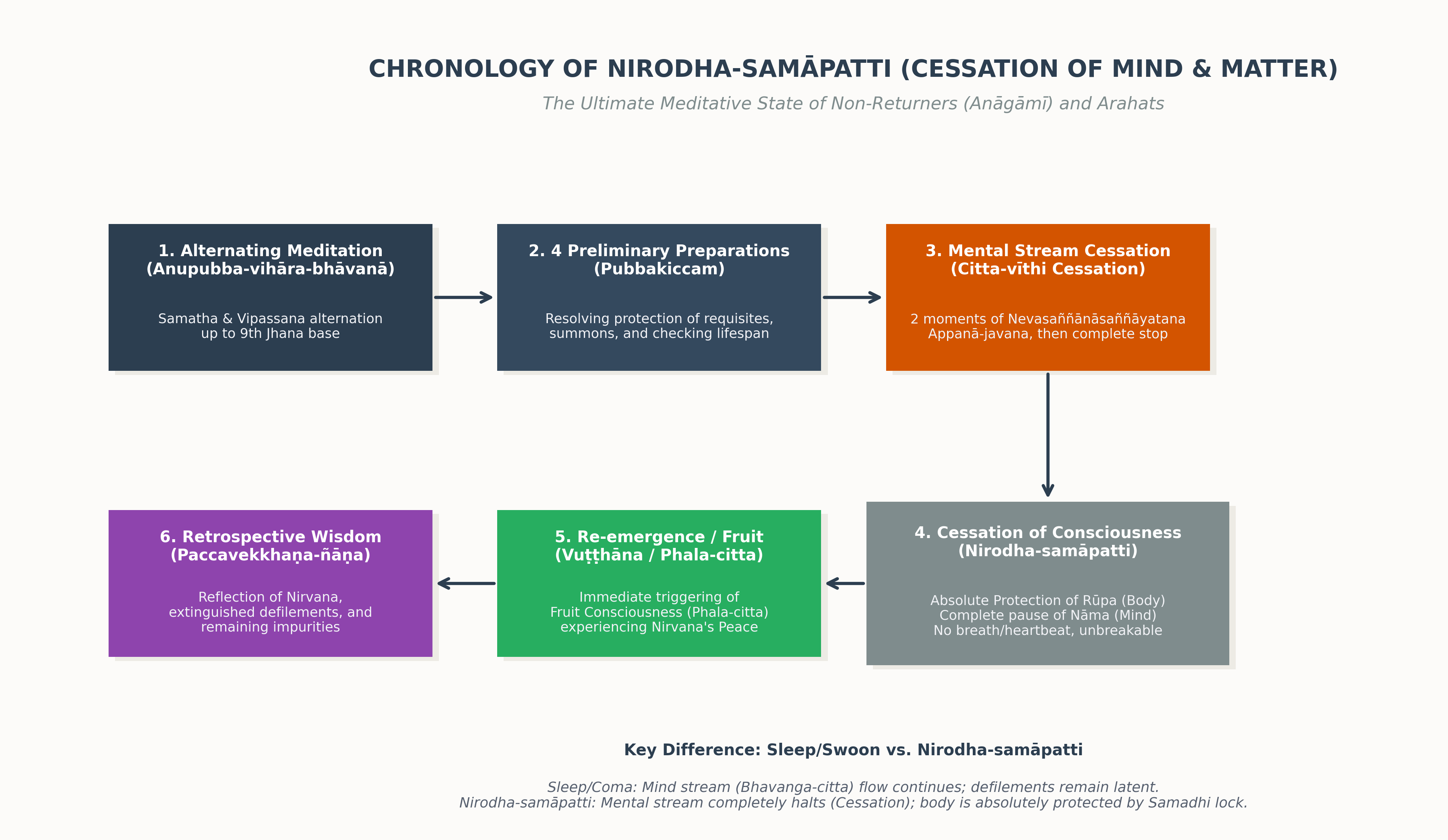
The diagram below illustrates the chronological sequence elucidated in Abhidhamma—from the total suspension of mind and mind-born matter (nāma-rūpa) to emergence (rebooting into waking life).
Figure 1: Suspension of the Mental Continuum and Emergence Process in Nirodha-samāpatti
■ Chronological Steps to Cessation and the Indestructible Living Body
The noble practitioner ascends sequentially from the First Fine-Material Jhāna up through the Third Immaterial Absorption ( the Sphere of Nothingness, ākiñcaññāyatana), practicing "alternating cultivation"—entering each absorption via Samatha, emerging, and contemplating its formations as impermanent, unsatisfactory, and non-self via Vipassanā. Immediately prior to entering the Sphere of Neither-Perception-Nor-Non-Perception (the eighth absorption), the sage makes four preliminary determinations (pubbakicca): (1) protection of requisites/belongings not directly connected to the body, (2) readiness to emerge should the Saṅgha summon them, (3) readiness to emerge should the Buddha summon them, and (4) verification of lifespan (confirming that one's remaining vitality exceeds the predetermined duration of up to seven days).
Entering the Sphere of Neither-Perception-Nor-Non-Perception in this state, after just two moments of ultra-subtle absorption impulsion consciousness (appanā-javana) flow by, the mental continuum (nāma) vanishes completely. In tandem with this, inhalation and exhalation, heartbeat, and mind-born metabolic activity come to a complete standstill (cessation of mind-born rūpa). By conventional medical criteria, this resembles clinical death; yet sustained by the life-faculty materiality (jīvitindriya-rūpa) and the profound harmony of the four primary elements conditioned by prior meditative mastery, the lived body remains incorruptible—shielded in an "indestructible equilibrium" untouched even by external fire or weapons. The canonical commentaries record the extraordinary account of Elder Sañjīva sitting in Nirodha-samāpatti deep in the forest: woodcutters and thieves, mistaking his motionless body for a dry stump, piled brushwood over him and set a roaring blaze, yet at sunrise the Elder emerged unscathed without a single burn, shook out his robes, and calmly walked on for alms.
Once the predetermined period (up to seven days) elapses, the suspended mental continuum automatically resumes within the body (emergence / vuṭṭhāna). At that very first instant of re-emergence, rather than ordinary life-continuum consciousness (bhavaṅga-citta), a single moment of either Non-Returner Fruition Consciousness (anāgāmi-phala-citta) or Arhat Fruition Consciousness (arahatta-phala-citta) arises, directly tasting the unconditioned peace of Nibbāna before seamlessly returning to everyday awareness.
■ Mechanics of an Arhat's Death-Consciousness (Cuti-citta) and Final Nibbāna (Parinibbāna)
When an ordinary being dies, the instant the final consciousness of this life—Death-Consciousness (cuti-citta)—ceases, without even a split-second intermediate gap, Rebirth-Linking Consciousness (paṭisandhi-citta) arises in the very next moment to inaugurate a new life, perpetuating saṃsāra. This occurs because the conditioned mind possesses a self-propelling momentum in which the perishing of the preceding moment acts as the contiguous condition ("nutriment") igniting the next.
However, at the moment of final passing (Anupādisesa-parinibbāna—Nibbāna without remainder of aggregates) of an Arhat who has eradicated every trace of defilement, this self-perpetuating engine stops completely. Within the Arhat's mind, not a single micron of "latent ignorance" (avijjānusaya) or "craving for existence" (bhava-taṇhā)—the karmic fuel required to ignite another birth—remains; throughout their awakened life, their active cognitive moments have operated purely through "Functional Consciousness" (kiriya-citta), which executes compassionate action while generating zero karmic residue for future rebirth.
Just as the Buddha illustrated—"When oil and wick are exhausted, the flame that was burning quietly goes out"—the conditioning force of mental waves subsides utterly. Never again does a new Rebirth-Linking Consciousness arise; what remains is serene dissolution into the unconditioned peace of Nibbāna, wholly beyond the reach of words, concepts, and dualistic predicates of existence or non-existence.
📚 Glossary of Abhidhamma Buddhist Psychology
Key Pāli and analytical terms central to this dialogue and to classical Abhidhamma psychology.
1. Mind and Matter (nāma-rūpa)
The two streams of objective experiential processes constituting a living individual: "Mind" (nāma—the flow of consciousness and mental factors/feelings) and "Matter" (rūpa—corporal and material processes).
2. Attainment of Cessation (nirodha-samāpatti)
The pinnacle of meditative absorption accessible only to Non-Returners and Arhats who possess the eight attainments, wherein consciousness (nāma) and mind-born bodily activity (rūpa) are temporarily brought to a 100% halt, realizing the peace of Nibbāna in the lived body.
3. The Seven Purifications (Satta-visuddhi)
The seven-stage ladder of progressive mental purification through ethical discipline, concentration, and Vipassanā insight—ascending from Purification of Virtue up to Purification by Knowledge and Vision.
4. Ten Corruptions of Insight (Vipassanupakkilesa)
Ten alluring mystical experiences—such as radiant illumination (obhāsa), rapturous joy (pīti), and deep bliss (sukha)—that arise as meditative clarity intensifies, acting as subtle traps if mistaken for final awakening.
The single threshold moment of mundane consciousness that, for the first time, releases conditioned phenomena and turns toward "Nibbāna," crossing from the lineage of an ordinary worldling into that of a Noble One.
6. Path Consciousness (magga-citta)
A supramundane consciousness arising for a single flash once per stage of awakening, instantaneously uprooting latent mental defilements so they can never arise again.
7. Fruition Consciousness (phala-citta)
Two or three moments of supramundane consciousness arising immediately after Path Consciousness, directly realizing and savoring the tranquil cessation of Nibbāna freed from defilements.
8. Functional Consciousness (kiriya-citta)
Purely functional consciousness operating in the daily actions and meditations of an Arhat—performing responsive activity without generating even a single drop of karmic potency (kamma) toward future rebirth.
9. Contiguity Condition (anantara-paccaya)
The causal law whereby the cessation of a preceding mental moment conditions the immediate arising of the succeeding moment without the slightest temporal gap—refuting both an eternal soul and an intermediate blank state.
10. Abhidhamma (Abhidharma)
Early Buddhism's rigorous system of phenomenological psychology and ontology, analyzing the teachings of the Sutta discourses down to irreducible ultimate phenomena (dhamma) and their conditional relations.

 AI Digest: A Precision Anatomy of "Non-Self" Surpassing East-West Psychology