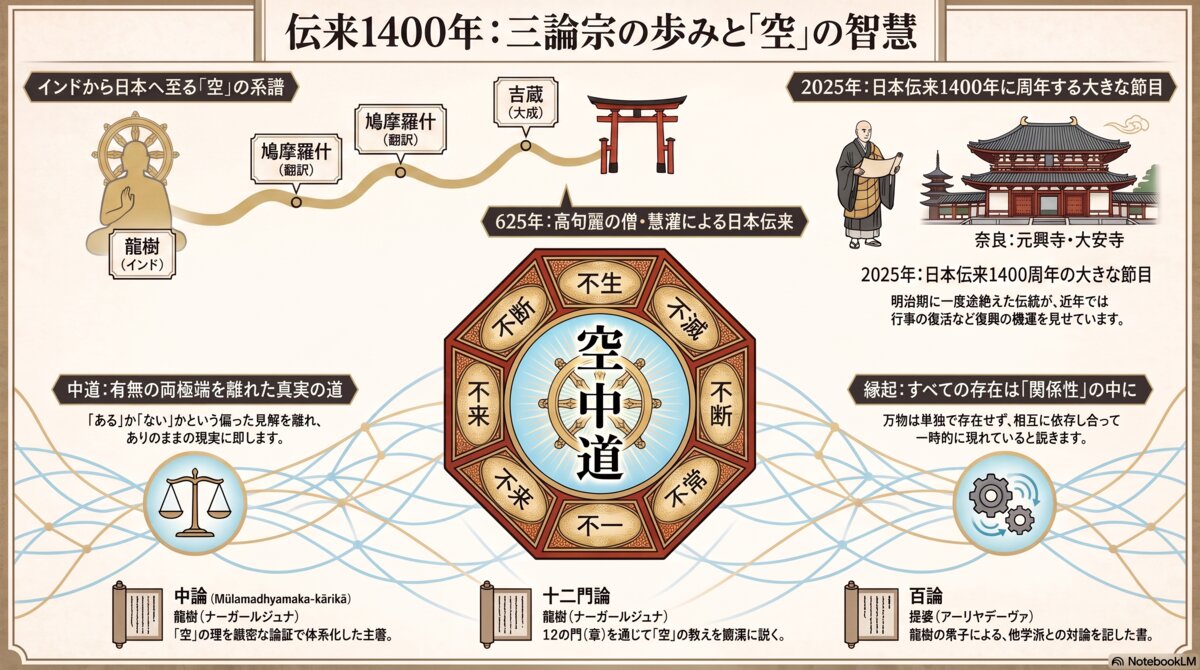
 AI Digest: A Lucid Logical Scalpel Dismantling the Spell of Language (Prapañca)
The dialectical architecture of Nāgārjuna's Mūlamadhyamakakārikā (Fundamental Verses on the Middle Way) is far from dry philology or abstract metaphysical speculation. Rather, it is a living system of cognitive and ethical praxis—a practical contemplative technology (meditative and reflective insight) enabling practitioners who confront ego-clinging and fixed worldviews (prapañca) every day to transform their perception and conduct at the root and awaken to liberation.
Designed to be revisited again and again as a "cognitive scalpel" on the meditation cushion or amidst everyday interpersonal friction, this dialogue dissects in rigorous detail how to break the spell of conceptual proliferation and dissolve grasping at "I" and "mine": traversing the realization of Twofold Selflessness, the Three Great Refutation Methods, the feedback-loop deconstruction of the Twelve Links of Dependent Origination, the Two Truths, "Not a Single Word Spoken," and the boundless dynamism of "Non-Abiding Nirvāṇa."
The foundational text of Madhyamaka, the Mūlamadhyamakakārikā, is commonly regarded as an exceedingly difficult and abstract philosophical treatise. Yet for practitioners engaged in meditation and everyday cultivation, why is the logic of the Mūlamadhyamakakārikā indispensable? Please explain, including the meaning of the phrase "the pacification of conceptual proliferation" (prapañcopaśama).
"Cognitive Surgery" Breaking the Spell of Language (Prapañca)
The greatest wall most practitioners encounter along the path of meditation is a stubborn mental inertia: "No matter how earnestly I try to brush away distracting thoughts, words and conceptual schemas keep bubbling up from the depths of consciousness, automatically defining myself and the world." In Buddhism, this linguistic habit of mind—being bound by words, reifying what lacks substance into rigid entities, and spinning out fruitless arguments and attachments—is called "conceptual proliferation" (prapañca).
Nāgārjuna's Mūlamadhyamakakārikā is by no means an "armchair philosophy book" divorced from meditative praxis. On the contrary, it is a "masterwork of cognitive surgery" that severs the conceptual proliferation nesting in the deepest recesses of the mind with the cool, razor-sharp scalpel of formal dialectic.
In the final verse of Chapter 25 of the Mūlamadhyamakakārikā, the ultimate horizon toward which the practitioner journeys is declared as follows:
"The pacification of all objectifying apprehension and the pacification of conceptual proliferation (prapañcopaśama) is auspicious peace [Nirvāṇa]. Nowhere, to no one, was any dharma ever taught by the Buddha."
This radical view of the Buddha's teaching—that the Buddha "did not utter a single word" (ichiji fusetsu)—reveals that the "complete stillness" remaining once every fixed linguistic definition has been pared away is itself the realm of non-clinging freedom. The significance of studying the Mūlamadhyamakakārikā for a practitioner lies in pushing formal logic to its absolute limit until the conceptual footholds of "self" and "other," "time" and "causality" give way completely, embodying Emptiness (Śūnyatā) as an open field of creative genesis (poiesis) where awareness leaps dynamically without fixating on anything.
To rightly understand "Emptiness" (Śūnyatā) and "Absence of Inherent Nature" (niḥsvabhāva), which form the bedrock of the Mūlamadhyamakakārikā, I first want to clarify what "inherent nature" (svabhāva) actually means. Also, what practical significance does realizing the "Twofold Selflessness" (selflessness of persons and selflessness of phenomena), emphasized in Tibetan Buddhism and elsewhere, hold for everyday life?
Thorough Deconstruction of "Self-Causation" and the Integrated Model Severing Ego-Grasping and Phenomenon-Grasping
The foremost illusion a practitioner must first clear away is "inherent nature / self-existence" (svabhāva).
In the Mūlamadhyamakakārikā, svabhāva refers to "something possessing 100% within itself the cause by which it stands as what it is (self-causation)." In other words, it denotes a fixed, immutable essence existing utterly alone, autonomously, and permanently, without requiring any relational dependence upon other causes and conditions.
Early Western Buddhologists and many modern readers tend to misread the teaching that "there is no inherent nature" (niḥsvabhāva / śūnyatā) as merely claiming "things have no defining characteristics" or "nothing exists at all (nihilism)." Yet the Aristotelian concept of static "essence" as an abstract property is foreign to classical Indian thought. In the Indian Madhyamaka context, svabhāva must be understood not as functional characteristics, but specifically as "self-causation" and "absolute independence requiring nothing outside itself."
■ Practical Approach to "Selflessness of Persons" and "Selflessness of Phenomena"
In systematically cultivating Madhyamaka insight, later Indo-Tibetan Buddhism (particularly the Gelug tradition founded by Tsongkhapa) placed paramount emphasis on realizing two dimensions of non-self: "Selflessness of Persons" (pudgala-nairātmya) and "Selflessness of Phenomena" (dharma-nairātmya).
- Selflessness of Persons (Dismantling Ego-Clinging): Untangling the delusion that an independent, permanent, unchanging soul or controlling agent (ātman) called "I" exists. In daily life we suffer by grasping ourselves as fixed entities—"I am a hopeless failure," "This is my unchangeable personality"—and this contemplation sees directly that no such reified "I" exists anywhere.
- Selflessness of Phenomena (Dismantling Phenomenon-Clinging): Untangling the delusion that the world surrounding us (the five aggregates, sense-spheres, elements, external matter, or objective doctrines) exists objectively and substantially from its own side.
At Nāgārjuna's time, the dominant Abhidharma school, the Sarvāstivāda ("School Teaching That All Exists"), negated an abiding personal soul (pudgala-nairātmya), yet insisted regarding the irreducible building blocks (dharmas) of the world that "their intrinsic essence exists substantially across past, present, and future" (sarvadā asti)—refusing to admit the selflessness of phenomena.
Against this subtle reification, Nāgārjuna demonstrated exhaustively that not only the personal "I," but "every constituent phenomenon (dharma) of the world is likewise 'empty' (śūnya), manifesting only transiently within networks of mutual interdependence (Dependent Origination / Pratītyasamutpāda)."
■ The Horizon of "Equal Realization of Twofold Selflessness" Opened by Candrakīrti
In the 6th–7th century, the great Prāsaṅgika-Madhyamaka master Candrakīrti introduced a pivotal breakthrough for practitioners in his Prasannapadā (Clear Words) and Madhyamakāvatāra (Entering the Middle Way). Whereas earlier commentators often divided the paths by claiming "Mahāyāna realizes the selflessness of phenomena, while Śrāvakas and Pratyekabuddhas realize only the selflessness of persons," Candrakīrti argued incisively: "Even Śrāvakas and Pratyekabuddhas cannot uproot mental afflictions at their root and attain liberation without thoroughly realizing the selflessness of phenomena (Emptiness) alongside the selflessness of persons."
In Candrakīrti's vision of the Three Vehicles, Śrāvakas, Pratyekabuddhas, and Bodhisattvas all equally realize the Twofold Selflessness. Through this insight, contemplating "the emptiness of the world" (dharma-nairātmya) and releasing "attachment to the personal self" (pudgala-nairātmya) became woven together into a single, inseparable rope of contemplative praxis.
How can we apply the dialectic taught in the Mūlamadhyamakakārikā right on the meditation cushion? Please explain how to practically cultivate the three logical filters presented by Nāgārjuna: Refutation via Identity and Difference, Refutation of the Three Times, and Refutation of Causal Production.
Three Logical Filters for Experientially Grasping "Emptiness & Absence of Self-Nature"
To shatter the illusion of inherent existence (svabhāva / self-causation), the practitioner applies three logical filters (contemplative methods) directly to whatever "object of attachment" arises during meditation or daily friction, restoring lucid awareness.
Method 1: Refutation via Identity and Difference (Ekatva-anyatva-pratiṣedha) — Severing the Fusion of Agent and Action
In everyday speech we habitually think in terms of "a walker is walking" or "an angry 'I' am feeling angry," splitting reality into a [Substantial Subject / Agent] and an [Activity / Phenomenon]. In Chapter 2 of the Mūlamadhyamakakārikā (Examination of Motion), Nāgārjuna completely dismantles this fused dualism of agent and action.
In lived reality, all that occurs phenomenologically is the dynamic event of "moving" (the process of walking). Observing that movement, our conceptual mind retroactively fabricates the noun "walker (mover)." Caught in the grammar of thought, however, we invert reality and imagine: "First an independent person (agent) exists, and then that person performs the act of walking."
Here Nāgārjuna poses a two-pronged inquiry:
- Are they "Identical" (One and the Same)? If the "walker" and the "act of walking" were 100% identical, agent and action could never be distinguished, and the person would cease to exist the moment they sat down.
- Are they "Different" (Separate Entities)? If the two existed as wholly independent, unrelated entities, there could be a standalone "walker" without any act of walking occurring at all, and an "act of walking" floating in midair with no one walking—an obvious contradiction.
[Application in Meditation]: When anxiety or anger surges during meditation, subject "the angry 'I' (agent)" and "the emotion of anger (phenomenon)" to this Refutation via Identity and Difference: "Are the 'I' who feels angry and the phenomenon of anger identical, or separate?" If identical, no observer could even notice the anger; if separate, there would be a bizarre "angry self" wholly untouched by any feeling of anger. Unsticking the fusion of subject and phenomenon in this way, one realizes right on the spot: "There is merely the dependently arisen event of anger surging and passing—nowhere is there a fixed ego-entity (svabhāva) who owns it," landing immediately in quiet ease (Non-Self / Emptiness).
[Contemplative Model: Refutation via Identity & Difference]
  "Anxiety is surging"
   │
   ├─► "The 'I' holding anxiety (Subject / Agent)"
   └─► "The feeling of anxiety (Activity / Phenomenon)"
         │
         ├──► [Identical?] ──► Subject & emotion collapse; observation impossible (×)
         └──► [Separate?]  ──► Contradiction of an "anxious I" feeling zero anxiety (×)
               │
               └───► "Neither identical nor separate" = Neither exists as an independent entity
Method 2: Refutation of the Three Times (Kāla-parīkṣā) — Liberation from Temporal Determinism
We often bind ourselves through the reification of time: "a present dragged down by past trauma" or "a present consumed with panic over an unseen future." Scholastic schools such as the Sarvāstivāda sought to freeze time into a substantial linear conveyor belt in which substantial entities travel from future into present and into past, like a seed substantively turning into a fruit.
In Chapter 19 (Examination of Time), Nāgārjuna deconstructs all three temporal divisions—past, present, and future. If the "present" depends upon the "past" to exist, then while the past existed the present was not yet born, and when the present is here the past has already perished. How can non-existent entities prop each other up or mechanically determine one another? Reifying time traps every living moment inside a suffocating determinism in which the present is 100% shackled by the past.
[Application in Meditation]: When assailed by regret over the past or dread of the future during meditation, activate this Refutation of the Three Times: "There is no substantial present chained by a still-existing past, nor a present held hostage by an already-existing future." Resetting the reified timeline in which past, present, and future lock one another down reveals the "Pure Now (the Now of the Fourth Lemma)"—alive with open fluctuation and bound by nothing. Precisely because nothing is rigidly predetermined, fresh vitality (poiesis) and transformation become possible in this very instant.
Method 3: Refutation of the Four Extremes of Causal Production — Dismantling the Hardest Schema of Cause and Effect
The most stubborn cognitive schema for any practitioner is substantialist causality: the assumption that "an inherently real Cause A produces an inherently real Effect B."
Exposing the logical impasse between independent causes and dependent effects, Nāgārjuna demonstrates that if things possessed inherent existence (svabhāva), their arising could occur in only four conceivable ways (the Catuṣkoṭi / Tetralemma of Causation):
- "Production from Self" (svataḥ): Something produces itself out of itself (self-causation).
- "Production from Other" (parataḥ): An intrinsically separate cause produces an intrinsically separate effect.
- "Production from Both" (dvābhyām): Self and Other combine to produce it.
- "Production Without Cause" (ahetutaḥ): Things pop into existence randomly out of nowhere.
At the very opening of Chapter 1 of the Mūlamadhyamakakārikā (Examination of Conditions), Nāgārjuna refutes all four. If something arises from itself, what already exists would pointlessly be born all over again without end. If it arises from an inherently separate "Other," cause and effect would be total strangers sharing zero intrinsic connection, meaning anything could arise from anything (rice sprouting from a stone, or darkness springing from a flame). "Both" inherits the contradictions of the first two, and "Without Cause" collapses all meaningful action and effort.
[Application in Meditation]: We habitually lock our suffering into a rigid causal chain: "Because this stressor exists (Cause), I am miserable (Effect)." Through this causal refutation, however, we contemplate: "Neither the cause nor the effect stands alone with its own inherent nature; both appear like reflections solely within mutual relational dependence (Dependent Origination)." The moment we cease reifying cause and effect into iron links, the heavy chain of suffering loosens, leaving only a spacious, dynamic field of living relationships.
How does the Mūlamadhyamakakārikā reinterpret the "Twelve Links of Dependent Origination" (dvādaśāṅga-pratītyasamutpāda) taught since Early Buddhism so as to halt our afflictions here and now? Please explain, incorporating the "Simile of Fire and Fuel" (the Buddha's dialogue with Vacchagotta).
Halting the "Looping Affliction Gears" and the Extinguishment (Nirodha) That Grows Still Right on the Spot
The Twelve Links of Dependent Origination (beginning with Ignorance and culminating in Aging-and-Death) are popularly interpreted embryologically as a linear, three-lifetime fatalism: "Ignorance in a past life produces suffering in this life and propels one linearly toward death in the next."
In the light of the Mūlamadhyamakakārikā (culminating in Chapter 26 alongside his earlier analyses), Nāgārjuna applies the non-substantialist dynamic of mutual dependence to the Twelve Links, unveiling a radically immediate structure. Rather than standing as isolated dominoes in a single straight line, adjacent links operate as a mutually reinforcing "feedback loop" (an affliction-amplification system) in which paired factors presuppose and intensify one another right now:
- Ignorance (avidyā) and Volitional Formations (saṃskāra): Primordial misapprehension breeds compulsive karmic patterning, and those compulsive habits thicken misapprehension.
- Consciousness (vijñāna) and Mind-and-Matter (nāma-rūpa): Cognizing awareness and the cognized psychophysical field stand up together by leaning on one another like two sheaves of reeds.
- Craving (tṛṣṇā) and Clinging (upādāna): Because there is thirsting desire one clings tightly, and because one clings tightly desire blazes all the hotter.
The escalation of attachment and vicious emotional spirals we experience every day are precisely these interlocking gears spinning at high speed, self-amplifying affliction.
[Feedback-Loop Model of the 12 Links of Dependent Origination (Forward Cycle)]
  ┌────────────────────────────────────────────────────────────────────────────┐
  ▼                                                                            │ (Affliction Amplification)
[Ignorance] ◄──► [Formations] ◄──► [Consciousness] ◄──► [Nāma-rūpa] ◄──► [Craving] ◄──► [Clinging] ──► [Aging & Death / Suffering]
  ▲                                                                            │
  └────────────────────────────────────────────────────────────────────────────┘
                                       │
              [ Severing the Feedback Loop via Non-Substantiality (Reverse Contemplation) ]
                 Seeing through the mutual dependence (Emptiness) of Subject & Object
                                       │
                                       ▼
             Tranquil Cessation (Nirodha) as "Non-Arising & Pacification of Prapañca"
■ Praxis of Reverse Contemplation (Cessation) — Disengaging the Gears
To bring this affliction-amplifying loop to a halt (the cessation cycle / pratiloma), the practitioner drives the wedge of "Absence of Self-Nature (Emptiness)" right between the meshing gears. For instance, at the very moment "Consciousness (the cognizing subject)" and "Nāma-rūpa (the cognized phenomenon)" arise together, one contemplates within meditation: "Are the cognizing 'I' and the cognized object identical, or inherently separate?" The instant one sees directly that neither possesses independent substance—that both appear transiently like mirages solely through mutual dependence—the thermal energy of the feedback loop loses its footing and cools down rapidly on the spot. This is none other than the experiential reality of Early Buddhism's original "Tranquil Extinguishment" (nirodha), wherein the roaring fire of affliction runs out of fuel and goes out right here.
■ The Dialogue Between the Buddha and Vacchagotta — The Ultimate Relief of "Fire and Fuel"
The celebrated analysis of "Fire and Fuel" developed in Chapter 10 of the Mūlamadhyamakakārikā (Examination of Fire and Fuel) draws inspiration from the Buddha's famous dialogue with the wanderer Vacchagotta (Aggivacchagotta Sutta). Vacchagotta pressed the Buddha: "Where does a liberated sage go after death? Do they exist somewhere in the universe, or are they annihilated into utter nothingness?"
Pointing to a blazing fire before them, the Buddha asked in return: "Vaccha, if this fire burning in front of you goes out when its fuel of grass and twigs is exhausted, in which direction has the fire gone—east, west, north, or south?" Vacchagotta replied: "The question does not apply, Gotama. Because the fuel of grass and twigs that sustained its burning was exhausted, it has simply grown cool and been extinguished right on the spot."
The Buddha declared: "Even so, Vaccha, is the liberated sage. Because the fuel that kept the fire of 'I' blazing—clinging to the five aggregates, craving, and conceptual grasping—has been completely exhausted, it has simply grown cool and still (nibbuta) right where it is. Neither has an entity traveled elsewhere, nor has an existing self been destroyed into nothingness."
This luminous intuition is the primordial Buddhist "ultimate peace (śānti / nirodha)" that Nāgārjuna sought to rescue from the substantialist metaphysics of Abhidharma scholasticism. We have zero reason to fear annihilation or a bleak void: the praxis of Emptiness is simply the process whereby the fruitless feedback loop (the feverish fire of prapañca) that has kept us scorched and unfree quietly loses its heat right where we sit.
If we push the ultimate truth that "all things are empty, neither arising nor ceasing" to its conclusion, doesn't that risk collapsing into nihilism—negating everyday moral responsibility and the value of spiritual practice itself? How did Nāgārjuna answer this objection? And what is the true meaning of the saying, "The Buddha did not utter a single word"?
Conventional Truth (Linguistic Foothold), Ultimate Truth (Wordless Reality), and "Complete Silence"
When the teaching that "all things are empty, without arising or ceasing" is heard superficially, a grave objection immediately arises: doesn't such radical emptiness negate the Four Noble Truths (suffering, origin, cessation, path), the stages of spiritual realization, and even ethical cause and effect (karma), plunging humanity into nihilism?
To answer this very critique, Nāgārjuna sets forth in Chapter 24 of the Mūlamadhyamakakārikā (Examination of the Four Noble Truths) his celebrated doctrine of the "Two Truths" (satya-dvaya):
- Conventional Truth (saṃvṛti-satya): Truth operating on the plane of everyday language, pragmatic concepts, and relational conventions (discriminative cognition). Everyday ethics, interpersonal responsibility, meditative curricula, and the instruction to "overcome suffering" all belong indispensably to this dimension.
- Ultimate Truth (paramārtha-satya): Direct, non-dual realization of interdependent reality exactly as it is, wholly transcending verbal fabrication and conceptual reification (non-discriminative wisdom / nirvikalpa-jñāna).
Nāgārjuna declares with unmistakable clarity (MMK 24.10): "Without relying upon everyday conventional practice (vyavahāra / saṃvṛti), the ultimate truth cannot be taught; and without realizing the ultimate truth, Nirvāṇa cannot be attained."
Practitioners first stand firmly upon language and ethical convention (saṃvṛti-satya) to restrain harmful actions and cultivate meditative discipline with integrity. Ultimately, however, even that linguistic scaffolding must be released as empty (paramārtha-satya). Neither scorning everyday ethical life to escape into detached mysticism, nor clinging dogmatically to words as absolute entities, accords with the Middle Way.
■ "Not a Single Word Spoken" (Ichiji Fusetsu) — The True Intent of the Buddha's Silence
The declaration at the close of Chapter 25 (Examination of Nirvāṇa)—that throughout his entire teaching career "no dharma was ever taught by the Buddha" ("not a single word spoken")—elevates a practitioner's relationship with language to the highest degree of metacognitive vigilance.
Why would the Buddha, who left behind vast baskets of discourses, be said not to have spoken a single word? Commenting on this verse, Candrakīrti demonstrates: "Had even a single inherently existent referent of language existed anywhere in the world, the Buddhas would have proclaimed it. Yet because no inherently existent entity (svabhāva) serving as the fixed referent of words exists at all, there was never any substantive thing for the Buddha to assert."
The Buddha's dharma-discourse is likened to "a master illusionist conjuring one illusory figure (skillful verbal teaching) in order to dispel the terror and suffering of another illusory figure (deluded beings)." Brought directly back to meditative praxis, this means: "No matter how sublime a 'vision of enlightenment' or 'sacred phrase' may dawn during meditation, it too is a conditioned appearance—empty of inherent nature—and must never be grasped as an absolute trophy." Attuning oneself to the Buddha's unbroken silence is the royal road to freeing awareness from the spell of conceptual proliferation.
Having thoroughly dismantled conceptual proliferation and embodied the truth of Emptiness, how does the practitioner ultimately live in this world? Please explain the way of life depicted by "Non-Abiding Nirvāṇa" (apratiṣṭhita-nirvāṇa) and how this resonates with Matsuo Bashō's famous "old pond" haiku.
The Non-Distinction of Saṃsāra and Nirvāṇa, and the "Dynamic Altruism" of the Mahāyāna
At the culmination of dismantling conceptual proliferation through Emptiness in the Mūlamadhyamakakārikā, the supreme existential compass reached by the Mahāyāna practitioner is "Non-Abiding Nirvāṇa" (apratiṣṭhita-nirvāṇa).
In Chapter 25, Nāgārjuna draws a conclusion that shakes every dualistic spiritual assumption to its core (MMK 25.19):
"There is not the slightest distinction of saṃsāra from nirvāṇa. There is not the slightest distinction of nirvāṇa from saṃsāra."
When we let go of reified notions of "Being" and "Non-Being" and behold all phenomena as "devoid of inherent self-nature (empty)," the "unfree everyday world of saṃsāra" we once loathed and the "pristine realm of nirvāṇa" we longed to escape into lose every ontological boundary between them (saṃsāra is none other than nirvāṇa). This very lived world (Umwelt) in which we breathe and meet others—once our cognitive grasping (ego-clinging) undergoes a 180-degree revolution (āśraya-parāvṛtti)—reveals itself right as it is to be unconditioned Nirvāṇa.
A Bodhisattva awakened to this non-duality of saṃsāra and nirvāṇa embodies a twofold transcendence ("non-abiding"):
- 1. Through Great Wisdom (Mahāprajñā), Not Abiding in Saṃsāra: Having seen completely through to the emptiness (niḥsvabhāva) of all phenomena, the Bodhisattva acts in the thick of the world without being stained, deluded, or ensnared by worldly afflictions and relational turmoil.
- 2. Through Great Compassion (Mahākaruṇā), Not Abiding in Nirvāṇa: Beholding countless sentient beings suffering because they have not yet recognized emptiness, out of deep, visceral resonance (Mahākaruṇā) the Bodhisattva refuses to retreat alone into quiescent extinction.
Transcending the deluded world through Great Wisdom while simultaneously returning right into the midst of that world through Great Compassion to engage in boundless, responsive service—this is "Non-Abiding Nirvāṇa," the freest and most creative mode of human existence envisioned by Mahāyāna Buddhism.
[Praxis Matrix of "Non-Abiding Nirvāṇa" (Apratiṣṭhita-nirvāṇa)]
                       [ Great Wisdom (Mahāprajñā) ]
                     Unfettered freedom amidst the world
                                   ▲
                                   │
 Not Abiding in Saṃsāra ◄──────────┼──────────► Not Abiding in Nirvāṇa
 (Unstained by delusion)           │            (Never retreating into solitary quietude)
                                   ▼
                     [ Great Compassion (Mahākaruṇā) ]
                 Vitality returning to engage with all beings
In his Madhyamakāvatāra, Candrakīrti invokes the famous "Parable of the Conjured City" from the Lotus Sūtra. When exhausted travelers crossing a perilous desert toward a "Treasure Island" (full Buddhahood) were about to give up in despair, their wise guide conjured an illusory resting city so they could recover their strength; once they were refreshed, he dissolved the mirage and led them onward. The quiescent Nirvāṇa of severing all worldly ties is merely a compassionate "Conjured City" provided temporarily along the way so weary seekers do not lose heart.
The true destination of practice is not the mute silence of a barren void, but "the endless, living process itself—robed in the unfettered wisdom of Emptiness (Mahāprajñā), engaging dynamically with others through the warmth of Great Compassion (Mahākaruṇā), and co-creating the world anew moment by moment."
■ Conclusion: A Living Worldview of "Neither Being Nor Non-Being" Resonating with Haiku and Lived Environment
The "Emptiness" of the Mūlamadhyamakakārikā is neither a bleak nihilism denying all value, nor a metaphysical realism positing an external transcendent deity. Rather, it is an extraordinarily supple, life-affirming worldview: "Everything exists by resonating transiently and fluidly within living webs of interdependence (Dependent Origination)."
East Asian aesthetic sensibility has long breathed this insight of non-substantiality (Śūnyatā) into haiku poetry, reverence for nature, and everyday mindfulness. Consider Matsuo Bashō's immortal verse:
"An ancient pond — / a frog leaps in, / the sound of water."
(Furuike ya / kawazu tobikomu / mizu no oto)
Here there is no "substantialist separation causality" in which an independent, pre-existing "old pond (container)" sits first, an isolated "frog (object)" jumps into it from outside, and a separate "sound" is mechanically produced afterward. Instead, the deep hush of the ancient pond, the arc of the leaping frog, and the clear plash of water arise together simultaneously in a single relational flash (Dependent Origination), each illuminating and bringing forth the others as "one dynamic Now." Neither the pond, nor the frog, nor the sound sits there possessing an isolated svabhāva of its own.
Our daily meditation, quiet reflection, and mindful stocktaking of everyday life are nothing other than a continuous practice of "leaning toward neither extreme, clinging to nothing, and melting gracefully into the richness of living relationships (Madhyamaka)."
Because all things are empty, anything can be born anew. Because all things are relational, we can connect with others at the deepest level. Before the practitioner who has walked through the lucid logical blade of the Mūlamadhyamakakārikā opens a radiant world where fruitless conceptual chatter has fallen still (prapañcopaśama)—auspicious, unencumbered, and ceaselessly renewing itself in creative genesis (poiesis).
Essential Sanskrit and contemplative terms central to this guide and to the praxis of Nāgārjuna's Mūlamadhyamakakārikā.