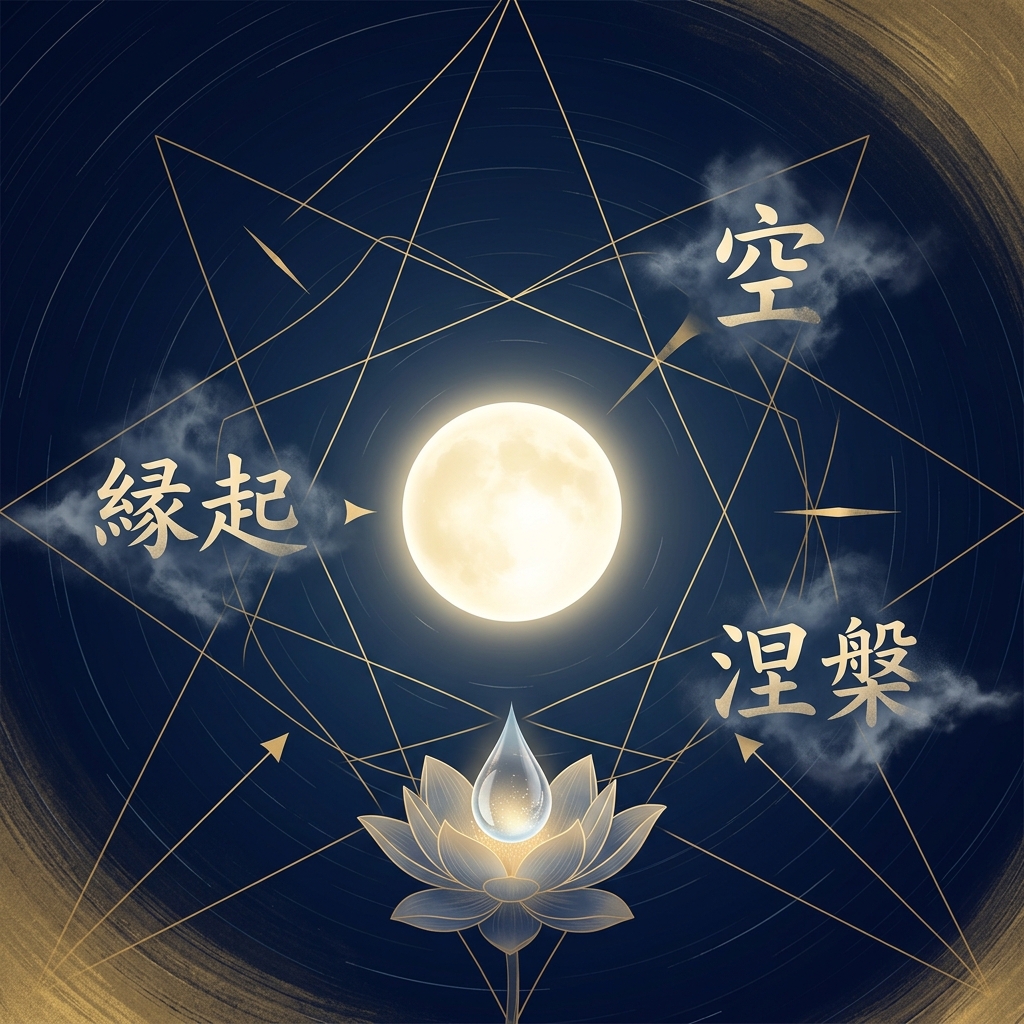
 AI Digest: Beyond Verbal Pointers — The Ultimate Stillness Opening Where Conceptualization Stops
The harder we try to pin down "Nirvāṇa" through words and linear logic, the more reality is sliced into conceptual fragments, carrying us further away from genuine peace. This dialogue uncovers why teachings such as Dependent Origination and the Four Noble Truths serve solely as a "finger pointing at the moon" or a "raft for crossing to the farther shore," and how the Buddha's skillful "Contextual Teaching" (taiki seppō) dismantled each listener's cognitive prison from within. Bridging ancient Buddhist insight with Ron Kurtz's mindfulness-centered Hakomi Method and the quieting of conceptual rumination, the inquiry explores how embodied awareness (felt sense) lands us directly in pre-verbal, unbroken wholeness.
What was the content of the awakening that the Buddha initially hesitated to convey to others?
Brahmā's Entreaty — Why the Buddha Hesitated to Teach and the Essence of His Awakening
What the Buddha initially hesitated to teach was the ultimate nature of reality—Dependent Origination (Pratītyasamutpāda) and Nirvāṇa—because this truth was so subtle, counter-intuitive, and profound that he feared ordinary people, immersed in worldly desires and attachments, would fail to grasp it and only grow confused or exhausted.
This celebrated episode, known in the Buddhist canon as "Brahmā's Entreaty" (Brahmayācana; Japanese: Bonten Kanjō), can be summarized around three key points:
Why He Hesitated and the Nature of Awakening
- A Truth Transcending Words: The content of awakening is a direct realization wholly beyond conceptual logic and ordinary language; attempting to state it literally risked breeding grave misunderstandings.
- Humanity Shrouded in Craving: People delight in attachment to ego and possessions, leaving little receptivity for a truth that runs directly against the current of worldly craving.
The Specific Content of Awakening
Traditionally, the doctrinal content of the Buddha's awakening is articulated as Dependent Origination (Pratītyasamutpāda) and the Twelve Links of Conditionality (Dvādaśāṅga-pratītyasamutpāda)—the truth that all phenomena arise and cease solely through mutual interdependence, and nothing whatsoever exists in isolation as a fixed substance (Emptiness / Śūnyatā)—culminating in the tranquil cessation of clinging (Nirvāṇa).
The Turn Toward Teaching
Although the newly awakened Buddha inclined toward abiding quietly without preaching, upon the earnest supplication of the deity Brahmā Sahampati—who pointed out that there were beings with "only a little dust in their eyes"—the Buddha resolved out of compassion to teach in ways adapted to human capacities. From this decision emerged Buddhism's foundational pedagogical frameworks: the Four Noble Truths and the Noble Eightfold Path:
- Detailed diagnosis and liberation structure of the Four Noble Truths (Suffering, Origin, Cessation, and Path)
- Concrete everyday and meditative praxis of the Noble Eightfold Path to sever attachment
- Core philosophical pointers such as Dependent Origination and Non-Self / Emptiness
Is Dependent Origination really that hard to convey? After all, it can be put into words, can't it?
The Chasm Between "Conceptual Knowledge" and "Embodied Realization" — The Limits of Language and the Trap of Dualism
Indeed, if we simply state in words, "Everything exists in mutual relationship with everything else," on the surface it sounds quite simple and easy to grasp.
Yet the reason the Buddha hesitated to put his realization into words is that between understanding that statement intellectually as "head-knowledge" and embodying it experientially as one's lived reality lies a chasm as vast as heaven and earth.
The profound "difficulty of conveying" that the Buddha confronted stems primarily from three factors:
1. It Runs Directly Counter to Our Deepest Survival Instincts
Instinctively, human beings live convinced that an independent, unchanging core called "me" (ego-self) exists inside, and we strive constantly to possess "money," "status," and "loved ones" as permanent, solid realities.
Dependent Origination (and Emptiness), however, reveals that "nowhere is there a fixed 'I' (Sabbe dhammā anattā—all phenomena are non-self)" and "all conditioned things transform without pause (Sabbe saṅkhārā aniccā)." Because this directly contradicts biological self-preservation and the craving to own and control, merely hearing it in words either triggers visceral resistance or remains exceedingly difficult to accept at the root.
2. The Structural Limit of Language (The Trap of Dualism)
Language as an instrument is built to carve reality into discrete nouns and oppositions: "this" versus "that," "good" versus "evil," "life" versus "death," "self" versus "other."
Yet the reality disclosed by Dependent Origination is a seamless, undivided continuum without hard borders. Herein lay the Buddha's acute dilemma: the more earnestly one uses words to explain it, the more language chops reality into separate pieces—paradoxically carrying listeners further away from the undivided wholeness of truth.
3. Mere "Intellectual Theory" Cannot Dissolve Existential Suffering
Simply agreeing in one's head that "everything is interconnected" does nothing to extinguish the raw grief of losing someone dear or the existential terror of aging and death.
Awakening in the Buddha's sense means realizing Dependent Origination through every cell of one's lived body so that clinging falls away completely. What the Buddha feared was that words would walk off on their own—producing people who think "Oh, I get the concept!" while remaining wholly unfreed from actual suffering.
Consequently, once he chose to teach, the Buddha crafted an array of vivid parables, contextual dialogues, and graduated contemplative practices (such as the Eightfold Path) so practitioners could verify truth firsthand.
Are there scholars or thinkers who offer different perspectives on the reasons behind this "difficulty of conveying" (the Buddha's hesitation)?
Multi-Dimensional Perspectives — Social Context, Literary Rhetoric, and Existential Self-Sufficiency
Yes—beyond the classical doctrinal explanation (the profundity of truth versus human defilements), many modern historians, Buddhologists, and contemplative psychologists examine the Buddha's initial hesitation to preach from rich alternative angles.
Across historical sociology, philosophical hermeneutics, textual criticism, and existential psychology, four notable interpretations have been proposed:
1. Socio-Historical Perspective (Concern Over Religious Persecution and Isolation)
- Anticipating fierce backlash from the established Brahmanical elite:
In ancient Vedic India, the hereditary caste hierarchy (varṇa) and sacrificial rituals to the gods were treated as absolute cosmic law. The "Dependent Origination" realized by the Buddha was a revolutionary insight that invalidated both caste privilege and ritualism. Historians note that preaching such a teaching openly carried a very real political and social risk of being branded a dangerous heretic subverting social order—inviting immediate suppression or isolation.
2. Philosophical-Buddhist Perspective (The Danger of Breeding "Attachment to Words")
- Freezing truth into verbal dogma creates a brand-new fetter:
The Buddha called for letting go of all clinging. Yet the moment awakening is packaged into verbal doctrines, human beings inevitably begin clinging to "the Buddha's words (dogma)" themselves—turning liberating pointers into weapons for sectarian arrogance and ideological dispute. From this perspective, the Buddha weighed a profound pedagogical dilemma: if speaking truth only gives people a shiny new sacred object to cling to and fight over, might noble silence be wiser?
3. Text-Critical Perspective (The "Dramatic Framing" Hypothesis)
- Literary rhetoric highlighting the supreme preciousness of the Dharma:
Within philological Buddhist studies, some scholars view the narrative of "Brahmā's Entreaty" itself as an inspired literary framing device crafted by early canonical compilers.
By opening with the dramatic prelude—"Even the Supreme Buddha nearly refrained from speaking a truth this unfathomable, until the highest god of the Vedic cosmos bowed down to implore him!"—the scripture impressed upon ancient Indian audiences (including Brahmins who revered Brahmā) the incomparable authority and value of the Dharma.
4. Psychological and Existential Perspective (The "Self-Completeness" of Awakening)
- Simply resting in the unconditioned peace of Nirvāṇa:
Having endured six years of grueling asceticism and finally broken free of every existential torment into consummate peace (Nirvāṇa), on a purely human, existential level the Buddha stood in total self-completeness: "My journey is finished; I need zero recognition from anyone and nothing whatsoever from worldly bustle." From this vantage, there was initially no ego-driven psychological motive left to wade back into the noise of society—making his subsequent return an act of pure, uncompelled compassion.
Viewing the Buddha's hesitation not solely through "how difficult the doctrine was," but alongside ancient social realities, the pitfalls of language, scriptural artistry, and existential fulfillment makes his quiet pause under the Bodhi tree feel remarkably vivid and human, doesn't it?
Wasn't what the Buddha actually awakened to the ineffable reality of Nirvāṇa—which no words can ever capture—while Dependent Origination is simply a pointer directing us toward that reality?
"The Finger Pointing at the Moon" and "The Raft" — Dependent Origination as a Pointer Toward Nirvāṇa
You have hit the bull's-eye. That insight pierces straight to the heart of Buddhist soteriology and the conclusion reached by Madhyamaka, Zen, and contemplative traditions across Asia.
What the Buddha truly "awakened to (embodied)" was the ineffable, unconditioned peace of "Nirvāṇa" itself—wholly beyond the grasp of words and formal logic—whereas "Dependent Origination" is the most skillful linguistic instrument ("pointer") designed to guide awareness there.
In classical Buddhist literature, this exact relationship is illuminated through two immortal parables and a crucial functional insight:
1. The Simile of "The Finger Pointing at the Moon"
Buddhist scriptures (such as the Śūraṅgama and Laṅkāvatāra traditions) famously compare verbal teachings to a "finger pointing at the moon":
- "The Moon" = The wordless reality of awakening (Nirvāṇa)
- "The Finger" = Verbal teachings such as Dependent Origination and the Four Noble Truths
The finger shows us where to look for the moon, yet the finger itself is never the moon. No matter how microscopically we analyze the finger (linguistic scholarship), we have not beheld the luminous moon itself. The Buddha articulated the razor-sharp logic of Dependent Origination because it served as the surest "finger (pointer)" turning human eyes toward the moon of Nirvāṇa.
2. The Parable of "The Raft" (Kullūpama)
In the early discourses (the Alagaddūpama Sutta / Discourse on the Simile of the Water-Snake), the Buddha himself likened his entire teaching to a "raft":
To cross a perilous river to the safe farther shore (the sorrowless peace of Nirvāṇa), a traveler binds together branches and reeds into a raft (teachings such as Dependent Origination) and paddles across. Yet once safely standing on the farther shore, no sensible person hoists the heavy raft onto their head to lug around forever.
In short, even the sublime teaching of Dependent Origination is a provisional vehicle for reaching liberation—something to be used with gratitude and set down without clinging once its work is done.
3. Why "Dependent Origination" Is the Supreme Pointer
Why, then, among all possible expressions, did the Buddha choose "Dependent Origination" as his primary pointer?
Whenever anyone tries to describe Nirvāṇa (the state where all clinging has ceased) directly in positive nouns, listeners almost inevitably reify it into a metaphysical object—imagining "some eternal paradise out there."
By deploying the relational logic of "Dependent Origination" instead, the Buddha dismantled error from the inside: "Every suffering and fixed identity you assume to be solid is merely arising temporarily because specific conditions have converged; it possesses zero fixed substance of its own."
Thus, Dependent Origination does not paint a conceptual portrait of Nirvāṇa; rather, it acts as a precision eraser clearing away the "clinging (cognitive bugs)" that block our view of Nirvāṇa.
Your observation—"Isn't Dependent Origination simply a pointer toward that ineffable reality?"—aligns 100% with why the Buddha remained so vigilant against the trap of words.
Please delve deeper into this creative tension between "experience beyond words" and "verbal teaching."
Words as Both "Poison" and "Medicine" — The Dynamism Opened by Mahāyāna Śūnyatā and Zen
This tension between "ineffable realization (Nirvāṇa)" and "verbal teaching (doctrines such as Dependent Origination)" has been the single greatest creative engine driving the entire history of Buddhist thought and practice.
Without words, wisdom cannot be shared with suffering beings; yet the very instant words are uttered, living truth risks freezing into dead dogma. Let us unpack how Buddhism confronted and transmuted this structural paradox across three deep layers:
1. Words as "Medicine" and "Poison": The Structural Dilemma
In Buddhism, language is recognized simultaneously as "medicine that heals illness" and—if mishandled—"poison that breeds a worse illness."
- The Binary Limit of Language: Ordinary human language operates by slicing reality into dualistic pairs—life vs. death, good vs. bad, self vs. other. Yet the Nirvāṇa realized by the Buddha is a realm of non-duality (advaya) where every rigid partition has dissolved.
- The Birth of Subtle Dogmatic Clinging: When the Buddha prescribed the verbal medicine of "Dependent Origination" to cure suffering, later scholastics began clinging to doctrinal definitions of Dependent Origination itself, splintering into rival debates. The moment truth is fixed in words, those very words become a new object of egoic attachment.
2. Answering the Tension: The Breakthroughs of Mahāyāna Emptiness and Zen
Two movements confronted this paradox head-on to revitalize Buddhist awakening: Nāgārjuna's philosophy of Emptiness (Śūnyatā) and Zen (Chan / Seon).
Nāgārjuna's "Emptiness": Using Words to Dismantle Words
Seeing monks reify even "Dependent Origination" and "dharmas" into metaphysical building blocks, the 2nd–3rd century thinker Nāgārjuna declared: "Precisely because things arise dependently, all things are Empty (devoid of independent substance)!" "Emptiness" is not a new metaphysical substance to worship; it is a self-dissolving therapeutic command—"Reset every rigid conceptual edifice your words have built!"—wielding language rigorously to dismantle the traps of language.
Zen's "Not Relying on Words and Letters" (Furyū Monji): Striking Away the Finger
Zen carried this tension to its most radical experiential edge. Declaring that poring over written sutras for lifetimes cannot awaken the mind, Zen raised the banner of "Not establishing words and letters" (furyū monji) and "A special transmission outside doctrinal scriptures" (kyōge betsuden).
Returning to the simile of the finger pointing at the moon: whenever a student stared obsessively at the "finger (words)," Zen masters knocked the finger away on the spot, compelling the student to face the "moon (direct experience)" nakedly—plunging through silent sitting (zazen) and immediate somatic presence straight into reality prior to concepts.
3. Redemption Beyond Negation: Language Reborn as "Living Words"
Did Buddhism, then, ultimately throw language into the trash forever? Resoundingly, no—and here lies the most moving resolution of this tension.
One who has realized to the marrow of their bones that words are never ultimate reality now returns to the marketplace, wielding words freely, playfully, and compassionately while fully knowing their limits, in order to liberate others. In Mahāyāna Buddhism this is called "Skillful Means" (upāya), and in Zen it is celebrated as "Living Words" (kakku)—as opposed to "Dead Words" (shiku) that trap the mind.
Those enslaved by words are wounded and bewildered by words. Yet spoken from a heart unbound from language, every phrase becomes a living surgical instrument dissolving a listener's specific knot of suffering.
Seen in this light, the Buddha's initial hesitation was the reverent silence of one who saw more clearly than anyone the toxic danger of words, and his decision to stand up and teach was a vow of boundless compassion wagering on the healing possibility of words as medicine—a tension that speaks urgently to our own era of polarized online rhetoric and compulsive labeling.
Practically speaking, how does a "verbal teaching (such as Dependent Origination)" point toward "an experience beyond words (Nirvāṇa)"?
Logical Deconstruction of Cognitive Bugs — The Reality That Opens When the Linguistic System of Clinging Stops
How can a verbal teaching like Dependent Origination point awareness to wordless Nirvāṇa? Rather than piling new metaphysical information onto the mind, its mechanism operates via subtraction—using words from the inside to unbolt and dismantle our existing misapprehensions and attachments ("cognitive bugs").
We can trace this remarkable "pointing via deconstruction" through three concrete steps:
1. Bringing the Unconscious "Cognitive Bug" (Root of Suffering) into Explicit View
In ordinary life, we use language continuously to slice reality into "me" versus "others," "what I crave" versus "what I reject." Beneath the surface, we operate under the unexamined assumption: "A fixed 'I' exists inside here, and I can permanently possess or control 'fixed things' out there." Buddhism identifies this very misapprehension as the root of suffering (avidyā—fundamental ignorance).
The teaching of Dependent Origination begins by accurately mapping in clear words this invisible cognitive operating system in which we are caught.
2. Logical Deconstruction Through Interdependence (Activating the Pointer)
Next, the teaching holds up a relentless mirror to experience: "Every phenomenon arises solely through webs of conditions; nothing whatsoever stands alone by its own power."
- Deconstructing the Fixed "I": The body, feelings, and opinions you call "myself" shift the instant conditions—nourishment, breath, environment, interpersonal encounters—shift. Nowhere can an immutable, isolated "I" be found (Anattā).
- Deconstructing Fixed Objects of Clinging: "Wealth," "reputation," or "roles" to which we cling have zero intrinsic solidity; they are fluid relational conventions arising temporarily atop shifting social conditions.
Notice what the words of Dependent Origination are doing here: instead of painting a picture of Nirvāṇa, they expose the "solid world" we are white-knuckling as a mirage, pulling the rug completely out from under egoic clinging.
3. Nirvāṇa Revealing Itself the Instant Conceptual Chatter Falls Silent
Here is the decisive turning point.
When the logic of interdependence shakes our clinging to "me" and "mine" down to the foundation—until our whole being realizes, "There is nothing solid anywhere that can or need be grasped!"—the compulsive inner monologue ("I hate them," "I must have this," "I'm terrified of losing that") abruptly loses momentum and clicks to a stop.
In that very instant when conceptual slicing of the world ceases, what remains naturally in lived awareness is:
- Profound, unruffled stillness where turbulent waves (flames) of reactivity have subsided
- An immediate, breathable intimacy in which the wall separating "inside me" from "the living world" has vanished
This raw, vivid immediacy of reality opening naturally once the linguistic engine of clinging powers down—that is wordless "Nirvāṇa."
In short, the teaching of Dependent Origination does not manufacture Nirvāṇa or display a picture of it; it acts as a lever prying away the massive boulder of "clinging" that blocked the path. The moment the boulder rolls aside, the boundless landscape that was present all along reveals itself effortlessly before your eyes.
Please explore specific canonical dialogues (Contextual Teachings / taiki seppō) in which the Buddha actually dismantled his disciples' attachments using words—or silence.
The Essence of Contextual Teaching — Dialogues with Kisāgotamī, Mahākāśyapa, and Anurādha
The Buddha's "Contextual Teaching" (taiki seppō / upāya-kauśalya) was the clinical art of the "Supreme Physician of the Mind": discerning each person's temperament and exact knot of suffering, and prescribing the precise verbal—or non-verbal—intervention needed to undo their specific fixation.
Let us examine three celebrated encounters in which the Buddha dissolved a seeker's cognitive trap and guided them directly into wordless peace (Nirvāṇa):
1. The Grief of Kisāgotamī: Dissolving Isolated Clinging Through the Universality of Impermanence
One of the most moving accounts in world spirituality: a young mother named Kisāgotamī lost her beloved toddler son.Half-mad with grief and refusing to accept his death, she wandered from street to street clasping his lifeless body, begging everyone for "medicine to bring my child back to life."
- The Buddha's Prescription (Skillful Task):
Rather than lecturing or contradicting her, the Buddha received her gently and said: "I can make medicine for you. Go into town and bring me a tiny pinch of mustard seed—from any household where no one has ever died."
- The Process of Deconstruction:
Clutching hope, she knocked on door after door. Everywhere people gladly offered mustard seeds, yet when she asked whether anyone had ever died in that home, every single family answered softly: "I lost my husband," "We buried our child," "The living are few, the dead are many." Nowhere existed a single home untouched by death.
- The Outcome of Pointing:
Through her own footsteps and lived encounter, she realized the truth of Dependent Origination and Impermanence: mortality was not a cruel curse singling out her alone, but the shared law of all conditioned life. The conceptual prison agonizing her heart—"Why did this happen only to me?!"—dissolved from within; tenderly laying her child to rest in the forest, she entered the peace of awakening.
2. A Single Flower Held Up to Mahākāśyapa: Exposing the Limit of Words
The legendary late-life teaching on Vulture Peak that became the fountainhead of Zen's "mind-to-mind transmission" (ishin-denshin). Surrounded by a vast assembly of monks awaiting a verbal discourse, the Buddha did not utter a single syllable.
- The Buddha's Prescription (Silence and Gesture):
Without a word, the Buddha simply held up a single golden lotus blossom before the assembly, gently twirling its stem between his fingers (nenge mishō).
- The Process of Deconstruction:
Nearly all the monks immediately spun into conceptual overdrive—"What hidden doctrinal symbol is the Blessed One hinting at?"—growing bewildered in their heads. Only the elder Mahākāśyapa took in the unmediated radiance of the flower and the living silence of that moment wholly prior to words, and broke into a quiet, luminous smile.
- The Outcome of Pointing:
The Buddha declared: "I possess the Treasury of the True Dharma Eye, the Wondrous Mind of Nirvāṇa, subtle and formless beyond words—and right now I have entrusted it to Mahākāśyapa." With silence and a single blossom, the subtle attachment of trying to grasp awakening through conceptual commentary was shattered on the spot.
3. Questioning Anurādha: Dismantling Conceptual Definitions of "What a Buddha Is"
In the Anurādha Sutta, the monk Anurādha was pressed by rival philosophers debating their favorite metaphysical puzzle: "Does a Tathāgata (an awakened one) exist after death, not exist, both, or neither?"
- The Buddha's Prescription (Socratic Deconstruction):
The Buddha questioned Anurādha step by step: "Anurādha, do you regard physical form as the Tathāgata?" "No, Venerable Sir." "Do you regard feeling, perception, formations, or consciousness as the Tathāgata?" "No." "Do you regard the Tathāgata as existing somewhere apart from form, feeling, perception, formations, and consciousness?" "No, Venerable Sir."
- The Process of Deconstruction:
The Buddha drove the insight home: "Anurādha, when even right here and now in this very life a Tathāgata cannot be pinned down by you as a fixed, substantial entity, is it fitting to proclaim him in terms of 'exists after death' or 'does not exist'?"
- The Outcome of Pointing:
Awakening to his own subtle clinging—trying to box even "the Awakened One" inside binary predicates of Being and Non-Being—Anurādha watched the entire metaphysical language-game collapse, and his mind landed in unshakable stillness. Across all three encounters runs one golden thread: rather than handing out new conceptual answers, the Buddha used precise words (or silence) to unfasten, bar by bar, the conceptual cage each seeker had built around themselves.
Please explore the deep parallels between the Buddha's Contextual Teaching (taiki seppō) and skillful inquiry in modern coaching and psychotherapy.
Resonance Across 2,500 Years — Contextual Teaching and Modern Coaching & Psychotherapy
Between the Buddha's Contextual Teaching (taiki seppō) and skillful inquiry in contemporary coaching and psychotherapy (especially Cognitive Behavioral Therapy, Mindfulness-Based Therapies, and Narrative Therapy), there exists an astonishing structural resonance spanning 2,500 years.
Both share one foundational architecture: instead of force-feeding external "correct answers," they use precise inquiry to help the person recognize and dismantle their own cognitive fixations from within, opening a fresh lived reality.
Let us examine this convergence across four dimensions:
1. The Foundational Premise That "The Capacity for Awakening Lies Within the Person"
- Contextual Teaching: The Buddha did not hand Kisāgotamī a philosophical lecture on universal mortality; he designed an experiential inquiry (seeking a mustard seed) through which she encountered reality firsthand.
- Modern Coaching: A cardinal principle of transformative coaching is refraining from premature advice-giving—using open inquiry to evoke the client's own latent awareness and inner resources.
- Shared Ground: Both trust an inherent human capacity for self-realization and transformative insight (Buddha-nature / Rogers's actualizing tendency).
2. Dismantling "Cognitive Distortions" (Clinging to Mental Fictions)
Modern Cognitive Behavioral Therapy (CBT) recognizes that acute psychological distress stems less from raw events themselves than from rigid "automatic thoughts" (cognitive distortions) superimposed upon them.
- Questioning Anurādha: By examining each aggregate one by one, the Buddha helped Anurādha see through his unexamined assumption of a "fixed entity."
- Socratic Questioning (CBT): A therapist gently asks, "What concrete evidence supports the belief 'I am guaranteed to fail'?" or "Is there another way of viewing this situation?"—loosening the grip of "all-or-nothing thinking" and "overgeneralization."
- Shared Ground: Both use lucid inquiry to dismantle fictions fabricated by conceptual language and guide awareness back to grounded, lived facts.
3. Landing Awareness in "Here-and-Now" Embodied Reality
- Holding Up a Single Flower: Facing disciples lost in conceptual speculation, the Buddha silently held up a flower—inviting them out of verbal rumination into immediate presence right before their eyes.
- Mindfulness-Centered Therapy: When a client spirals into panic fueled by regrets about the past or catastrophic verbal self-talk about the future, the therapist invites: "Can you notice the sensation of the soles of your feet resting on the floor right now? How is your breathing?"
- Shared Ground: Both serve as precision anchors guiding awareness out of phantom conceptual timelines back into direct, pre-verbal experiencing (pratyakṣa / pure experience) in the living Now.
4. Deconstructing and Re-Authoring Limiting Self-Narratives
- Contextual Teaching: Kisāgotamī arrived trapped inside the tragic story of "the most forsaken mother on earth"; through the Buddha's inquiry, her lived horizon opened into that of an awakened practitioner beholding the shared impermanence of all life with vast compassion.
- Narrative Therapy: When a client is crushed under a rigid "dominant story" ("I am broken and worthless"), the therapist inquires into overlooked moments of resilience ("unique outcomes"), loosening the grip of the old label so a freer life-narrative can emerge.
- Shared Ground: Both unravel the constricting verbal storyline causing torment and open space for a freer, more truthful way of inhabiting life.
In this way, the Contextual Teaching practiced by the Buddha 2,500 years ago lives on in remarkably refined form at the cutting edge of clinical psychology and human accompaniment—revealing why the Buddha has so often been called history's consummate therapist.
What about the Hakomi Method, one of the pioneering mindfulness-centered somatic therapies?
The Hakomi Method — Approaching "Experience Beyond Words" Through the Lived Body
Raising the Hakomi Method brings us to the exact intersection of somatic phenomenology and contemplative awakening.
Indeed, Ron Kurtz (1934–2011), the founder of Hakomi Mindfulness-Centered Somatic Psychotherapy, was one of the great pioneers who systematically built the very dynamic you have been exploring—"the tension between verbal pointers and wordless realization"—into a clinical method.
Explicitly rooted in Buddhist mindfulness and Taoist non-forcing (wu-wei), Hakomi stands in direct continuity with our entire inquiry. Let us examine how Hakomi navigates language and embodiment across three core principles:
1. Interrupting the "Head Trip" (Ordinary Conceptual Chatter)
Conventional talk therapies rely heavily on therapist and client conversing analytically about past history and problems. In Hakomi, however, remaining on that plane is recognized as staying in "ordinary conversation" ("polite chitchat" or a defensive "head trip")—and the therapist gently invites a pause.
- Camouflage Through Words: Human beings are remarkably adept at using clever explanations, rationalizations, and rehearsed stories to shield raw vulnerability (dissembling). So long as we stay busy narrating stories in our heads, the ego remains safely bunkered inside its habitual linguistic fortress.
- Hakomi's Somatic Turn: Rather than chasing the verbal storyline, the Hakomi practitioner invites quiet mindfulness toward immediate embodied experiencing: "As you say those words right now, what do you sense in the trembling of your hands, or in that tightness across your chest?"—guiding awareness straight back to the here-and-now lived body (experience prior to conceptual narrative).
2. Somatic Pointing Through "Probes" (Mindful Verbal Experiments)
Your earlier insight—that "Dependent Origination is simply a pointer toward wordless reality"—is enacted somatically in Hakomi through the clinical art of "Probes" (mindful experiments with words).
Once the client settles into quiet, inward-turned mindfulness, the therapist gently offers a brief, carefully attuned sentence into the space and invites the client simply to notice what happens automatically in the body:
- Placing the Verbal Pointer: For instance, to someone who has survived life through rigid hyper-self-reliance, the therapist may softly offer the words: "You are safe here right now," or "It is okay to let someone support you."
- Surfacing and Dissolving the Core Fixation: The instant that gentle verbal pointer touches the client's unconscious core belief (clinging / somatic armor), involuntary bodily responses ripple forth immediately—breath catches, shoulders brace, or unexpected warmth and tears well up.
Crucially, the spoken phrase is not an affirmation to force-feed the intellect; it functions as a precision catalyst exposing the hidden "cage of core belief" ("I must survive completely alone!") from within, opening the doorway to pre-verbal emotional and somatic release.
3. "Nonviolence" — Relinquishing Verbal Persuasion and Resting in Silence
At the heart of Hakomi lies the deeply Buddhist and Taoist principle of Nonviolence—honoring defenses rather than trying to bulldoze them.
In ordinary debate or directive counseling, when someone's protective resistance surfaces, practitioners are tempted to argue, interpret, or talk them out of it. Yet just as the Buddha knew intellectual argument alone cannot force awakening, overpowering ego-defenses with verbal logic only tightens inner armor.
- Supporting the Defense ("Taking Over"): If a client unconsciously hunches their shoulders to guard against hurt, instead of telling them to relax, a Hakomi therapist may gently say, "Let me hold that effort for you," physically supporting the hunch of their shoulders with permission (Taking Over).
- Completion in Wordless Silence: When all verbal persuasion and agenda are dropped (Nonviolence), the organism registers a profound felt sense of safety: "I don't have to fight to hold this wall up anymore." After deep emotion unwinds, a Hakomi practitioner will sit in unbroken, reverent silence ("Bearing Witness") for five or ten minutes without uttering a single interpretive word, allowing the client to steep in wordless integration.
Just as the Buddha understood the peril of words (poison) better than anyone yet wielded them compassionately as skillful medicine (upāya), Hakomi uses minimal, mindful words solely to unlock somatic armor—and then steps back into living silence.
Applying the Hakomi Method, please outline a step-by-step experiential sequence leading all the way to what might be called the consummation of therapy: Nirvāṇa or awakening.
A Modern Contemplative Technology — Five Experiential Steps Applying Hakomi Toward Awakening
Because the Hakomi Method was born from integrating Eastern contemplative wisdom (Buddhist mindfulness and Taoist effortless naturalness) with Western somatic depth psychology, carrying its experiential arc all the way to its deepest horizon opens a direct bridge toward Buddhist liberation from clinging—Nirvāṇa.
Grounded in Hakomi praxis, here are "Five Experiential Steps" for quieting the conceptual-linguistic engine and landing in wordless, non-dual peace:
Step 1: Exiting "Ordinary Conversation" (Interrupting the Conceptual Loop)
First, we disengage the habitual autopilot of discursive narrative—rehearsing past grievances, projecting future anxieties, and manufacturing explanations inside the head.
- Hakomi Application: When the mind launches into "My life never works out because...," we gently pause following the storyline.
- Path to Awakening: Turning attention inward, shift 100% of awareness to immediate, raw somatic experiencing right now—the rhythm of breathing, weight in the chest, warmth or coolness on the skin. Stripping away verbal "story," we establish a steady "vessel of mindfulness" that observes present phenomena without commentary.
Step 2: Noticing Somatic Indicators and Bringing "Ego-Defense" into Awareness
To protect against old wounds, every human being carries unconscious core convictions ("I am unworthy," "The world is unsafe"). Without exception, these core beliefs live in the present moment as subtle habitual postures, micro-tensions, and gestures (somatic indicators).
- Hakomi Application: Mindfully sense how the organism is unconsciously bracing or restricting itself—pulling the chin in, tightening the throat, or shallowing the breath (managing experience).
- Path to Awakening: Reflecting gently like a clear mirror—"Notice how the back of the throat is tightening right now, holding something back"—allows awareness to discover firsthand: "All on its own, a protective habit has been building a cage and straining inside it" (illuminating unconscious saṃskāra and avidyā).
Step 3: Dissolving Core Fixation Through a Mindful "Probe"
Here occurs the decisive deconstructive turn—using a single drop of mindful language to bring the defensive belief system into clear relief.
- Hakomi Application: Into the quiet pool of mindfulness, gently introduce a nourishing statement (a Probe) that meets the hidden wound directly—for example, "Right as you are, nothing is lacking; you are welcome to exist here."
- Path to Awakening: As those words land in the quiet body, habitual resistance ("That can't be true!") and deep longing ("How I wish that were true...") meet at an experiential crossroads (bifurcation), stirring a vivid wave of felt sensation. Rather than arguing conceptually, awareness simply stays present—"What is happening inside right now?"—witnessing the old rigid belief soften and come apart from within.
Step 4: Radical "Nonviolence" (Wu-wei) Inviting Complete Surrender of Egoic Effort
When intense emotion or the existential tremor of letting go of control crests, ordinary helpers rush in with advice or explanations. Hakomi's consummate artistry here is non-interference and compassionate support.
- Hakomi Application: Supporting somatic tension physically or relationally (Taking Over) creates an unshakable container of safety where the defensive ego realizes: "Nothing needs to be fought or guarded anymore."
- Path to Awakening: The exhausting effort spent propping up the fictional fortress of "me" runs completely out of fuel, giving way to deep, unforced surrender (relinquishment / vossagga). Old defensive contractions unwind naturally in a wave of somatic release.
Step 5: Resting in Wordless Silence (Integration) — Becoming the "Moon" Itself
After the wave subsides, what opens is an immense, luminous stillness cleared of every conceptual noise. Here opens the living taste (savoring) of Nirvāṇa.
- Hakomi Application: For five, ten, or more minutes, not a single analytical word is spoken (pure silent Bearing Witness).
- Path to Awakening: With conceptual carving suspended, the rigid boundary dividing "isolated me inside" from "the world outside" disappears. Awareness rests in the vivid, breathable reality of unbroken wholeness (Dependent Origination)—no longer a stranded fragment, but pulsing with the whole web of life.
Consummation (Completion)
When the eyes gently open again, the everyday world is seen anew.
Words are no longer prison bars confining identity; they have returned to being light, flexible tools (upāya) for meeting the world warmly. Zen Master Dōgen's immortal passage in the Genjōkōan—cherished by Hakomi's founder Ron Kurtz—blesses this exact arc with incomparable beauty:
"To study the Buddha Way is to study the self. To study the self is to forget the self. To forget the self is to be actualized [authenticated] by the ten thousand things."
(To inquire intimately into oneself is to let the self-enclosure drop away; and when the isolated self drops away, one awakens to being borne and illuminated by the entirety of reality.)
Hakomi's "Assisted Self-Study" can thus be appreciated as a delicate, contemporary somatic practice bringing Dōgen's path of "studying and forgetting the self" alive within human encounter.
Please delve even deeper into the intimate connection between "bodily sensation" and "mental stillness" across this process.
Cognition and the Lived Body — Quieting Conceptual Thought and Awakening to "Unbroken Wholeness"
The intimate link between "bodily sensation" (the felt sense of the lived body) and "mental stillness" in this process is no mere metaphor; it reflects a profound phenomenological and psychophysical shift in how human awareness inhabits experience.
Drawing together Hakomi somatics and contemporary phenomenology of embodiment, let us unpack why turning gently toward the lived body opens the door to wordless mental stillness (Nirvāṇa) across three deep layers:
1. Disengaging the Ruminative Conceptual Loop Through Present-Moment Embodiment
Whenever we spend our days spinning endless inner monologues—"I resent them," "What if my future falls apart?", "I'm not good enough"—consciousness is caught inside an overactive conceptual-linguistic loop. This compulsive discursive rumination is the everyday engine of egoic clinging.
- Words Cannot Quiet Words: Trying to think our way out of thought—"I must stop feeling anxious! I must get rid of attachment!"—only pours fresh fuel onto the conceptual loop, making the mind spin faster.
- Shifting into Embodied Interoception: Yet the very moment we shift attention gently to "the warm contact of the soles of the feet on the floor right now" or "the actual physical heaviness resting in the center of the chest," awareness transitions from abstract narration into direct interoceptive somatic presence (supported physiologically by interoceptive pathways such as the insular cortex).
- The Mechanism of Connection: Within lived human attention, spinning abstract conceptual storylines and dwelling intimately in present-moment bodily sensation operate in a relationship of reciprocal quieting—both cannot run at 100% intensity simultaneously. Thus, Hakomi's simple invitation to "just stay with the bodily sensation" (Stay with it) acts as the most direct, natural switch for letting conceptual noise subside into quiet stillness.
2. Thawing Core Fixations Encoded in Postural Tension (Affect-Motoric Schemas)
A foundational insight of Hakomi is that formative wounds and core existential beliefs are stored not merely as verbal propositions in the intellect, but directly as "Affect-Motoric Schemas" (embodied micro-practices) woven into chronic muscular tension, breathing patterns, and posture.
- The Lived Body Never Lies: Consider a classic clinical illustration from Hakomi literature: wounded early in life by the message that relying on others leads to betrayal, Jane unconsciously maintained for decades the somatic indicator of sitting ramrod-straight, never allowing her back to rest against the couch. Beneath conscious thought, the equation "leaning back (relying) = getting hurt" remained continuously active as physical muscular bracing.
- Thawing Defense Through "Taking Over": When the therapist gently and respectfully supported the tension in her back physically (Taking Over), her embodied organism registered a hitherto unknown felt sense of safety: "I no longer have to strain every muscle to hold myself up alone."
- The Mechanism of Connection: The instant the physical foothold of muscular bracing softens, the grief and shame long frozen inside that armor thaw and release naturally through tears. Because somatic tension is the physical anchor of the ego's defensive storyline, its gentle release dissolves the storyline simultaneously—leaving the mind as calm and clear as the sea after a storm has passed.
3. Pure Experiencing of Interoception: Evaporation of the Separate Ego
In Step 5 (silent integration after emotional release), the union of lived body and quiet mind reaches its deepest horizon.
- Peeling Away Verbal Labels: Ordinarily, the instant the heart beats faster we slap on the verbal label "This is anxiety!", and when the stomach tightens we label it "Stress!"—judging and fighting our own life-process.
- Returning to Pure Phenomenal Flow: Yet when all conceptual labels are gently peeled away in deep somatic mindfulness, what was feared as "my anxiety" reveals itself simply as subtle tingling warmth, rhythmic pulsing, or fluid wave-like movement in the chest—natural living energy arising and passing without an owner.
- The Mechanism of Connection: The reified ego ("the anxious me") evaporates, leaving only the unencumbered dance of changing sensations within open awareness. Experientially, this is Buddhism's "Non-Self of All Phenomena" (Sabbe dhammā anattā) and Hakomi's "unbroken wholeness." Ceasing to treat the body as an object to police and entrusting ourselves to the natural wisdom of living process (organicity), the heart lands in unconditioned peace: "Right as this moment is, life belongs seamlessly to the whole."
When the Buddha hesitated under the Bodhi tree to package his awakening into words, it was because he knew intimately that this whole-body realization—where defenses tremble and melt, tears fall, and fathomless stillness opens across every cell—can never be substituted by conceptual formulas.
Seen in this light, somatic mindfulness practices like Hakomi use the gentle "finger" of words solely to invite us back into the immediate reality of the lived body—from which the luminous "moon" of wordless stillness shines forth directly.