 AI Digest: Beyond the Threshold of Perception into Pure Awareness
Drig-Drishya-Viveka (Discrimination Between the Seer and the Seen) stands as a timeless beacon of Advaita Vedānta self-inquiry. In everyday life, we habitually mistake the external world, the physical body, and our fluctuating thoughts and emotions for "who I am"—yet every one of these is merely a perceived Object (Dṛśya). The ultimate Subject (Dṛg) beholding them all is our True Self (Ātman / Pure Witness Consciousness). From step-by-step pointers for intuiting unobjectifiable "Knowing Itself" amidst daily life to the culmination of Nirvikalpa Samādhi—where the very duality of Seer and Seen dissolves—this dialogue illuminates the royal road of discriminative wisdom.
Why must we never conceptualize the ultimate "Observer"?
The reason we must never conceptualize the ultimate "Observer" is that the very instant the mind tries to grasp it as a concept, what was supposedly the perceiving "Subject" is turned into a perceived "Object."
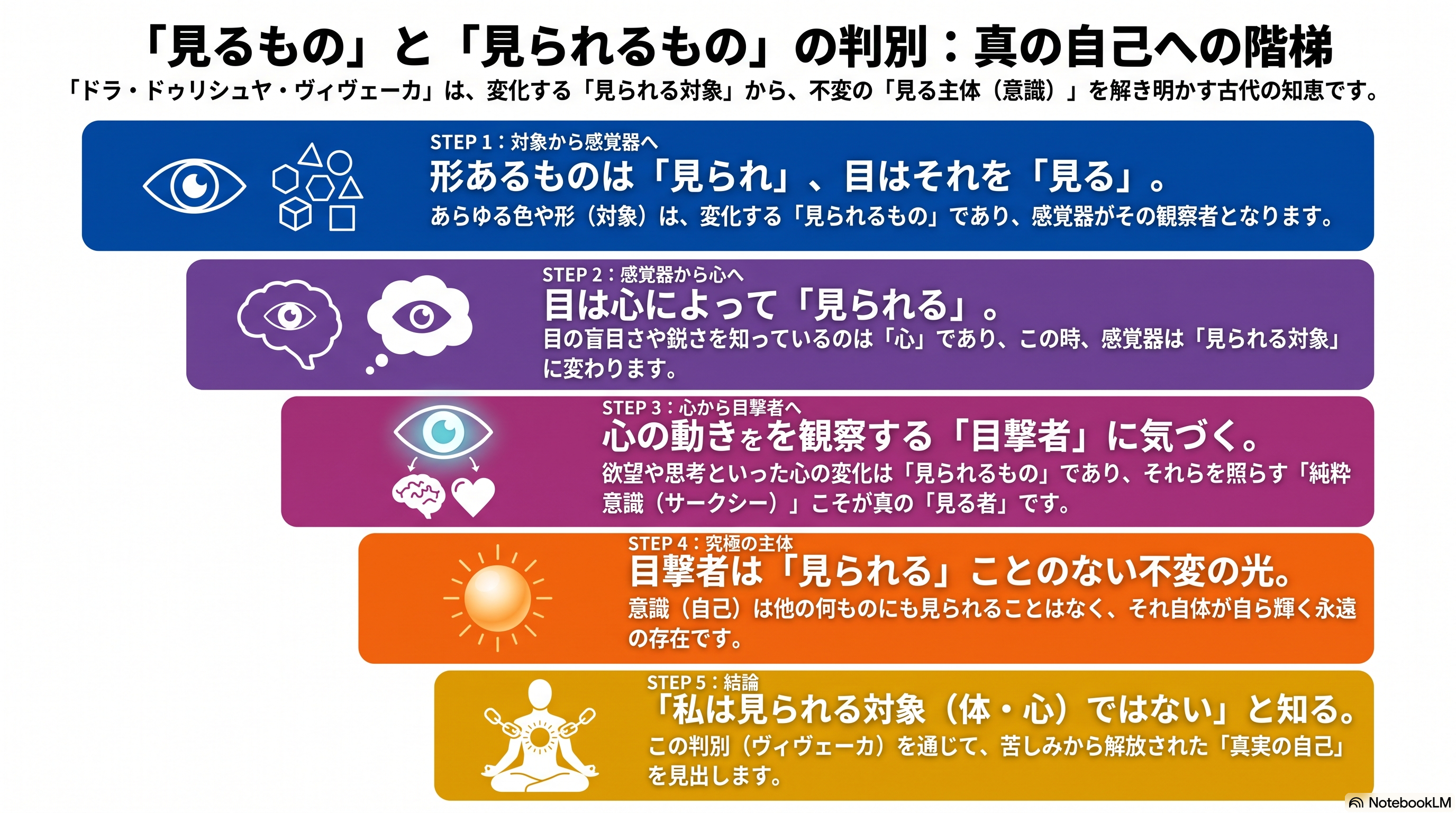
In the teaching of Drig-Drishya-Viveka (Discrimination Between the Seer and the Seen), we peel back the architecture of perception layer by layer: the physical eye is the subject beholding outer forms (objects), yet the mind is the deeper subject beholding the condition of the eye, and deeper still, an inward Witness beholds every movement of the mind itself—its thoughts, doubts, and moods.
However, the ultimate Observer arrived at where this inquiry culminates (Ātman / Pure Witness Awareness) remains eternally the pure Subject and can never become an object of perception. Classical Vedānta compares it to "an eye that sees everything yet cannot see itself" or "tongs that grasp objects yet cannot grasp themselves"—precisely because it is the very light of Knowing itself, it can never be inspected like a thing in front of you.
If the mind conceptualizes the ultimate Observer and claims, "Ah, I am Pure Consciousness!" or "I am the Witness!", that very claim is an operation of the ego-sense (ahaṃkāra), demoting pure Subjectivity into a subtle mental object. Even if you believe you have found the ultimate Observer, if it is something you can observe or picture, it is merely another object—which would immediately require yet another observer behind it, trapping inquiry in an infinite regress (regressus ad infinitum).
Rather than trying to hold onto an image or concept of the "ultimate Observer" in the mind, the practice calls for quietly witnessing every arising thought and emotion—and even sublime spiritual insights such as "I am awakening to deeper awareness"—simply as "seen objects" passing before you.
How can one realize the "True Observer" without falling into infinite regress?
To realize the "True Observer (Pure Consciousness)" without slipping into infinite regress, two complementary keys are essential: ceasing the mental effort to picture the Witness conceptually by continuously discerning everything that arises within you as a "seen object," and cultivating the graduated deepening of Samādhi (contemplative absorption).
According to Drig-Drishya-Viveka, this unfolds through the following concrete practices:
1. The Praxis of Setting Aside Everything Arising as "Object"
The most direct safeguard against the trap of conceptualization is treating every phenomenon that appears as "that which is seen."
Each time a thought arises, recognize it as an object; each time an emotion surges, recognize it as an object. Even when luminous spiritual intuitions arise—such as "I am Pure Consciousness" or "My awareness is growing clearer"—witness those thoughts too as subtle objects.
When you do so consistently, only the undeniable fact that "Awareness is effortlessly cognizant of all these" remains—revealing that the Witness is neither a passing experience nor a concept, but self-shining Being itself.
2. The Sixfold Praxis of Samādhi
To realize one's true nature as Existence-Consciousness-Bliss (Sat-Cit-Ānanda), Drig-Drishya-Viveka prescribes the sustained cultivation of six forms of Samādhi—three directed inward (antar-dṛśyānuga) and three directed outward toward the world (bahir-dṛśyānuga):
[Inward Samādhi (Contemplation Directed Within the Mind)]
- Savikalpa Samādhi Associated with Mental Objects (Dṛśyānuviddha): Treating inward waves of desire, memory, and thought as "known objects," while resting meditative attention in the Pure Witness Consciousness beholding them.
- Savikalpa Samādhi Associated with Truth-Words (Śabdānuviddha): Contemplating the liberating pointer: "I am unattached, self-luminous, non-dual Existence-Consciousness-Bliss."
- Inward Nirvikalpa Samādhi (Concept-Free Absorption): As the preceding two deepen, the mind grows utterly still like an unflickering flame in a windless place; even the duality of Witness and witnessed subsides into the fullness of Self-realization.
[Outward Samādhi (Contemplation With Open Eyes in the World)]
- Savikalpa Samādhi Associated with Outer Objects: Disentangling fleeting "names" (nāma) and "forms" (rūpa) from external things and events, focusing attention upon the unchanging Pure Being (Sat) underlying them.
- Savikalpa Samādhi Associated with Truth-Words Outwardly: Steadily contemplating how undivided Existence-Consciousness-Bliss (Brahman), unconfined by time or space, shines equally as the reality behind every outer appearance.
- Outward Nirvikalpa Samādhi: Immersed in the unbroken recognition of Ultimate Reality, the mind ceases to be seduced by superficial names and forms, abiding in unshakeable stillness right amidst perception.
What Awaits at the Culmination of Praxis
Through sustained practice of these six modes of Samādhi, identification with the physical body and personal ego dissolves at its root. Whether attention turns inward toward thought or outward toward the marketplace, one abides effortlessly in natural Samādhi—living directly as the True Witness everywhere. Relinquishing the urge to grasp a concept and surrendering into the living actuality of Awareness itself is the key to liberation.
What pointers help us directly intuit that we are pure "Subject" rather than an object?
To help you directly intuit yourself as the unobjectifiable "Subject," let us walk through a step-by-step experiential inquiry drawn straight from the opening verses of Drig-Drishya-Viveka, followed by practical pointers for everyday life.
1. The Golden Axiom: "Whatever Is Perceived Is Not 'I'"
Everything rests upon one crystalline axiom: "Any object I can observe cannot be the 'I' (the Seer) observing it." Applying this axiom across the successive layers of your own present experience peels away false identifications one by one.
2. Experiential Inquiry: Peeling Back the Three Layers of Perception
Right in this present moment, trace these three steps inwardly for yourself:
- Layer 1 (The Outer World and the Eye): Right now, you see this screen and the room around you—shapes, colors, and movement. At this first level, the bodily "eye" functions as the Seer (Subject), while the visual scene is the Seen (Object).
- Layer 2 (The Eye and the Mind): Now step one layer deeper. You immediately know whether your eyes feel rested or tired, whether your vision is sharp or blurry, or that your eyelids just blinked. The physical eye cannot step back to inspect its own condition—it is your inward "mind" that observes the state of the eyes. At this deeper level, the "eye" turns into a perceived Object, and the "mind" stands revealed as its Seer.
- Layer 3 (The Mind and Pure Witness Awareness): Step deeper still. Right now, as your mind reads these lines, it may feel intrigued, skeptical, calm, or distracted—and you are effortlessly aware that your mind is moving in those ways. Just as a weighing scale cannot weigh itself in the act of weighing, if the fluctuating mind is itself observed, there must be a deeper Awareness beholding it. Here, the entire "mind" stands revealed as an Object, illuminated by Pure Consciousness (Sākṣī)—the ultimate Subject.
Notice the unmistakable pattern: what appeared to be the "Subject" on a shallower rung turns out to be an "Object" the moment you step deeper inward.
3. Intuiting That "What Cannot Be Grasped" Is Precisely What You Are
Following this discriminative inquiry all the way back brings you to a silent threshold: an ultimate Witness that can never be turned around and looked at as an object.
It is invisible not because it is hiding somewhere far away, but because seeing an object requires division into seer and seen, whereas the Witness is forever the indivisible Seer alone. Recall the classic pointers: "the eye that cannot see itself" and "the tongs that cannot grasp themselves." Though never knowable as an object, this unmistakable, self-luminous "Knowing Itself" is the pure Subject you already are.
4. Practical Pointers in Daily Life
To rest naturally as this pure Subject amidst everyday life, keep two simple pointers close:
- Treat Everything That Rises as "Seen": Whenever a thought surfaces, note quietly, "This is something seen." Whenever an emotion swells, recognize, "This too is an object."
- Set Aside Even the Spiritual Claim "Now I've Got It!": Here lies the subtlest trap on the path. The instant the mind exclaims, "Aha! Now I understand—I am Pure Awareness, I feel the Witness!", the ego (ahaṃkāra) has already turned Subjectivity into a conceptual trophy (an object). Even when thoughts like "I am becoming much more mindful" or waves of meditative bliss appear, behold them gently as passing "seen objects."
When you simply remember the quiet fact that "Awareness is cognizant of all this" and drop every mental effort to capture that Awareness in a concept, the changeless Witness abiding effortlessly right here shines forth of itself.
What are concrete ways to intuit "the Knowing Itself" right in the midst of daily life?
To intuit "the Knowing Itself (Pure Consciousness)" amidst everyday activity, what matters most is not confining inquiry to formal sitting meditation, but gently inverting how attention meets lived experience throughout the day.
Grounded in Drig-Drishya-Viveka, here are four concrete everyday practices:
1. Meet Everything Arising as an "Object (That Which Is Seen)"
Recognize every shifting state throughout the day not as "me," but as an appearance beheld by Awareness:
- Each time a thought passes through, behold it as a seen object.
- Each time an emotion—joy, grief, irritation, or anxiety—rises in the lived body, behold it too as a seen object.
- Even when spiritual thoughts arise—"I'm becoming more awake" or "This must be Pure Consciousness"—treat them equally as subtle seen objects.
2. Quietly Acknowledge the Simple Fact That "Awareness Knows All This"
Once thoughts and feelings are recognized as objects, notice the effortless fact that Awareness is already cognizant of them. That Awareness is not the passing mood or event itself: it was present before you sat down to meditate, and it remains untouched long after today's experiences fade. Without grading or judging states, it simply is.
3. Trace the Layers of Perception Backward on the Spot
In ordinary moments—waiting for a train, looking out a window, working at a desk—briefly trace perception backward:
- Step 1: Distinguish the visual scene or screen (Object) from the "eyes" seeing it (provisional Subject).
- Step 2: Notice that what knows whether the eyes feel strained or clear is the inward "mind"—making the eyes an Object and the mind the Subject.
- Step 3: Notice further that something effortless is aware of the mind's own doubting, wandering, or understanding—revealing the entire mind to be an Object illuminated by deeper Awareness.
Savoring how each provisional subject turns into an object until inquiry comes to rest at the unobjectifiable threshold of "the Knowing Itself" awakens immediate clarity.
4. Attend to the "Changeless Ground" Behind Both Inner Desires and Outer Things
- Inward Practice: Whenever a desire, aversion, or worry stirs inwardly, recognize the impulse as a perceivable object and turn attention gently back toward the silent Consciousness witnessing it.
- Outward Practice: When looking at any object in the world—a cup, a tree, the sky—look past its transient "name" and "form" and notice the sheer, quiet fact of its Being ("is-ness") right here and now.
Above all, stay alert to the moment the intellect whispers, "Aha, now I've grasped Pure Consciousness!"—recognizing that very thought as one more subtle object. As conceptual grasping subsides, self-effulgent "Knowing Itself"—never an object, yet never absent—reveals itself naturally.
What is the state of "Nirvikalpa Samādhi," in which the mind grows completely still and the concepts of subject and object vanish?
In Drig-Drishya-Viveka, Nirvikalpa Samādhi (non-conceptual contemplative absorption) is revered as the culmination of meditative inquiry into the True Self. Blossoming naturally once every gross and subtle object—even the meditative thought "I am Pure Consciousness"—has been gently relinquished, this state exhibits four classical hallmarks:
1. Utter Stillness of Mind and Dissolution of Subject-Object Duality
In Nirvikalpa Samādhi, conceptual modifications of the mind (vṛttis) subside completely, dissolving the dualistic division between "knower (Subject)" and "known (Object)." Classical texts liken the mind here to "an unflickering flame standing in a windless sanctuary." Even the subtle effort to "observe" comes to rest in profound, imperturbable peace.
2. The Decisive Difference from "Deep Dreamless Sleep"
Because mental chatter ceases and duality disappears, beginners sometimes wonder whether Nirvikalpa Samādhi resembles "deep sleep" or unconsciousness—yet Vedānta draws a razor-sharp distinction between the two.
In deep dreamless sleep (suṣupti), the mind subsides beneath a veil of causal ignorance (avidyā) in which one's true nature remains unrecognized. In Nirvikalpa Samādhi, by contrast, the veil of ignorance is absent: abiding in unveiled identity as ever-luminous Pure Consciousness (Ātman), there is only radiant, wide-awake Awareness without a second.
3. Effortless Non-Attachment Through Immersion in Supreme Bliss
Resting in the direct plenitude of Self-realization (Paramānanda / Supreme Bliss), consciousness discovers fulfillment prior to any external condition—rendering the mind naturally unmoved by fleeting sensory distractions or conceptual proliferation.
4. Dissolution of the Boundary Between "Inside" and "Outside" (The Metaphor of the Clay Pot)
Drig-Drishya-Viveka illustrates this non-dual wholeness through two luminous classical metaphors: "an empty clay pot resting inside boundless open sky" (undivided space both within and without) and "a water-filled jar submerged deep within the ocean" (undivided water filling both inside and outside). The imaginary wall separating an "inside me" from an "outside cosmos" loses all meaning, leaving only seamless, indivisible Wholeness.
Summary
Nirvikalpa Samādhi is the culmination in which, at the end of discriminating Seer from seen, even the separate posture of "an observer watching objects" melts away—leaving one abiding simply as undivided Existence-Consciousness-Bliss (Sat-Cit-Ānanda). Born of clear discernment between the eternal and the transient and the complete release of grasping, it shines as the natural peace of our original Being.