Rishukyō (Guiding Principle of Wisdom Sūtra) — Esoteric Wisdom Transforming Desire into Awakening

The Essence of "Afflictions Are None Other Than Awakening" and the Path of Universal Liberation in the Rishukyō

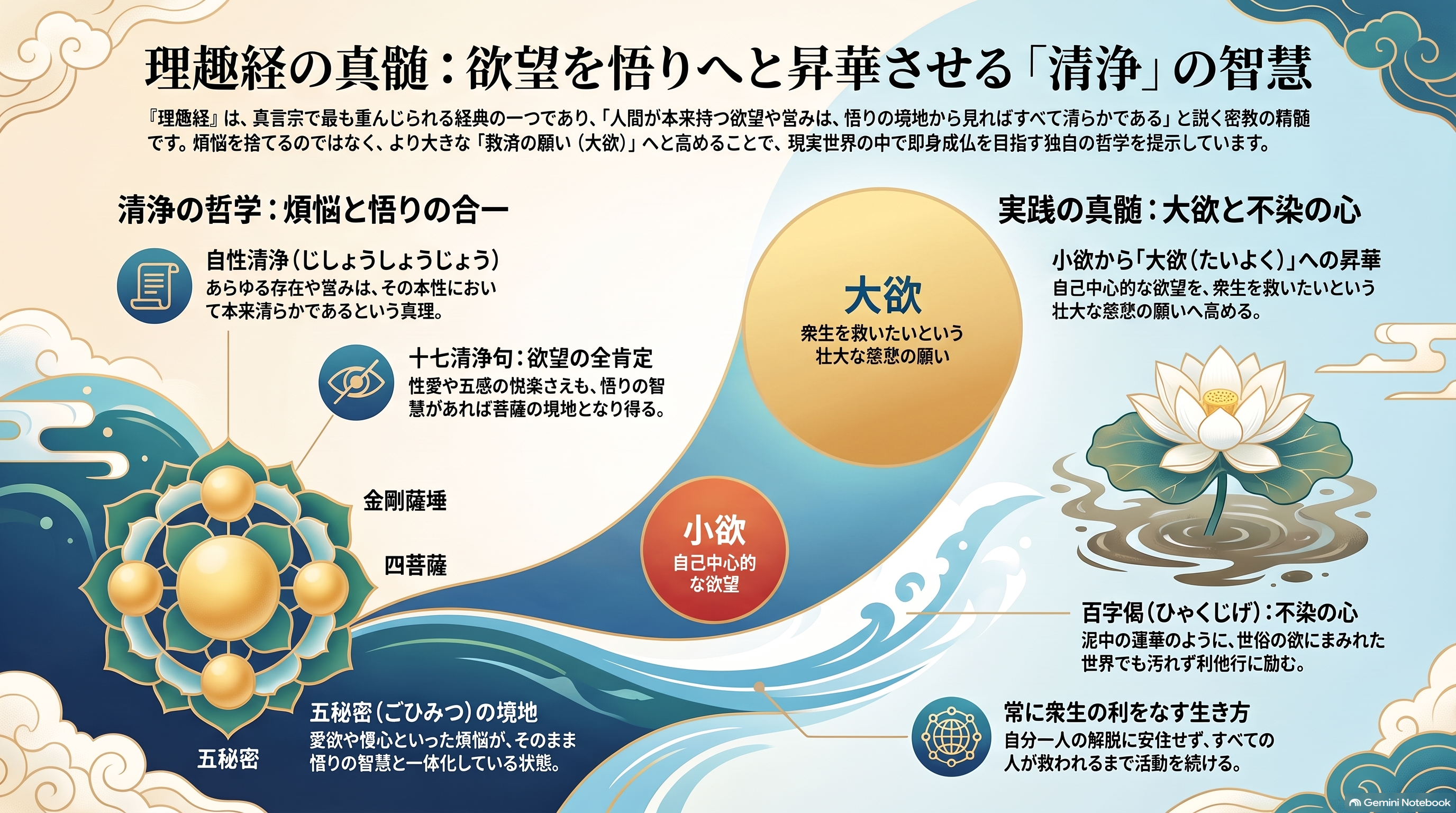
The Rishukyō (Skt. Adhyardhaśatikā Prajñāpāramitā, "The Guiding Principle of Wisdom Sūtra" in 150 lines, translated into Chinese by Amoghavajra) is the most treasured daily liturgical scripture in Shingon and East Asian Esoteric Buddhism (Mikkyō), chanted sonorously at morning and evening services as well as memorial and votive rites. Its most striking hallmark is its bold declaration that human passion, desire, and sensory experience—so often treated in exoteric Buddhism as defilements to be suppressed or eradicated—are "innately pure in their fundamental nature, constituting the very stage of a Bodhisattva" (the Seventeen Pure Phrases, Jūshichi Seijōku).

Rather than condemning desire as evil and attempting to extinguish life's vitality, Esoteric Buddhism transmutes it—through unstained, non-clinging wisdom (asakti / fuzen)—into the boundless compassionate energy that brings awakening and peace to all beings (Great Desire, Daiyoku, and Great Bliss, Dairaku). Herein lies the supreme esoteric truth of Bonnō-soku-Bodai: "Afflictions are none other than Awakening."

[Historical Episode: Kūkai and Saichō — Their Parting Over the Rishushaku Commentary and the Gravity of Esoteric Transmission]

This Rishukyō was brought from Tang-dynasty China to Japan in the early Heian period by Kōbō Daishi Kūkai (774–835) as one of the crown jewels of Esoteric Buddhism.

At the time, Saichō (767–822), founder of the Japanese Tendai school, maintained an earnest exchange with Kūkai in order to absorb the esoteric teachings. Seeking to decipher the profound doctrines concealed within the Rishukyō, Saichō earnestly requested to borrow Kūkai's esoteric commentary, Amoghavajra's Rishushaku (Commentary on the Guiding Principle of Wisdom Sūtra).

Kūkai, however, firmly declined the request. In Esoteric Buddhism, ultimate truth is never something to be grasped merely through intellectual reading of written texts (exoteric conceptual interpretation); it must be embodied directly through authentic master-to-disciple initiation (Abhiṣeka / Kanjō) and the lived contemplative practice of the Three Mysteries of body, speech, and mind (Sanmitsu Kaji). Moreover, Kūkai recognized the grave danger that reading the literal surface of its radical "affirmation of desire" without esoteric initiation would invite fatal misunderstanding and distortion.

Precisely over this refusal to lend the Rishushaku, the two towering giants of Japanese Buddhism—Kūkai and Saichō—parted ways forever. This historic episode vividly testifies to how strictly the Rishukyō was guarded as a sacred esoteric transmission (Hihō) admitting no facile conceptual reduction.
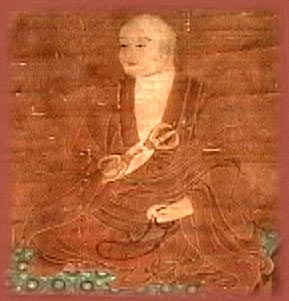
Portrait of Kōbō Daishi Kūkai
Traditional iconography of Kōbō Daishi Kūkai traces back to portraits commissioned after his entry into eternal samādhi (835 CE) from the living memories and records of his younger brother and disciple Shinga and Prince Shinnyo.
Inquirer

What is the true meaning of the teaching in the Rishukyō that "sensual desire and passion are pure"?

The True Meaning of "Desire Is Pure" — The Esoteric View of Humanity and the Wisdom of Sublimation

The declaration in the Rishukyō that "passion and desire are pure" (expounded in the Seventeen Pure Phrases) is by no means a license for unbridled egoic craving or hedonistic indulgence as they stand. Beneath its provocative phrasing lies the foundational cosmology and view of human nature unique to Esoteric Buddhism.

Specifically, its true intent can be illuminated from four essential perspectives:

1. "Innate Purity of Own-Nature" (Jishō Shōjō) — All Phenomena Are Intrinsically Pure

In the opening chapter of the Rishukyō (the Dharma-Gate of Great Bliss), seventeen dimensions of intimate bliss, touch, loving attraction, and sensory delight are proclaimed to be "pure, constituting the stage of a Bodhisattva." The fundamental ground for this proclamation is stated explicitly in the scripture itself: "Why is this so? Because all phenomena are innately pure in their own-nature" (一切法自性清浄故, Skt. sarvadharmāḥ prakṛtipariśuddhāḥ). Rooted in Tathāgatagarbha (Buddha-nature) and esoteric ontology, Esoteric Buddhism perceives every vital energy of humanity and the cosmos not as something intrinsically defiled, but as an originally immaculate manifestation of the creative life-force of Mahāvairocana Tathāgata (Dainichi Nyorai).

2. Sublimation from "Lesser Desire" (Shōyoku) into "Great Desire" (Daiyoku)

Whereas conventional exoteric Buddhism tended to treat passion and desire solely as afflictions (kleśa) to be repressed or severed, Esoteric Buddhism recognizes eros and desire as the primordial generative force of life and cosmic creativity. Rather than being dragged around by narrow, self-serving craving (Shōyoku, lesser desire), the practitioner redirects and elevates that potent vital energy into the vast aspiration to awaken and liberate all sentient beings (Daiyoku, Great Desire), sublimating it into universal peace and awakening (Dairaku, Great Bliss / Mahāsukha).

3. "Afflictions Are None Other Than Awakening" (Bonnō-soku-Bodai) and the Unstained Bodhisattva

Esoteric Buddhism upholds the non-dual principle of Bonnō-soku-Bodai: precisely where afflictions arise, awakening blooms. Crucially, however, "desire is pure" is a truth realized from the awakened standpoint of a Bodhisattva or Buddha free from egoic clinging. As sung in the "Hundred-Character Verse" distilling the essence of the Rishukyō: "Just as a lotus, though born out of mud, is never stained by the mire..." (如蓮体本染 不為垢所染). Not drowning blindly in desire, yet seeing clearly into its empty, luminous nature through Prajñā wisdom so as to benefit all beings without being stained by possessive attachment—that is the true comportment of the Bodhisattva.

4. Vigilance Against Antinomian Distortion and Why It Was Guarded as an "Esoteric Secret"

This teaching is never an indulgence permitting an ego-bound person fettered by attachment to act out every craving, nor a literalist cult of physical sexuality. Because chasing the literal wording invites grave distortion—as historically occurred in heterodox offshoots such as the medieval Tachikawa lineage—the Rishukyō was strictly safeguarded as an esoteric transmission (Hihō) to be unpacked only by practitioners who had undergone proper contemplative discipline and initiation, just as illustrated by Kūkai's refusal to lend the Rishushaku to Saichō. For this very reason, Shingon tradition established the custom of chanting the sūtra in specialized Tang-style Sino-Japanese Kan'on phonetics rather than vernacular Japanese, preventing casual, uninitiated misreading.

Inquirer

I would like to know the concrete modern translation of all Seventeen Pure Phrases.

Complete Translation of the Seventeen Pure Phrases (Jūshichi Seijōku)

Expounded in the first section of the Rishukyō (the Dharma-Gate of Mahāvairocana's Great Bliss), the Seventeen Pure Phrases (Jūshichi Seijōku) enumerate seventeen concrete facets of human passion, intimacy, and sensory experience, proclaiming of each: "Because this phrase/state is innately pure, it is the stage of a Bodhisattva."

1. 妙適清浄句是菩薩位
Byōteki seijōku kore bosatsui (Skt. सुरत / Surata-viśuddhi-pada)
Translation: The state of wondrous intimate bliss (surata, sublime rapture and vital union), being innately pure, is the stage of a Bodhisattva.
2. 欲箭清浄句是菩薩位
Yokusen seijōku kore bosatsui
Translation: The arrow of desire (the dynamic directional energy of longing drawn toward another), being innately pure, is the stage of a Bodhisattva.
3. 触清浄句是菩薩位
Soku seijōku kore bosatsui
Translation: Intimate tactile contact (warm bodily touch and embrace), being innately pure, is the stage of a Bodhisattva.
4. 愛縛清浄句是菩薩位
Aibaku seijōku kore bosatsui
Translation: The bond of loving embrace (drawing together and uniting closely in affection), being innately pure, is the stage of a Bodhisattva.
5. 一切自在主清浄句是菩薩位
Issai-jizaishu seijōku kore bosatsui
Translation: Sovereign mastery and boundless freedom experienced in union (all-pervading liberation and vitality), being innately pure, is the stage of a Bodhisattva.
6. 見清浄句是菩薩位
Ken seijōku kore bosatsui
Translation: The loving gaze (beholding another with deep longing and affection), being innately pure, is the stage of a Bodhisattva.
7. 適悦清浄句是菩薩位
Tekietsu seijōku kore bosatsui
Translation: Sensuous delight and joyful pleasure, being innately pure, is the stage of a Bodhisattva.
8. 愛清浄句是菩薩位
Ai seijōku kore bosatsui
Translation: Deep loving affection (the heart of love itself), being innately pure, is the stage of a Bodhisattva.
9. 慢清浄句是菩薩位
Man seijōku kore bosatsui
Translation: Dignified self-affirmation and pride born of fulfillment (unshakeable confidence in innate worth), being innately pure, is the stage of a Bodhisattva.
10. 荘厳清浄句是菩薩位
Shōgon seijōku kore bosatsui
Translation: Graceful adornment and beautification, being innately pure, is the stage of a Bodhisattva.
11. 意滋沢清浄句是菩薩位
Ijitaku seijōku kore bosatsui
Translation: Richly moistened, nourished fulfillment of mind (inner contentment and warmth), being innately pure, is the stage of a Bodhisattva.
12. 光明清浄句是菩薩位
Kōmyō seijōku kore bosatsui
Translation: Radiant luminosity (the incandescent brilliance of peak rapture and clarity), being innately pure, is the stage of a Bodhisattva.
13. 身楽清浄句是菩薩位
Shinraku seijōku kore bosatsui
Translation: Bodily ease and somatic bliss, being innately pure, is the stage of a Bodhisattva.
14. 色清浄句是菩薩位
Shiki seijōku kore bosatsui
Translation: Visual form (all captivating shapes and colors perceived by sight), being innately pure, is the stage of a Bodhisattva.
15. 声清浄句是菩薩位
Shō seijōku kore bosatsui
Translation: Sound and voice (all enchanting tones and resonances heard by the ear), being innately pure, is the stage of a Bodhisattva.
16. 香清浄句是菩薩位
Kō seijōku kore bosatsui
Translation: Fragrance (all alluring scents perceived through olfaction), being innately pure, is the stage of a Bodhisattva.
17. 味清浄句是菩薩位
Mi seijōku kore bosatsui
Translation: Flavor (all delectable tastes savored on the tongue), being innately pure, is the stage of a Bodhisattva.
[Concluding Declaration and Ontological Ground]

Immediately after expounding these seventeen phrases, Mahāvairocana Tathāgata reveals the foundational reason why they are pure:

  • 何以故 一切法自性清浄故 ("Why is this so? Because all phenomena are innately pure in their own-nature.")
  • 般若波羅蜜多清浄 ("Therefore, the Perfection of Wisdom [Prajñāpāramitā] itself is pure.")
Inquirer

What merits and benefits arise from reciting the Rishukyō?

Merits and Benefits of Reciting the Rishukyō — All-Embracing Power Spanning This World and Beyond

Among Esoteric Buddhist scriptures, the Rishukyō is especially renowned for how explicitly and generously the text itself extols the transformative merit of daily recitation and contemplation. For this reason, throughout the Shingon tradition it is chanted more frequently than almost any other sūtra—from morning and evening devotions to memorial rites and fire offerings (Goma).

1. Supramundane Benefits (Awakening, Dissolution of Karmic Hindrances, and Purification of Mind)

  • Swift Realization of Awakening (Sokushin Jōbutsu — Buddhahood in This Very Body): Through daily recitation and contemplative reflection, one awakens directly to this living world as the radiant realm of Mahāvairocana, realizing supreme enlightenment in this very existence.
  • Eradication of Karmic Obstructions and Freedom from Adverse Realms: Even if heavy past misdeeds and the four fundamental hindrances obscuring wisdom (the hindrances of veiling, afflictions, dharmas, and karma) have accumulated deeply, they are thoroughly dissolved so that one never falls into states of torment.
  • An Unstained Heart Like a White Lotus (Fuzen): Even while living squarely amidst a world filled with desire and turmoil, one preserves a luminous, unstained mind free from clinging—like a pure white lotus blooming out of dark mud.
  • Vast Offering to All Buddhas: Upholding, reciting, copying, and contemplating this sūtra is taught to delight the countless Tathāgatas throughout the cosmos as the most vast spiritual offering.

2. Worldly Benefits (Peace, Abundance, Fulfillment of Aspirations, and Protection)

  • Supreme Peace, Joy, and Spiritual-Material Abundance (Funyō): Filling both body and mind in this present life with deep serenity, joy (Dairaku), security, and rich abundance.
  • Harmonious Fulfillment of Endeavors and Vows: Empowering one's constructive undertakings and heartfelt aspirations to come to fruition smoothly, turning worldly circumstances into a virtuous cycle.
  • Dispelling Obstacles and Calamities: Shattering internal and external hindrances (māra) and bestowing unshakeable spiritual protection unswayed by negative forces.
  • Everyday Healing and Well-Being: Historically cherished for supporting recovery from illness, vitality, and household harmony—even inspiring folk devotion in which feeling the breeze fanned by the unfolding accordion-book sūtra during temple recitation was believed to ward off illness.

3. A "Universal Scripture" for Both Memorial Dedication and Living Supplication

In Shingon liturgy, the Rishukyō is uniquely revered as efficacious in equal measure for dedicating merit to the deceased (wakes, funerals, and ancestor memorials) and for praying for the flourishing, peace, and awakening of the living.

Inquirer

I would like to read a complete modern translation of its distilled essence, the "Hundred-Character Verse" (Hyakujige).

Complete Translation of the "Hundred-Character Verse" (Hyakujige) — The Distilled Heart of the Rishukyō

Crystallizing the entire teaching of the Rishukyō into a compact jewel, the "Hundred-Character Verse" (Hyakujige) is a sacred poem composed of 20 five-character lines—100 Chinese characters in total. Spoken near the close of Chapter 17 (the Dharma-Gate of Profound Mystery), it encapsulates the ultimate essence of the Esoteric Bodhisattva Path: not eradicating passions, but sublimating them into pure Great Desire in order to liberate all sentient beings.

1. The Bodhisattva's Resolve to Benefit Self and Others Without Retreating into Quiescence (Lines 1–4)
菩薩勝慧者 乃至尽生死 恒作衆生利 而不趣涅槃
[Liturgical Kan'on Reading] Hō-sā shō-kē-shā / dai-shī shin-sē-shī / kō-saku shū-sē-rī / jī-fū-shū deppan
Translation: The Bodhisattva of supreme wisdom, right through to the exhaustion of birth-and-death (saṃsāra), ceaselessly works for the benefit and liberation of all sentient beings, and never retreats alone into quiescent Nirvāṇa.
2. Purifying the Entire World Through Wisdom and Skillful Means (Lines 5–8)
般若及方便 智度悉加持 諸法及諸有 一切皆清浄
[Liturgical Kan'on Reading] Hanjā kyū hō-ben / chī-tō shikkā-chī / shō-hō kyū shō-yū / issē kai sē-sē
Translation: Empowered and embraced throughout by transcendent Wisdom (Prajñā) that shatters ego-delusion and compassionate Skillful Means (Upāya), all dharmas and all realms of existence are wholly purified without exception.
3. Harmonizing Desire to Liberate All Realms of Existence (Lines 9–12)
欲等調世間 令得浄除故 有頂及悪趣 調伏尽諸有
[Liturgical Kan'on Reading] Yoku-tō chō sē-kan / rē-toku sē-chō-kō / yū-tē kyū aku-shū / chō-fuku shin shō-yū
Translation: Skillfully harmonizing the world through the very energy of desire and passion so that defilement is purified away—from the highest summit of existence (Bhavāgra) down to the lowest realms of torment—one tames and liberates every state of conditioned being.
4. The Parable of the Lotus Unstained by Mud (Lines 13–16)
如蓮体本染 不為垢所染 諸欲性亦然 不染利群生
[Liturgical Kan'on Reading] Jō-ren-tē hon-zen / fū-ī kō-sō-zen / shō-yoku-sē eki-zen / fū-zen rī kin-sē
Translation: Just as a lotus blossom, radiant in its natural hue though rooted in mud, is never stained by the mire's filth, the intrinsic nature of all desires is likewise pure: remaining unstained by clinging, the Bodhisattva brings benefit to multitudes of living beings.
5. Realizing Boundless Peace and Abundance Through "Great Desire" (Lines 17–20)
大欲得清浄 大安楽富饒 三界得自在 能作堅固利
[Liturgical Kan'on Reading] Tai-yoku toku sē-sē / tai-an-raku fū-jō / san-kai toku shī-sai / nō-sā ken-kō-rī
Translation: Attaining immaculate purity through "Great Desire" (Daiyoku — the vast aspiration to awaken self and all others together), one realizes Great Bliss and rich spiritual abundance; moving with sovereign freedom throughout the Three Realms of the cosmos, one accomplishes unshakeable, enduring benefit for all beings.
Inquirer

What is the state of realization known as the most important awakening in the sūtra—the "Five Mysteries" (Gohimitsu)?

The Supreme Awakening of the "Five Mysteries" (Gohimitsu / Five-Mysteries Samādhi)

In the Rishukyō, the "Five Mysteries" (Gohimitsu / Gohimitsu Samādhi) designate the supreme esoteric realization in which humanity's four most fundamental affective drives—Desire (Yoku), Touch (Soku), Love (Ai), and Pride (Man)—are neither repressed nor amputated, but transmuted through Buddha-wisdom into pure Bodhicitta (the Mind of Awakening), unified seamlessly around Vajrasattva.

1. The Five Deities Constituting the "Five Mysteries" and the Realms They Embody

Vajrasattva (金剛薩埵 — Central Deity) — The Realm of "Bodhicitta, Great Bliss, and Great Desire"

The central figure embodying universal truth and the diamond-like Mind of Awakening (Bodhicitta) itself. Realizing Great Bliss within while living out the unbreakable vow (Daiyoku, Great Desire) to awaken and liberate all sentient beings amidst active engagement in the world.

Iṣṭa-vajrā / Desire Bodhisattva (欲菩薩・欲金剛明妃) — The Realm of "Purification Through Great Wisdom and Great Compassion"

Transcending narrow egoic craving by uniting ego-shattering Great Wisdom (Mahāprajñā) with all-embracing Great Compassion (Mahākaruṇā)—discerning the true nature of longing and elevating both world and self into pure Bodhicitta.

Kelikilā-vajrā / Touch Bodhisattva (触菩薩・触金剛明妃) — The Realm of "Harmonizing Passion and Blossoming Innate Buddha-Nature"

Skillfully guiding and harmonizing worldly passion through warm, responsive contact—awakening the luminous wish-fulfilling jewel of innate Buddha-nature sleeping within every living being.

Rāga-vajrā / Love Bodhisattva (愛菩薩・愛金剛明妃) — The Realm of "Unstained Lotus Compassion and Creative Individuality"

Like a lotus blooming out of mud without being soiled by mire (Fuzen), abiding right within the world of human passion without being tarnished by possessive attachment—turning each person's unique vitality and warmth into boundless compassionate care for others.

Māna-vajrā / Pride Bodhisattva (慢菩薩・慢金剛明妃) — The Realm of "Great Dignity (Unshakeable Confidence and Immovable Equanimity)"

Inverting petty egoic arrogance into "Great Dignity" (Daiman)—the unshakeable conviction that one's own life and all beings inherently embody Mahāvairocana's Buddha-nature, empowering fearless, steadfast compassionate leadership amidst a turbulent world.

2. Why Is This Realization Called "Secret / Mysterious" (Himitsu)?

Because the very four impulses ordinarily shunned in conventional Buddhism as prime defilements—Desire, Touch, Love, and Pride—when integrated into single non-dual mandalic unity with Vajrasattva's awakening, are instantaneously transmuted into sacred practical power that liberates both self and others (Jiri-Rita). Because this profound truth remains invisible to literal, dualistic reading on the surface of words, it is revered as the "Profound Mystery."

3. The Ultimate Message of the Rishukyō

Its ultimate message lies in Non-Abiding Nirvāṇa (Apratiṣṭhita-nirvāṇa / Mujūsho Nehan): refusing to flee alone into a secluded heaven of private tranquility, and instead dedicating one's entire life right in the midst of society until every being is freed from suffering.

[Reference Links & Archival Materials]

Detailed Japanese commentaries and historical iconographic materials on the Rishukyō can also be explored via the following resources:

← Back to Archive Next: Lotus Sūtra "Expedient Means" & Ten Suchnesses →