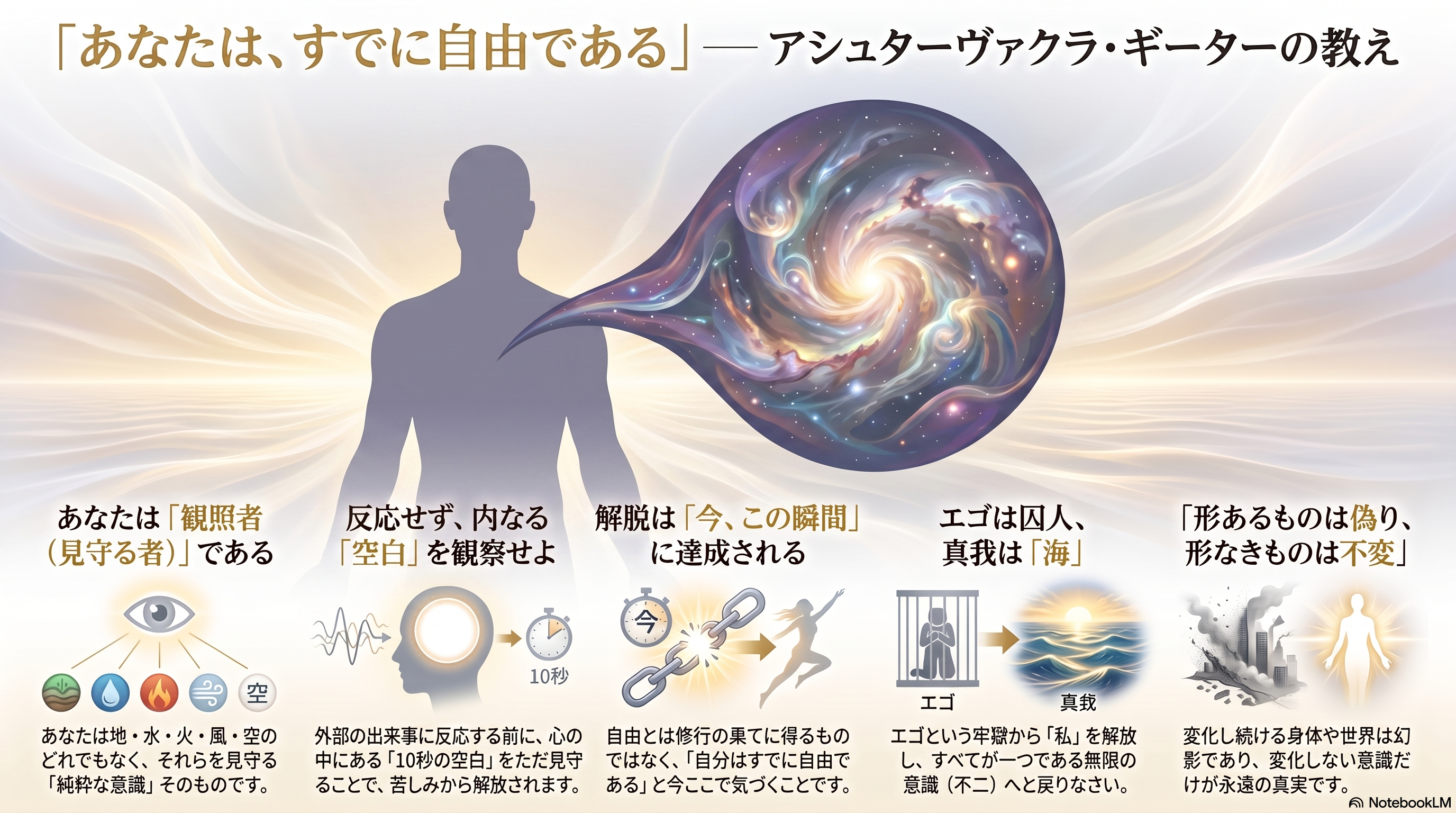
 AI Digest: From Actor to Spectator — The Essence of Complete Freedom
Revered by sages across India as the purest, most uncompromising expression of the essence of Advaita Vedānta (Non-Dualism), the Aṣṭāvakra Gītā opens with a direct thunderbolt of truth delivered by the sage Aṣṭāvakra to King Janaka: "You are the solitary Witness, beholding all things in pure awareness."
The suffering and bondage we experience in daily life arise solely from the illusion of misidentifying this ever-free True Self (Ātman) with the body and mind. This dialogue explores practical pointers for seeing through all events as a cosmic dream and shifting your standpoint from the "actor" entangled in life's drama to the silent "spectator." Clinging to nothing and simply relaxing into the innate freedom of "I Am" (Sahaja Samādhi / Natural Samādhi)—let us inquire together into the living essence of complete liberation.
Could you explain the changeless Witness that beholds all things?
The Changeless Witness Beholding All Things
Drawing directly on the teachings of the Aṣṭāvakra Gītā, let us explore its central revelation: the "changeless Witness" (Sākṣin) that beholds all phenomena.
The Intrinsic Nature of the Witness (True Self)
In the Aṣṭāvakra Gītā, the "Witness" points to the authentic nature of our True Self (Ātman). You are none of the five material elements—neither earth, water, fire, air, nor ether—nor are you the physical body or the fluctuating mind. The True Self is taught to be Pure Consciousness (Awareness) itself, which silently illuminates all of these: formless, free from action, unattached to anything whatsoever, and eternally at peace.
Abiding as the "Seer" Rather Than the "Seen"
To abide as the Witness is to remain as changeless Consciousness, simply beholding thoughts, emotions, bodily sensations, and outward events without ever being altered by or entangled in any of them. If life is a theatrical drama, it means ceasing to regard yourself as the "actor (doer)" or "experiencer" weeping and laughing onstage, and remaining instead in the seat of the "spectator (Witness)" watching every scene unfold. The scripture teaches that the moment one begins to recognize one's True Self as the solitary Witness of all actions transpiring through the senses, attachment and thoughts assuming the shapes of diverse objects naturally subside.
The Key to Liberation (Mokṣa) from Bondage
The root cause of our felt suffering and bondage lies in the optical illusion (Adhyāsa / superimposition) of mistaking and identifying this pure, ever-free Witness with the body, the mind, or an "acting personal self." The Aṣṭāvakra Gītā calls for a radical shift of identity—away from the changing contents of experience (events and emotional states) back to the Consciousness in which experience itself appears. The direct injunction—"Be the Seer (Witness), not the seen (object)"—stands as the supreme key to liberation from all bondage and entry into unconditioned freedom.
Thus, knowing oneself immediately as the "one solitary Witness beholding all things" forms the living core of the Aṣṭāvakra Gītā.
What are some practical pointers for maintaining "changeless awareness" amidst everyday life?
Practical Pointers for Sustaining "Changeless Awareness" in Everyday Life
Here are five practical ways to cultivate and abide in the "changeless Consciousness (Witness)" taught in the Aṣṭāvakra Gītā right in the midst of daily activities.
1. Observe the "Gap (Space)" Prior to Reaction
When we receive external stimuli (sensory impressions), we tend to react instantaneously with habitual thoughts or actions. Yet between receiving a stimulus and reacting to it, there exists a subtle inward "gap (space)." When someone says something provocative or an unpleasant situation arises, instead of reacting immediately, cultivate the habit of turning inward to observe that felt space. Even in an unfair situation where you feel 100% justified, refraining from automatic reaction and looking quietly within is the first step toward freedom from attachment.
2. Practice Choiceless Perception
This is the practice of refraining from singling out "specific objects" from incoming visual or auditory impressions and forging egoic relationships with them. For example, when looking out over a garden, rather than fixating on a single plant and spinning a train of thought—"That plant is starting to wither"—simply behold the entire field evenly. When street noise arises, instead of recoiling with irritation—"When will that racket stop?"—perceive it simply as sound. Without adding judgment or evaluation, keep the mind in a clear state of "no-mind" that neither clings to nor rejects objects.
3. Abide in the Pure Felt Sense of Being: "I Am"
Let go of identifications with social roles and the body—such as "I am a parent" or "I am an office worker"—and rest simply in the unadorned felt sense: "I exist" ("I Am" / Sattā). This resembles the pre-verbal state of a newborn infant who possesses neither words nor concepts, simply existing in pure presence. Add no extraneous attributes; simply steep in the quiet sense of "Being."
4. Comport Yourself as the "Spectator" Rather Than the "Doer"
Observe all daily activities not as "things I am doing," but as movements spontaneously "happening" within wholeness. Detaching yourself from the fruits of action—success or failure, praise or blame—remain seated in the audience of life's drama. Likewise, when walking, simply walk; when eating, simply eat—allowing no extraneous worries or narratives to intrude, resting wholly in the lived immediacy of the moment.
5. Release Craving and Aversion, Stepping Back from the Mind
Intensely craving something (attachment) or intensely resisting something (aversion) binds the mind to objects. Cultivate an attitude that welcomes whatever arrives just as it is and lets go of whatever departs just as it goes. Whenever unwanted thoughts or turbulent emotions well up in meditation or daily life, inwardly address the mind—"I have nothing to do with you; go ahead as you please"—clearly dis-identifying yourself (the Witness) from the mind and body.
Although this may feel challenging at first, you can begin with something simple—such as dropping (disengaging from) rumination over things you dislike—and gradually widen the sphere of "observing without reacting."
Could you share concrete exercises for widening that "gap" between stimulus and reaction?
Concrete Exercises for Widening the "Gap" Between Stimulus and Reaction
Grounded in the spirit of the Aṣṭāvakra Gītā, here are concrete practices for expanding the inward space between stimulus and reaction and cultivating the power of non-reactivity.
Between receiving a sensory impression in the lived body and enacting an outward response, there exists a subtle experiential interval (sometimes noted in empirical observation as a window of roughly ten seconds before an impulse fully crystallizes into action). Here are three practical approaches to inhabit this space:
1. Suspend the Reaction and Inwardly Narrate the Mind's Impulse
Whenever something pleasant or unpleasant occurs—especially something directed personally at you—the mind immediately issues a command: "Act like this!" or "Retort right now!" Instead of translating that impulse into action, turn the vector of awareness toward the "inward space" within your lived body. Without enacting what the mind urges, silently note and observe it: "Right now, a movement to snap back is arising." Sustaining awareness of this inward space for as long as possible is the foundational practice.
2. Filter Impulses Through Socrates' "Three Golden Gates"
A remarkably effective companion practice is to pose to yourself, right inside that silent interval, the "Three Questions" traditionally attributed to the ancient Greek philosopher Socrates. Whenever you are about to react, check whether your response can pass through these three gates (filters):
- Is it true? Is what I am about to say or do genuinely true?
- Is it necessary? Is there truly any need for me to say or do anything about this at all?
- Should it be me? Rather than my reacting impulsively, is this something best left to another person or to the natural unfolding of events?
Asking these questions during those few seconds of inward pause allows the compulsive urge to act and react to subside on its own, revealing a state already free from entanglement.
3. Begin by "Disengaging from the Negative"
Remaining non-reactive toward every stimulus all at once is rarely easy. A practical first step is simply to "stop thinking about (disengage from) whatever displeases you." By practicing not feeding unpleasant stimuli with mental commentary—attending gently instead to what is wholesome—you can steadily expand your capacity until the Aṣṭāvakra Gītā's teaching of "observing without reacting" becomes effortless and immediate.
Could you explain more specifically how to "ignore" (disengage from) negative events and emotions?
More Specific Ways to "Disengage From" Negative Phenomena
In the context of the Aṣṭāvakra Gītā, "ignoring" negative things (unpleasant events or turbulent emotions) never means forcibly suppressing them or fleeing in avoidance; rather, it means refusing to forge an egoic relationship (non-involvement) with the object.
Here are three concrete ways to embody this in daily life:
1. Practice "Choiceless Perception" (Refraining from Singling Out Objects)
Left on autopilot, our sensory faculties (sight, hearing, and so on) unconsciously single out specific objects and trigger chains of associative thought—"I like this," "I hate that," "How irritating!" Here is a dedicated practice to dissolve this habit:
- Practice: Sit relaxed and undisturbed for one to two hours (or whatever quiet period your day permits) on a balcony, in a garden, or by a window. Simply behold the surrounding scenery and sounds as an undivided whole. Instead of zooming in on a particular shrub thinking, "That plant is dying," or fixating on neighborhood noise wondering, "When will it stop?", perceive everything equally as "simply what is present there."
- Accumulating this practice of "not selecting specific objects to entangle with the mind" nurtures a natural state of "no-mind" in which awareness no longer automatically contracts around negative stimuli.
2. Declare a "Divorce" from Arising Negative Emotions
In the wake of unpleasant events, negative thoughts and emotional waves inevitably well up in the mind. Trying to forcibly silence those thoughts only generates further tension and suffering.
- Practice: When negative thoughts surge, inwardly declare to the mind: "I divorce you, mind. I no longer have any dealings with you whatsoever. Spin whatever thoughts you please—it has nothing to do with me. I simply remain as I am."
- Addressing the mind in this way draws a luminous boundary between yourself (the pure Witness) and the agitated mind-body complex, allowing negative thoughts to pass untouched as "not mine."
3. Remember That "Everything Is an Event Inside a Dream"
We react to negative appearances only because we take them to be "solid, absolute reality" capable of harming our true being.
- Practice: When you are attacked by bandits in a nighttime dream, for as long as the dream lasts it feels terrifyingly real. Yet the instant you wake up, you realize: "Only I was here all along; both the bandits and the terror were projections conjured by my own mind."
- Whenever you confront distressing situations in waking life, adopt this very recognition: "What is unfolding right now is likewise nothing more than a passing episode within a vast cosmic dream (appearance)." From this vantage point, you see directly that there is no need to agonize over dream-events as ultimate realities, allowing unpleasant occurrences to flow past without leaving a scar.
How can one genuinely cultivate the perspective of seeing "everything as an event inside a dream"?
Cultivating the Perspective That "Everything Is an Event Inside a Dream"
In the Aṣṭāvakra Gītā, recognizing all phenomena as events within a dream is an essential gateway to liberation from sorrow and bondage. Below are four contemplative keys for awakening to this perspective:
1. Recognize the Structural Identity Between Nighttime Dreams and the "Waking State"
While sleeping alone in a quiet room at night, we may dream of encountering strangers or robbers, losing our wealth, or even facing mortal danger. Inside the dream, every person and object feels unimpeachably real, and our heart pounds with fear. Yet upon waking, we immediately see that "only I existed all along, and every apparent 'other' was an unsubstantial phantom projected within my own mind."
The Aṣṭāvakra Gītā reveals that what we take to be solid reality—this "waking state" (Jāgrat)—is in truth an identical "cosmic dream." Viewed from Ultimate Truth, this world is not an independent absolute reality, but a transient appearance projected upon Pure Consciousness.
2. See Through the Illusion of "Duality," the Root of All Suffering
The fundamental cause of grief and fear lies in duality—the conviction that others and a world exist as separate entities apart from oneself.
Just as no matter how many characters crowd into a dream, in reality only the "one dreamer" exists, so too this waking universe is ultimately a single "dream drama" in which one solitary actor—the pure True Self (Ātman)—plays billions of roles (persons and events) simultaneously. Waking up from the illusion of separate others and remembering that "the True Self alone exists" is taught as the sole radical cure for suffering.
3. Stop Trying to Fix the Dream Merely as a "Dream Character"
When chased by a lion in a dream, turning around as the terrified dream-character and shouting "Stop!" will never make the lion vanish. Frantically scrambling as an ego to control every worldly problem shares the same predicament. The true resolution is to step out of total absorption in the dream-character's role and shift your identity back to the changeless Consciousness (Witness) beholding the entire dream—that is, to wake up. Right amidst waking life, we are called to remember our true nature not as the anxious doer, but as pure Awareness itself.
4. Relinquish Egoic Ownership and Possessiveness
Once you awaken to the truth that the world and all its objects are like a dream—appearances arising within Consciousness—nothing exists apart from the Self. Consequently, notions of egoic ownership and clinging—"This belongs to me," "I must never lose this"—lose their very foundation. Just as no one weeps all day over treasure gained or lost in last night's dream, one moves through worldly events free of possessiveness, letting all things come and go in serene equanimity.
Thus, beholding waking events panoramically as a "vast cosmic dream witnessed by the True Self"—and shifting your center of gravity from the character inside the dream to the Consciousness illuminating the dream—is the master key to the boundless freedom proclaimed in the Aṣṭāvakra Gītā.
How can I deepen the pure felt sense of existence—"I Am"?
Deepening the Pure Felt Sense of Existence: "I Am"
In the light of the Aṣṭāvakra Gītā and the living Advaita tradition, deepening the pure sense of existence—"I Am" (Sattā / pure Beingness)—requires adding nothing extraneous onto your existence and simply steeping in unadorned "amness."
Here are three concrete pointers for living this directly:
1. Append No Attributes, Titles, or Labels Whatsoever
Never attach social roles or qualifiers onto the pure sense "I Am"—such as "I am someone's child," "I hold a master's degree," or "I am a physician." Equally vital is the clear recognition, "I am not the physical body," dis-identifying yourself from bodily limitation. The deeply ingrained assumption "this body is who I am" (dehātma-buddhi / ego) is the single greatest obstacle to realization.
2. Live It as Direct "Felt Presence" Rather Than Mental Repetition
Rather than conceptually repeating the words "I am" inside your head, you are invited to inhabit the pre-verbal, lived felt sense of simply existing. Being effortlessly what you already are is the most unstrained, natural state of all.
3. Contemplate the State of a Newborn Infant
To intuit this quality of presence, imagine an infant born just thirty minutes ago. Possessing no language, the newborn entertains zero conceptual labels such as "cat," "mat," or "hospital room." Once basic physiological needs are met, the infant simply lies in angelic stillness, bathed in the primal, wordless sense of "being." Returning consciously to that pre-conceptual simplicity brings liberation (Mokṣa) alive right here and now.
The Fruit of This Simple Abiding
The modern Indian sage Sri Nisargadatta Maharaj received from his Sadguru one sole instruction: to abide steadfastly in this pure sense of "I Am." By practicing this single, unadorned pointer with wholehearted devotion, he awakened fully to the Absolute within just three years.
Nothing exotic needs to be contrived. Simply relaxing and abiding in the pure, wordless presence of "I exist" is the most potent spiritual practice there is.
What is the difference between "abiding in the sense of Being" and conventional meditation?
The Difference Between "Abiding in Being" and Meditation
In the radical perspective of the Aṣṭāvakra Gītā, the decisive difference between "abiding in pure Being ('I Am')" and conventional meditation hinges on whether an "egoic doer ('I')" and a "future goal to be attained" remain in place.
1. Presence vs. Absence of Doership ("I Am Practicing")
When one sits down to "meditate," an intention readily forms: "I am going to meditate in order to attain samādhi (a superconscious state)." The Aṣṭāvakra Gītā points out with piercing clarity that this very resolve and sense of doership—"I am practicing meditation"—springs from the ego and becomes an "unnecessary bondage" that subtly chains you (cf. Aṣṭāvakra Gītā 1.15, 18.33).
By contrast, resting in pure Beingness is simply remaining in the already accomplished "natural state" of the True Self; it is not an action performed by a personal "me."
2. Striving to Acquire Something vs. Effortless Recognition
Meditation is frequently approached as a spiritual technique designed to acquire something currently absent—enlightenment, mystical states, or mental tranquility. Yet your authentic reality as pure Ātman can never be newly manufactured or earned through spiritual exertion. You are already abiding in Natural Samādhi, and the text declares that there is zero need to travel toward that state via the deliberate act of meditation. When you are innately free from the very beginning, forcibly straining to control the mind in order to achieve freedom is entirely superfluous.
3. How Mental Agitation Is Addressed
As the teaching notes, "Meditation is needed only when the mind has been disturbed by false imagination." Whereas conventional meditation serves as a remedial medicine to calm an agitated mind, abiding in pure Being means living directly from the unconditioned ground of freedom where, from the outset, "there is neither elation nor sorrow, neither grasping nor pushing away."
Thus, at its summit, the Aṣṭāvakra Gītā invites us to relinquish ultimately even meditation as an "act" or "means" aimed at gaining enlightenment, and simply remain as our innately free, unadorned True Nature.
What kind of state is "Natural Samādhi" (Sahaja Samādhi)?
What Is "Natural Samādhi" (Sahaja Samādhi)?
In the Aṣṭāvakra Gītā, "Natural Samādhi" (Sahaja Samādhi) does not refer to an extraordinary trance or altered "superconscious state" newly attained through strenuous meditative techniques; rather, it designates the innate, primordial, effortless nature of our True Self (Ātman).
Its essential characteristics are illuminated in the text as follows:
1. Simply Abiding in One's "Original Nature"
Even in Patañjali's Yoga Sūtras (1.3), culmination is defined as "the Seer (Witness) abiding in its own intrinsic nature" (tadā draṣṭuḥ svarūpe 'vasthānam). The True Self is pure, stainless Consciousness itself, and we have never left that state for a single instant. Therefore, once false identification with the body and personal ego drops away, without needing to enter formal trance, one discovers oneself abiding perpetually in "Natural Samādhi."
2. Being as Serene as "Deep Sleep" Even While Wide Awake
An awakened sage (Jñānī) abides continuously in this Natural Samādhi—what might be called "meditation without meditating." When we are in dreamless deep sleep (Suṣupti), we behold no separate objects; pure existence alone remains without any division (duality). In the very same way, when one moves and acts wide awake in daily life while remaining established in seamless, non-dual naturalness free of self-other division, the scripture compares that unshakeable poise to resting in deep sleep right amidst waking activity.
3. Requiring Zero "Effort" to Control or Concentrate the Mind
In strikingly uncompromising verses (such as Chapter 18), the Aṣṭāvakra Gītā remarks that only the deluded strive earnestly at strenuous mental control (sādhanā), straining to concentrate the mind on a single point or forcibly arrest thoughts. The wise, knowing directly that they already rest in the blissful reality of innate Natural Samādhi, have no need for coercive mental suppression. Like one peacefully asleep to worldly illusion—serene, uncontrived, and unperturbed—they simply repose in their own True Nature.
✦ Summary
"Natural Samādhi" (Sahaja Samādhi) is not the pursuit of an exotic spiritual experience; it is simply "Being" effortlessly at ease as the already complete True Self, liberated from all duality (the split between "me" and "everything else"). It is already right here—and you are That.