 AI Digest: The Geometric Equivalence of Dependent Origination and Nirvāṇa — From "Deconstructing the Mechanism" to "Great Compassion Without an Agent"
Haeojuui Part 3: The Logic of Satori and Liberation Through Contemplative Reason pushes the inquiries of the preceding two installments—the "Solo Dream Play (Ālayavijñāna Projection Model)" and the "OS Debugging System"—to their ultimate culmination. Here, with mathematical and geometric precision, it demonstrates why the "Law of Dependent Origination (Pratītyasamutpāda)" and the "State of Nirvāṇa" are completely equivalent: a bidirectional, necessary and sufficient condition.
By stripping solipsism of every vestige of an egoic, substantial self and rigorously isolating the sole functional reality of the "Witness (Pure Consciousness)," we arrive at the threshold where subject and object simultaneously dissolve (grāhya-grāhaka-vigama / kyōshiki gummin). This dialogue unveils how the awakened Buddha lived daily existence within this unified field, fully deploying Kṛtyānuṣṭhāna-jñāna (the All-Accomplishing Wisdom of spontaneous salvation) and Identical-Body Great Compassion (Dōtai-daihi) without an ego-operator.
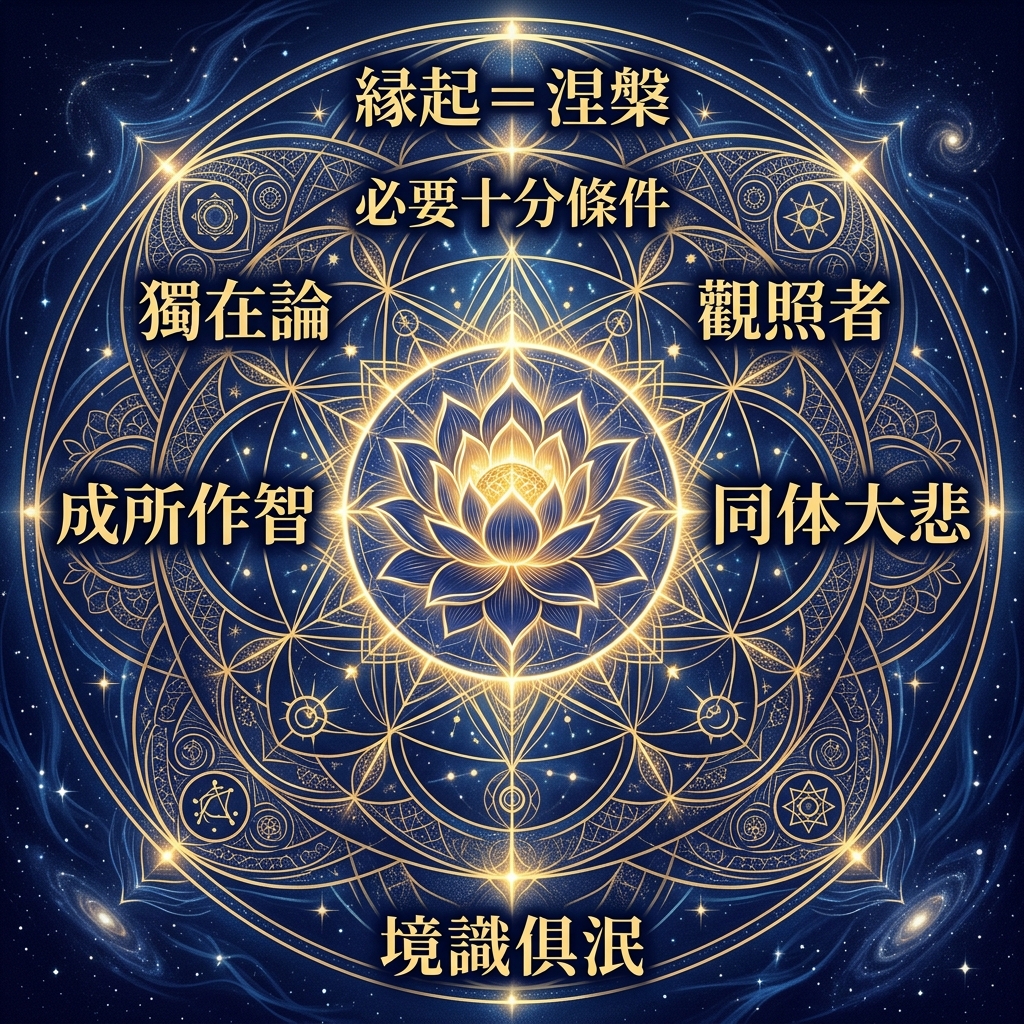
🗺️ "Haeojuui Part 3" Structural Mind-Map of Inquiry
From the Geometric Equivalence of Dependent Origination & Nirvāṇa to Witness Purification and the Spontaneous Operation of Great Compassion
- Dependent Origination (Universal Law): The causal mechanism of suffering's arising (forward order).
- Nirvāṇa (State of Mind): The total cessation of suffering (reverse order / way of cessation).
- Equivalence: "Deconstructing the mechanism" = "Automatic attainment."
- Sufficient Condition: Genuine understanding of Dependent Origination ➔ Automatic entry into Nirvāṇa.
- Necessary Condition: The state of Nirvāṇa ➔ Absolute verification of understanding Dependent Origination.
- Bidirectional Unity: The inseparable identity of contemplative reason and experiential state.
- Elimination of Ego: Complete deconstruction of any substantial "I".
- The Witness: The pure cognitive function mirroring phenomenal projection.
- Culmination of Advaita: The seer within non-dual oneness.
- Daily Life After Subject-Object Dissolution: Autonomous operation of Great Compassion without an agent.
- Kṛtyānuṣṭhāna-jñāna: Transformed sensory apparatus functioning as a somatic salvation vessel.
- Total Embracing: The consummation of One Reality acting in self-orchestrated harmony.
It is said that what Shakyamuni Buddha awakened to was the Law of Dependent Origination (Pratītyasamutpāda), but attaining the state of Nirvāṇa seems to carry far greater significance. Are the two equivalent? If so, please explain the underlying logic.
As you rightly point out, when viewed from the perspective of the ultimate spiritual goal (practical existential value), attaining the state of Nirvāṇa (nirvāṇa-śānta)—the total liberation from all forms of suffering—stands as the supreme culmination and carries the greatest significance.
To state the conclusion directly: in Buddhist logic, the Law of Dependent Origination and the state of Nirvāṇa are "equivalent (two sides of the same coin)." This is because Nirvāṇa is precisely the "state of mind" that is automatically attained as the inevitable result of fully understanding and actualizing the "underlying mechanism of the world (truth)" known as Dependent Origination.
Why can these two be called equivalent? Let us unpack this logical nexus in three progressive steps:
1. The Logic of Dependent Origination: The Mechanism Through Which Suffering Arises
The law of Dependent Origination discovered by the Buddha in its forward sequence (anuloma-paṭiccasamuppāda) dictates that "when causes are present, results come into being." Applying this universal principle to human suffering yields the Twelve Links of Dependent Origination (Dvādaśāṅgapratītyasamutpāda):
- Every form of suffering (aging, illness, death, sorrow, lamentation) has a causal origin.
- Tracing back this root cause leads directly to the failure to know the true nature of reality—Ignorance (Avidyā).
- Because of this fundamental ignorance, beings form obsessive clinging (Craving / Tṛṣṇā) to a non-existent "abiding, unchanging ego" and fleeting sensual pleasures.
- Because they cling, "suffering" (duḥkha) is inevitably generated whenever things change, decay, or fail to conform to their desires.
In short, our everyday existence is driven by a causal chain: [Ignorance (Misunderstanding Reality) ➔ Craving / Clinging ➔ Suffering].
2. The Logic of Nirvāṇa: The Mechanism Through Which Suffering Is Extinguished
How, then, does one arrive at Nirvāṇa (the state where the fires of suffering have been thoroughly quenched)? The Buddha reversed the wheel of Dependent Origination in backward contemplation (pratiloma-paṭiccasamuppāda / the gate of cessation / nirodha):
- When the causes (ignorance and craving) are extinguished, the effect (suffering) is likewise extinguished.
- Fully awakening to the Law of Dependent Origination (transforming fundamental ignorance into clear wisdom / prajñā).
- Once wisdom dawns, one realizes to the very marrow of one's being that "all things are impermanent, and there is no fixed, independent self anywhere (Anitya, Anātman)."
- With this realization, all clinging (craving / tṛṣṇā) naturally falls away; one no longer grasps at anything.
- Because clinging has ceased, the fuel feeding the flames of agony is cut off, and suffering is completely and permanently extinguished (Nirvāṇa-peace / nirvāṇa-śānta).
In short: [Complete Understanding of Dependent Origination (Wisdom) ➔ Extinction of Clinging ➔ Nirvāṇa (Cessation of Suffering)].
3. Why Are They Termed "Equivalent"?
Expressed in terms of philosophical logic, Dependent Origination represents the "objective truth (law)," while Nirvāṇa denotes the "subjective state (realization)." While they may appear to belong to different layers at first glance, in Buddhism they converge in the following manner:
- One can never attain Nirvāṇa without awakening to Dependent Origination (understanding Dependent Origination is a necessary and sufficient condition for Nirvāṇa).
- A mind established in Nirvāṇa constantly and perfectly harmonizes with the Law of Dependent Origination (the state of Nirvāṇa itself is the living embodiment of Dependent Origination).
Nāgārjuna, the great master of Mahāyāna philosophy, went even further in his foundational treatise, the Mūlamadhyamakakārikā, declaring that "There is not the slightest difference between Saṃsāra (the world of dependent origination) and Nirvāṇa (Saṃsāra-nirvāṇābhedatā / Life-and-Death is itself Nirvāṇa)." This is because awakening to the truth that all things exist purely through relational dependence (Dependent Origination / Emptiness / Śūnyatā) is itself none other than the unclouded realm of Nirvāṇa.
💡 Summary
- The Law of Dependent Origination = The "equation (theory)" of how suffering arises and how it ceases.
- The State of Nirvāṇa = The "solution (practical result)" in which that equation has been solved and suffering reduced to absolute zero.
Therefore, the theory (Dependent Origination) and the practical culmination (Nirvāṇa) are strictly indivisible. For the Buddha, "seeing reality as it truly is (Dependent Origination)" and "attaining ultimate peace of mind (Nirvāṇa)" referred to one and the identical reality.
Please unpack and explain in simple, accessible terms the logic behind the statement: "Understanding Dependent Origination is a necessary and sufficient condition for Nirvāṇa."
To unpack the phrase "Understanding Dependent Origination is a necessary and sufficient condition for Nirvāṇa" into plain, everyday language without technical jargon, it comes down to this:
In a single sentence: "Understanding Dependent Origination 100%" and "reaching Nirvāṇa (ultimate peace and freedom)" are completely equal (=); it is fundamentally impossible for one to occur without the other.
Let us examine this step-by-step through the formal lenses of logic: "necessary condition" and "sufficient condition".
1. From the Perspective of "Necessary Condition": Without Understanding Dependent Origination, Nirvāṇa Is Absolutely Impossible
A necessary condition is "an indispensable prerequisite without which the objective can never be attained." (For example, having a driver's license is a "necessary condition" to legally drive a car. Without a license, you cannot even stand at the starting line.)
- The Mental Mechanism: We experience anxiety and suffering (delusion) because, even if our heads grasp the rule that "everything changes (impermanence)," our hearts have not truly accepted it. Clinging to thoughts like "I want this happiness to last forever" or "I must not be hurt" breeds suffering.
- The Role of Dependent Origination: Dependent Origination is the underlying mechanism of the cosmos: "All things are like puzzle pieces assembled through cause and condition, appearing only temporarily. There is not a single independent, permanently unchanging entity (neither a fixed self nor an enduring object) in existence."
- Logical Conclusion: Unless we see through and accept this "architecture of reality (Dependent Origination)" from the bottom of our hearts, we can never let go of clinging. In other words, without understanding Dependent Origination, the doorway to the state where suffering has ceased (Nirvāṇa) remains 100% barred. Thus, it is a necessary condition.
2. From the Perspective of "Sufficient Condition": Once Dependent Origination Is Fully Understood, Nirvāṇa Occurs Automatically
A sufficient condition is "a condition which, once satisfied, automatically guarantees the achievement of the objective without requiring any supplemental effort." (For example, scoring 100% on a national qualifying exam satisfies the "sufficient condition" for passing; you need prove nothing further.)
- The Mental Mechanism: What the Buddha called "understanding" is not mere intellectual study or conceptual knowledge; it is a dramatic shift akin to "sitting terrified in a pitch-black room thinking there is a ghost, only to turn on the light and realize it was just an old coat hung on the wall."
- The Role of Dependent Origination: The very instant you completely realize that all phenomena throughout the universe are merely transient ripples in a web of causation (Dependent Origination), and that an "immutable self that must be defended" does not exist anywhere, an earth-shattering shift occurs within consciousness. If there is no "self" to defend, there remains no reason to envy others, no reason to fear loss, and no reason to cling to vanity or pride.
- Logical Conclusion: Just as fear vanishes automatically the moment you see the ghost is just a coat, the complete understanding of Dependent Origination forcibly switches off the ignition of attachment. You are automatically, inevitably catapulted into the state where suffering is extinguished (Nirvāṇa). Hence, it is a sufficient condition.
💡 In Conclusion: Why Is It "Necessary and Sufficient" (Identical)?
- Without understanding Dependent Origination, you cannot enter Nirvāṇa (Necessary Condition).
- The moment you understand Dependent Origination, you spontaneously arrive at Nirvāṇa (Sufficient Condition).
In Buddhist logic, the act of severing the chains of causation with the "scissors of Dependent Origination" (the cause) and the state of peace wherein the heart rests liberated from pain (the effect) are simultaneous, seamless occurrences without a temporal gap.
Because mastery of the theory (understanding Dependent Origination) is directly coterminous with spiritual liberation (Nirvāṇa), these two constitute a necessary and sufficient condition (equivalence).
Then please explain how "Nirvāṇa" is a necessary and sufficient condition for the "understanding of Dependent Origination."
Previously, we explored the direction: "If there is [understanding of Dependent Origination], then [Nirvāṇa] follows (= necessary and sufficient condition)."
Now let us examine the reverse proposition: "Being in the [state of Nirvāṇa] is a necessary and sufficient condition for having completed the [understanding of Dependent Origination]."
This means that "the state where the mind is completely at peace (Nirvāṇa)" and "seeing through the mechanism of reality (understanding Dependent Origination)" are thoroughly inseparable; if someone's mind is truly liberated from suffering, that individual 100% undeniably understands Dependent Origination.
1. From the Perspective of "Necessary Condition": Without Nirvāṇa (Complete Peace of Mind), One Can Never Truly Be Said to Understand Dependent Origination
A necessary condition is "an indispensable condition without which the other proposition cannot hold true."
- The Distinction Between Knowledge and Embodiment: Anyone can read a book and acquire theoretical knowledge that "everything is interconnected and impermanent (Dependent Origination)." However, if in daily life you erupt in fury when insulted, or sink into despair upon losing a possession, you cannot be said to have "truly understood Dependent Origination." This is because your mind still harbors clinging (delusion) toward "the self that was offended" or "the object one cannot bear to lose."
- Nirvāṇa as the Sole Certificate of Authenticity: In Buddhism, the sole objective proof that the understanding of Dependent Origination has been genuinely completed is the complete and total extinction of suffering, irritation, and agitation from that person's mind (Nirvāṇa).
- Logical Conclusion: No matter how eloquently one articulates sublime theories, if complete serenity (Nirvāṇa) has not settled in the heart, that comprehension of Dependent Origination remains counterfeit—mere book knowledge. Therefore, abiding in the state of Nirvāṇa is an indispensable "necessary condition" for the understanding of Dependent Origination to be genuine.
2. From the Perspective of "Sufficient Condition": If One Abides in Nirvāṇa, That Fact Alone Guarantees Perfect Understanding of Dependent Origination
A sufficient condition is "a state which, once present, automatically guarantees that the other proposition is fulfilled without requiring extra proof."
- The Undisturbed Water Surface: Nirvāṇa is a state wherein the turbulent waves of desire, anger, and anxiety have settled into absolute stillness. Why are there no ripples? Because the mind has thoroughly relinquished the energy known as "attachment."
- Why Has Attachment Been Relinquished?: For all clinging to vanish from the human mind, one must see through—from the deepest depth of one's being, or live entirely in accordance with the fact—that "all things in this world do not exist independently, but are illusion-like appearances temporarily brought forth by cause and effect (Dependent Origination)." It is only because one knows to the bone that "nothing possesses intrinsic, permanent substance" that the mind stops grasping at anything and rests in absolute relaxation (Nirvāṇa).
- Logical Conclusion: If someone's mind is completely serene and unshakeable under all circumstances (Nirvāṇa), then even if they do not know complex philosophical terminology, they are 100% perfectly embodying the truth of Dependent Origination in their living presence. Therefore, being in the state of Nirvāṇa serves as a "sufficient condition" for having understood Dependent Origination.
💡 In Conclusion: Why Is It "Necessary and Sufficient" (Identical)?
- Without Nirvāṇa (complete peace of mind), one cannot be said to understand Dependent Origination (Necessary Condition).
- If Nirvāṇa (complete peace of mind) is present, one can definitively state that Dependent Origination is understood (Sufficient Condition).
In Shakyamuni Buddha's teaching, internal "theory (understanding Dependent Origination)" and actual mental "state (Nirvāṇa)" cannot exist in isolation.
Just as one can state: "Because I saw the ghost in the dark room was only clothes, fear vanished (Dependent Origination ➔ Nirvāṇa)," one can equally state: "The fact that I am entirely free of fear right now is living proof that I have seen through the ghost (Nirvāṇa ➔ Dependent Origination)."
In this manner, whichever end you take as the starting point, the other holds 100% simultaneously. Thus, Nirvāṇa is a necessary and sufficient condition (equivalent) for the understanding of Dependent Origination.
Nirvāṇa appears to be the state of solipsism. Are the two equivalent?
To state the conclusion directly: Nirvāṇa and Solipsism are NOT "equivalent."
In fact, from a logical standpoint, they adopt fundamentally opposite approaches.
Solipsism posits that "the only entity cognizing this world is myself (the subject); other persons and the external world are merely projections of my own consciousness (or cannot be proven to exist)." At first glance, this seems to resemble the absolute solitude, profound stillness, and cessation of all delusion and external noise characteristic of "Nirvāṇa's tranquil extinguishment" (nirvāṇa-śānta).
However, in Buddhist logic, there lies a decisive and radical distinction between the two. Let us examine this structural divergence through three key points:
1. Diametrically Opposed Treatments of the "Ego" (The "I")
- Solipsism: By doubting and stripping away the external world, what remains at the very end is an inflated, hyper-absolutized "Ego (Subject)" standing at the center as the sole indubitable real entity.
- Nirvāṇa (Buddhism): The bedrock of Buddhism is Non-Self (Anātman). Nirvāṇa is the realm realized precisely when one sees through the fact that the fixed, substantive "self (I)" supposedly residing at the center never existed anywhere from the very beginning (the consummation of Dependent Origination).
If solipsism is the logic of "erasing the world to leave only the self," Nirvāṇa is the logic of "erasing the illusion of the self so that the world and oneself merge seamlessly without boundaries (becoming Dependent Origination itself)."
2. Diametrically Opposed Treatments of "The Other"
- Solipsism: Other minds and external beings are discarded or downgraded as "illusions whose reality can never be verified."
- Nirvāṇa (Buddhism): It is founded entirely upon the Law of Dependent Origination, wherein everything exists only in reciprocal codependence. The self exists because others exist; others exist because the self exists.
After Shakyamuni Buddha attained Nirvāṇa, he did not turn away from others as mere phantasms; instead, moved by supreme Compassion (Karuṇā), he spent his life traveling across India teaching to alleviate the suffering of all beings (answering the request of Brahmā Sahampati / Brahma-yācana). He did so because he dwelt not in the solipsistic prison of a closed mind, but in the luminous web of Dependent Origination where all beings are indivisibly interconnected (Nirvāṇa).
3. Logical Divergence Illustrated by the Metaphor of the "Dark Room"
The fundamental divergence between solipsism and Nirvāṇa can be illustrated by how one perceives a dark room:
- The Logic of Solipsism: "I am the only one inside this pitch-black room. Whether there is an outside world or other people is unknown and irrelevant. My consciousness alone constitutes the totality of this room."
- The Logic of Nirvāṇa: "I thought this was a dark room, but turning on the light (understanding Dependent Origination), I discovered that neither the walls of a 'room' nor the lonely intruder called 'I' ever existed in the first place. There was only infinite, boundless open space (Śūnyatā / Emptiness) shining unobstructed."
💡 Conclusion
- Solipsism = The Absolutization of the Ego/Subject (Only I exist).
- Nirvāṇa = The Complete Dissolution of the Ego/Subject (A fixed self exists nowhere = Non-Self / Anātman).
Therefore, while both may superficially appear similar in terms of subjective serenity and stillness, their logical architecture points in diametrically opposite directions: maximizing the ego (solipsism) versus reducing the ego to absolute zero (Nirvāṇa).
This unique Buddhist logic—"unifying with the entire cosmos precisely by erasing the self" (the philosophy of Emptiness / Mādhyamika and Mind-Only / Yogācāra)—unfolds a thrilling contemplative trajectory entirely distinct from Western philosophical solipsism.
If solipsism were to discard the ego as a substance and recognize solely the function of the Observer, how would that be evaluated?
If solipsism is radicalized to the point of stripping away the "ego as a substantial entity" and admitting purely that "the only real thing is the function (perspective) of the Observer integrating present experience here and now," this philosophy approaches astonishingly close to the sophisticated psychology of Buddhism (most notably Yogācāra / Mind-Only philosophy).
Yet even then, its logical terminus diverges from the Buddha's "Nirvāṇa." Let us examine the points of convergence and the final point of rupture between this "ultra-refined solipsism (Functional Solipsism)" and "Nirvāṇa":
1. Convergence: Astounding Alignment with Buddhist Yogācāra (Mind-Only) Philosophy
In Western thought, this resembles Ernst Mach's "neutral monism" (elements) or Erwin Schrödinger's quantum insight that "consciousness is a singular of which the plural is unknown."
Buddhism (especially the Mahāyāna Yogācāra / Vijñānavāda tradition) traverses the exact same progression:
- The notion that "an objective world exists outside of my awareness" is an illusion.
- What truly exists is simply "the vivid, continuous stream of immediate experiencing (cognizing)."
- Even memories and the sense of egoic identity (the 7th consciousness, Manas-vijñāna) are merely internal data-structures generated by this cognitive architecture.
Thus, when formulated as "both the external world and the substantive self are phantoms, and only the observing function (the stream of awareness) is operating," this represents an authentic, real experiential landscape that one traverses along the Buddhist path of contemplative praxis.
2. The Point of Rupture: How the "Observer (Function)" Is Handled
Here lies the decisive parting of ways between "Radicalized Solipsism" and "Nirvāṇa":
① Radicalized Solipsism: [Absolutizing] the "Observer (Function)"
No matter how thoroughly psychological ego-data is discarded, it remains trapped in the foothold: "The very [function] of observing belongs to my sphere, and this alone is the sole reality of the cosmos."
- While the "observed world" is dissolved, the "observing perspective (the screen)" is preserved as a privileged absolute.
- Because reality remains logically confined within "the vantage point of I," the genuine suffering and living connection of others remain severed (an isolated, sterilized silence).
② Nirvāṇa (Buddhism): [Dissolving] even the "Observer (Function)" Through Dependent Origination
The Buddha's logic (the Law of Dependent Origination) ruthlessly dismantles even this final refuge—the "function of the observer."
The Buddha proclaimed:
"The function of seeing (consciousness) cannot exist independently. It is an ephemeral spark arising only in that precise instant when the object of sight (form/light) and the visual organ (eye) come into contact (sparśa) through Dependent Origination."
- If the "object seen (objective realm)" is empty, then the "perspective seeing it (subjective observer)" is simultaneously empty (Śūnyatā).
- Only when the screen (the observer) itself dissolves does the duality between "subject" and "object" vanish entirely.
3. Comparison via the Metaphor of the "Cinema"
- Conventional Solipsism: "The world projected on the movie screen (the external world) is an illusion. Only 'I' sitting in the audience seat am real."
- Observer-Only Solipsism: "The 'I' in the audience seat is also an illusion. What alone exists is the 'screen itself (the observing function)' upon which the movie is shown."
- Nirvāṇa (Buddhism): "When the projector of causes stops, the images on the screen vanish. The screen and the film were mutually interdependent conditions. Realizing that neither possesses an abiding reality yields absolute liberation from the very framework of the cinema itself."
💡 Conclusion: How Is It Evaluated?
A solipsism that discards the ego and acknowledges solely the "function of the observer" represents one of the highest summits of human reason, having tracked down the very last piece of the puzzle of delusion (the root of subjectivity).
From the perspective of Buddhism, however, it is "resting with one's hand on the doorknob of Nirvāṇa (standing at the threshold of Non-Self)."
Seeing through even this "function of the observer" as not a self-existent absolute, but merely a transient ripple arising through Dependent Origination with conditions, and completely letting it go (dropping out)—that is precisely what the Buddha termed "Nirvāṇa."
This ultimate breakthrough—where even the witness disappears—is termed in Buddhist epistemology "the simultaneous dissolution of subject and object" (grāhya-grāhaka-vigama / 能所双亡: the synchronous cessation of the grasper and the grasped).
I would like to explore more deeply how the Buddha lived his daily life in the world following the dissolution of subject and object—specifically, the behavioral principles of his compassion.
In the world where the subject-object divide (the dividing line between "the 'I' who observes" and "the world observed") has completely dissolved, why did the Buddha not fall into nihilistic paralysis, but instead ceaselessly aided others with overwhelming vigor and energy? The behavioral principle of his compassion (Karuṇā) stands as the most radiant and sublime culmination of Buddhist philosophy.
To state the conclusion directly: for the Buddha after the dissolution of subject and object, "helping another" became completely identical (=) to "applying ointment to one's own wound."
Let us illuminate this extraordinary daily embodiment and its behavioral architecture across three logical dimensions:
1. Identical-Body Great Compassion (Dōtai-daihi / Mahā-karuṇā of One Body): Another's Pain Becomes "One's Own Pain"
The dissolution of subject and object means the complete collapse of the psychic "wall" separating self from world.
Ordinary humans operate under subject-object dualism ("I am here, and you are over there"); consequently, when observing another's suffering, they can only feel "Pity (an observer looking at someone else's misfortune)."
In the realm of Nirvāṇa where all dividing walls have evaporated, however, another's suffering is felt as immediately and directly as pain flaring within one's own physical body.
In Buddhism, this is called "Identical-Body Great Compassion" (Dōtai-daihi: because all beings share one identical body of reality, boundless compassion surges forth naturally).
- The Metaphor of the Right Hand: When your left hand is pricked by a thorn, your right hand does not stop to deliberate: "Should I assist it or not?" Because both hands share the same body, the right hand automatically and reflexively reaches over to extract the thorn from the left hand.
- The Buddha's Behavioral Principle: This was the exact nature of the Buddha's daily life. When he encountered a suffering person, because there was no subject-object separation, their pain was simply "the world's pain = my own pain." Thus, his rescue of beings was never born of moralistic duty, contrived altruism, or spiritual hypocrisy; it operated as a completely natural physiological reflex: "Because it hurts, the hand automatically reaches out."
2. Unconditioned Great Compassion (Muen-no-Daihi / Anālambana-mahā-karuṇā): Zero Conditions, Zero Return, Zero Clinging
Ordinary human benevolence is invariably bound by "conditions" (pratyaya / causes): "Because they are my family," "Because they support me," or "Because I wish to be thanked"—a transaction between subject and object.
In contrast, the compassion of the Buddha after subject-object dissolution is known as "Unconditioned Great Compassion" (Anālambana-mahā-karuṇā / Great Compassion without an Objective Support).
- Zero Conditions: Whether the person before him was a saintly mendicant or a ruthless murderer who attempted to take his life (such as Aṅgulimāla), he made zero discrimination. To his eye, both were simply waves dancing within the identical current of Dependent Origination.
- Not Even the Notion "I Saved Them" Remains: Because subject and object are extinct, the "three spheres" of dualistic action—the giver, the receiver, and the gift / the rescuer, the rescued, and the act of rescue (trimaṇḍala)—fail to arise. Thus, though the Buddha walked the length and breadth of India for 45 years saving countless beings, not a single millimeter of pride or attachment ("Look at the great merit I have accumulated") ever stained his mind.
3. Daily Praxis: Tuning the Resonant Web of Indra (Indrajāla)
How did the world appear through the eyes of the Buddha after the dissolution of subject and object?
It appeared as a colossal "Jeweled Net of Indra (an infinite cosmic web where a radiant wish-fulfilling jewel is affixed at every single node)." When one jewel sparkles, its light reflects across every other jewel throughout the entire web.
- The Buddha's Everyday Routine: The Buddha knew that every word he uttered, every gentle smile, every step he took vibrated through the web as a harmonizing resonance across the cosmos (the living embodiment of Dependent Origination).
- Therefore, upon rising each morning, he would first enter deep meditative absorption (samādhi / dhyāna) to scan "what waves of suffering from which quarter of the cosmic net were reaching him today (who was crying out for liberation)." He would then walk directly to that specific node in the web (that individual) and speak the exact words suited to their capacity (customized upāya / tai-ki seppō), effortlessly tuning and healing the distortion of the world.
💡 Conclusion
For the Buddha after the dissolution of subject and object, living everyday life and enacting compassion was as effortless and organic as breathing or the beating of a heart.
Because the superfluous brake of "I" (the ego and the reified observer) had been completely removed, the primordial energy of the cosmos (Dependent Origination) flowed unobstructed through the transparent vessel of "the Buddha" as 100% pure loving-kindness and compassion pouring into the world.
This "dissolution of subject and object" and "automation of compassion" (Kṛtyānuṣṭhāna-jñāna) is the ultimate reason why Buddhism is not a cold, detached theoretical philosophy, but a living, warm religion of universal salvation.